Topic Space Exploration có thể là một chủ đề khá lạ với nhiều thí sinh Việt Nam, nhưng vẫn có khả năng xuất hiện trong IELTS Writing Task 2. Nếu chưa biết cách triển khai một Space Exploration essay, hãy cùng IELTS The Tutors tham khảo những ý tưởng, từ vựng và bài mẫu dưới đây để hiểu đề nhanh hơn và tự tin hơn khi viết bài.
Các vấn đề thường gặp chủ đề Space exploration trong IELTS Writing task 2
Trong IELTS Writing Task 2, Space Exploration thường được khai thác dưới góc độ ngân sách, khoa học, công nghệ và tương lai của con người. Có thể thấy đây là một chủ đề khá trừu tượng và cần bạn có những hiểu biết đủ rộng để triển khai bài Space Exploration essay hợp lý và đúng thực tế.
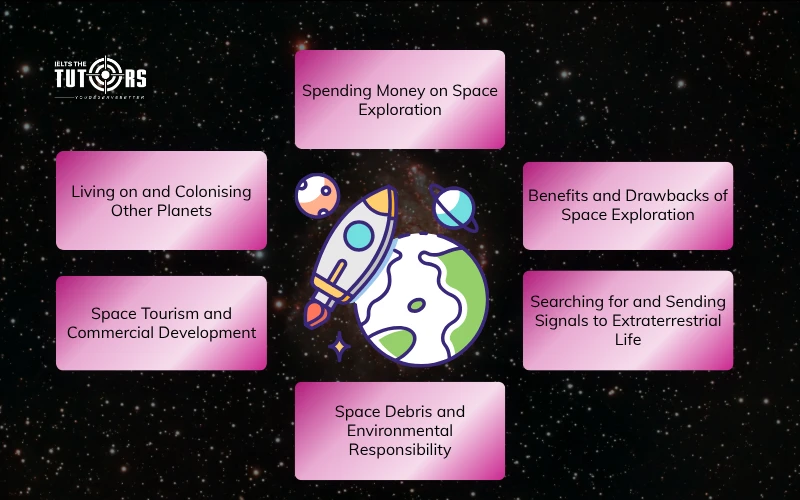
Dưới đây là những vấn đề thường gặp trong IELTS Writing Task 2 Space Exploration topics:
Việc chính phủ nên tiếp tục đầu tư cho các chương trình không gian hay ưu tiên những vấn đề cấp thiết trên Trái Đất.
Những lợi ích và hạn chế của hoạt động khám phá vũ trụ.
Việc con người có nên tìm kiếm hoặc chủ động gửi tín hiệu đến sự sống ngoài Trái Đất hay không.
Khả năng con người sinh sống và định cư trên sao Hỏa hoặc các hành tinh khác trong tương lai.
Sự phát triển của du lịch vũ trụ và vai trò ngày càng lớn của các công ty tư nhân.
Tình trạng rác vũ trụ gia tăng do ngày càng nhiều vệ tinh và phương tiện được phóng lên quỹ đạo.
Ý tưởng triển khai topic Space Exploration Writing task 2
Spending Money on Space Exploration
Đề bài: Billions of dollars are spent on space research, while many serious problems on Earth remain unresolved. Some people consider this a waste of money. To what extent do you agree or disagree?
Dạng bài: Agree or Disagree
Yêu cầu đề bài:
Đánh giá tính hợp lý của việc chi hàng tỷ đô la cho nghiên cứu không gian.
Cân nhắc những vấn đề cấp thiết trên Trái Đất vẫn chưa được giải quyết.
Xem xét liệu khoản đầu tư này có phải là sự lãng phí ngân sách hay không.
Đưa ra lập trường rõ ràng về mức độ đồng ý với quan điểm trên.
Ý tưởng phát triển Space exploration essay:
Agree
Disagree
Governments should prioritise poverty and hunger because millions of people still lack food, clean water and other basic necessities.
Public money could be used to improve hospitals, make medicine more affordable and prevent deaths from treatable diseases.
Many schools lack qualified teachers, suitable facilities and learning materials, so education should receive greater investment.
Governments should repair roads, public transport, electricity networks, housing and clean water systems before funding expensive space missions.
Climate change is an immediate threat, so more funding should go towards renewable energy, pollution control and climate adaptation.
Space programmes may appear less useful when unemployment is high and many people need practical training and stable jobs.
Expensive space projects may mainly benefit wealthy countries while poorer nations continue to struggle with urgent social problems.
Many space projects take decades to produce results, so their benefits may seem too distant from people’s daily lives.
Rocket launches cause pollution, consume large amounts of resources and contribute to the growing problem of space debris.
Robotic missions, simulations and other technologies may explore space at a lower cost and with less risk than sending humans.
Money spent on space has an opportunity cost because it could instead fund schools, hospitals, food programmes or environmental projects.
Space research can support medical studies, improve materials and deepen our understanding of the Earth, climate and diseases.
Space programmes have produced useful technologies such as GPS, satellite communication, water purification systems and improved solar panels.
Satellites help locate water and mineral resources, monitor crops, improve land use and support disaster prevention.
Space exploration can inspire young people to study science, technology and engineering and encourage a culture of innovation.
Exploring and settling other planets may help protect humanity from future threats such as asteroid impacts or an uninhabitable Earth.
The space industry creates highly skilled jobs, attracts private investment and contributes to long-term economic growth.
International space projects allow countries to share knowledge, work towards common goals and strengthen peaceful cooperation.
Planetary defence systems can detect and track near-Earth objects, helping scientists prepare for potentially dangerous asteroid impacts.
Satellites support weather forecasting, navigation, communication, internet access, agriculture and emergency response.
Human curiosity and the desire to explore have always driven scientific discovery and social progress.
Space budgets usually represent only a small share of government spending, so countries can fund space research without abandoning essential public services.
Benefits and Drawbacks of Space Exploration
Đề bài: The first human landing on the Moon was described as a major step forward for humanity, but some argue that it made little difference to ordinary people. To what extent do you agree or disagree?
Dạng bài: Agree or Disagree
Yêu cầu đề bài:
Đánh giá tác động của sự kiện con người lần đầu tiên đặt chân lên Mặt Trăng.
Xem xét liệu đây có phải là một bước tiến quan trọng của nhân loại hay không.
Cân nhắc những ảnh hưởng thực tế của sự kiện này đến cuộc sống của người dân.
Đưa ra lập trường rõ ràng về ý nghĩa của cột mốc lịch sử trên.
Ý tưởng phát triển Space exploration essay:
Agree
Disagree
The event brought no immediate improvement to everyday life. It did not solve poverty, hunger, disease or other urgent problems on Earth.
Its main value was symbolic. It created national pride and political prestige, but most people did not receive any direct practical benefit.
Many benefits appeared decades later and cannot be linked entirely to the Moon landing. Some technologies may have developed without the programme.
The programme cost billions of dollars. This money could have been spent on healthcare, education, clean water, housing and public infrastructure.
The mission was largely driven by Cold War competition. It was used as a political and propaganda tool rather than a project for the benefit of all humanity.
Only astronauts, scientists and government agencies took part directly. Ordinary people remained disconnected from space exploration.
Spending resources on space exploration may have distracted governments from serious environmental and social problems on Earth.
The Moon landing was a one-time achievement, and humans have not returned since 1972. This makes its long-term value appear limited.
The mission placed astronauts’ lives at risk for political prestige and scientific goals that did not directly help the public.
Public money could have produced faster and more visible results if it had been used to improve living conditions on Earth.
The space programme led to advances in electronics, computing, materials science, satellite systems and medical equipment. Many of these technologies later became part of daily life.
Satellites transformed modern life by supporting GPS, weather forecasting, television, global communication and Internet services.
The mission expanded scientific knowledge about the Moon, the solar system and the Earth’s place in space. It also improved research methods and supported future exploration.
The achievement inspired millions of young people to study science, technology, engineering and mathematics. It also encouraged a culture of ambition and innovation.
The Moon landing was watched around the world and became a shared human achievement that went beyond national borders.
The mission showed that humans could overcome major technical challenges through teamwork, planning and problem-solving.
Images of Earth taken from space helped people see the planet as fragile and unique, contributing to greater environmental awareness.
The programme created skilled jobs, supported high-tech industries and helped build an innovation system that later benefited the wider economy.
Space exploration later encouraged international cooperation through shared research, peaceful agreements and projects such as the International Space Station.
The achievement increased confidence in human ability and encouraged the belief that difficult global problems can be solved through science and innovation.
Searching for and Sending Signals to Extraterrestrial Life
Đề bài: Some scientists support sending messages into space to contact intelligent life on other planets. Others believe that doing so could be dangerous. Discuss both views and give your opinion.
Dạng bài: Discussion Essay
Yêu cầu đề bài:
Trình bày quan điểm ủng hộ việc gửi tín hiệu vào không gian để liên lạc với sự sống thông minh ngoài Trái Đất.
Trình bày quan điểm cho rằng hoạt động này có thể gây ra những rủi ro khó lường.
Cần thảo luận cân bằng cả hai quan điểm trước khi đưa ra kết luận.
Đưa ra ý kiến cá nhân rõ ràng về việc con người có nên chủ động liên lạc với sự sống ngoài Trái Đất hay không.
Ý tưởng phát triển Space exploration essay:
Supporting Sending Messages to Space
Concerns About Potential Dangers
Sending messages into space could expand our knowledge of the universe. Contact with another civilization might help humans discover new technologies, scientific ideas and answers about the existence of life beyond Earth.
Communication with alien life could create opportunities for peaceful cooperation. Humans might exchange scientific knowledge, cultural information and ideas with other civilizations.
Contact with intelligent life may support humanity’s long-term survival. Other civilizations could provide knowledge about habitable planets, new resources or ways to protect the human species.
Exploration is a natural part of human progress. People have always taken risks to discover unknown places, and many past explorations eventually brought important benefits.
Supporters may argue that the possible scientific and social benefits are worth the risks, especially if messages are carefully planned and internationally approved.
Extraterrestrial civilizations may not have peaceful intentions. A more advanced species could see humans as weak, inferior or easy to exploit.
Revealing Earth’s location could create serious security risks. It may expose our technological weaknesses and leave humanity unable to defend itself against a more powerful civilization.
The consequences of contact are impossible to predict. It could lead to cultural, biological or technological disruption that cannot be reversed.
Space communication programs can be expensive and may produce no clear results. The money could instead be used to solve urgent problems on Earth, such as poverty, disease or environmental damage.
There is no global agreement on who should represent humanity or what message should be sent. A small group should not make a decision that could affect the entire planet and future generations.
Living on and Colonising Other Planets
Đề bài: People may need to live on other planets in the future. Therefore, money should be spent on researching planets such as Mars. To what extent do you agree or disagree?
Dạng bài: Agree or Disagree
Yêu cầu đề bài:
Đánh giá liệu chính phủ có nên đầu tư ngân sách vào việc nghiên cứu sao Hỏa và các hành tinh khác hay không.
Xem xét khả năng con người phải sinh sống ngoài Trái Đất trong tương lai.
Phân tích lợi ích lâu dài của nghiên cứu không gian và những chi phí đi kèm.
Có thể chọn hoàn toàn đồng ý, hoàn toàn không đồng ý hoặc đồng ý một phần.
Đưa ra lập trường rõ ràng và giải thích vì sao mức đầu tư này là cần thiết hoặc chưa nên được ưu tiên.
Ý tưởng phát triển Space exploration essay:
Agree
Disagree
Mars research could support humanity’s long-term survival. Earth faces risks such as climate change, resource depletion and major natural disasters, so exploring another habitable location may provide a form of protection for the future.
Space research can lead to scientific and technological progress. It may improve life-support systems, renewable energy, robotics, artificial intelligence and medical technology, with many of these advances also benefiting life on Earth.
Mars and nearby asteroids may contain valuable minerals and other resources. In the future, space mining could reduce pressure on Earth’s limited natural resources and create new economic opportunities.
Investing in Mars research shows long-term vision. It can open a new stage of human exploration, inspire younger generations and reduce the risk of humanity depending on only one planet.
Recent missions have shown that Mars exploration is becoming more realistic. Successful rovers, growing private investment and cooperation between countries may reduce costs and speed up future progress.
Mars research can encourage international cooperation and private-sector innovation, reducing the financial burden on governments and creating new jobs in the space industry.
Governments should prioritise urgent problems on Earth. Poverty, hunger, disease, climate change, clean water, education and healthcare affect millions of people now and require immediate funding.
Mars exploration and colonisation would require enormous amounts of money. The return is uncertain, while the same budget could be used to improve living conditions and public services on Earth.
Living on Mars would be extremely difficult. The planet has no breathable atmosphere, high radiation levels, very low temperatures, limited water and weak gravity, all of which pose serious risks to human health.
A permanent settlement on Mars may still be decades or centuries away. Current generations are unlikely to benefit, so it may be more practical to focus on making Earth safer and more sustainable.
Mars colonisation may mainly benefit wealthy countries and individuals. It could widen inequality if rich people gain access to new opportunities while poorer communities remain affected by problems on Earth.
More practical alternatives are available, such as investing in renewable energy, sustainable cities, underground shelters, ocean research and space stations closer to Earth.
Space Tourism and Commercial Development
Đề bài: Space travel has existed for some time, and some people believe that space tourism could be developed in the future. Is this a positive or negative development?
Dạng bài: Positive or Negative Development
Yêu cầu đề bài:
Xác định rõ du lịch vũ trụ là một xu hướng tích cực, tiêu cực hay có cả hai mặt.
Giải thích rõ lý do cho quan điểm đã lựa chọn.
Phân tích những tác động của sự phát triển du lịch vũ trụ đối với kinh tế, công nghệ, xã hội và môi trường.
Có thể chọn hoàn toàn tích cực, hoàn toàn tiêu cực hoặc nghiêng nhiều hơn về một phía.
Phát triển lập luận logic, kèm dẫn chứng và ví dụ phù hợp.
Duy trì quan điểm nhất quán và đưa ra kết luận rõ ràng ở cuối bài.
Ý tưởng phát triển Space exploration essay:
Positive
Negative
Space tourism can create a new industry, generate jobs and attract private investment. It may also support growth in aerospace, tourism and hospitality.
Competition between private companies can encourage innovation in spacecraft design, reusable rockets and safer travel systems. These developments may reduce costs over time.
Revenue from commercial flights can provide additional funding for space research. Scientists may also collect useful data about the effects of space travel on the human body.
Space tourism may inspire young people to study science, technology, engineering and mathematics. It can also increase public interest in astronomy and space exploration.
Travelling into space represents progress in human exploration and allows people to experience a new perspective beyond Earth.
Seeing Earth from space may help travellers understand how small and fragile the planet is. This experience could encourage stronger support for environmental protection.
Continued investment could make space travel safer, cheaper and more accessible in the long term.
Space tourism is extremely expensive and mainly available to wealthy individuals. This can make it seem like an elitist activity with little benefit for the wider public.
Rocket launches release carbon emissions and other pollutants into the atmosphere. Frequent launches may also damage the ozone layer and increase space debris.
Space travel involves serious safety risks, including accidents, radiation exposure and medical emergencies. Rescue options are also very limited.
Some people believe that spending large amounts of money on space tourism is difficult to justify while poverty, hunger and other urgent problems remain on Earth.
The commercial use of space may create disputes over ownership, resources and territorial control. Without clear international rules, competition could increase political tension.
Only a small number of people can take part because of high prices, strict health requirements and limited infrastructure. Space tourism is therefore unlikely to become widely accessible in the near future.
Current regulations may not clearly cover safety standards, environmental damage, legal responsibility or compensation after accidents.
Space Debris and Environmental Responsibility
Đề bài: The increasing number of satellite launches and the resulting space debris are becoming a threat to Earth. What are the main causes of this problem? What measures can be taken to address it?
Dạng bài: Causes and Solutions
Yêu cầu đề bài:
Xác định và giải thích những nguyên nhân chính dẫn đến tình trạng rác vũ trụ.
Đề xuất các giải pháp thiết thực và khả thi để giải quyết vấn đề.
Mỗi nguyên nhân và giải pháp cần được giải thích rõ ràng, kèm ví dụ phù hợp.
Các giải pháp phải trực tiếp xử lý những nguyên nhân đã nêu.
Ý tưởng phát triển Space exploration essay:
Causes
Solutions
The rapid growth of commercial space activity has led to more satellite launches. Lower costs and competition between private companies have also increased congestion in orbit.
Current international agreements are outdated, while many existing guidelines are voluntary. Different countries also apply different standards, making global coordination difficult.
Many inactive satellites remain in orbit after their missions end. Removing them is expensive, and older satellites were often designed without a clear disposal plan.
Collisions between satellites can create thousands of smaller fragments. These pieces travel at extremely high speeds and may cause further collisions, making the problem increasingly difficult to control.
Anti-satellite weapon tests deliberately destroy satellites and release large amounts of debris. These fragments may remain in space for decades and threaten both civilian and scientific missions.
Rocket stages, equipment and small objects are sometimes left behind after launches. Although some fragments are tiny, they can still seriously damage spacecraft.
Debris in higher orbits can remain there for hundreds of years because there is no natural process that removes it quickly. As a result, the amount of waste continues to build up.
Large satellite constellations place additional pressure on already crowded orbital areas. Launching too many satellites without coordination increases the risk of accidents.
Existing tracking systems cannot detect every small object, so satellite operators may receive incomplete warnings about possible collisions.
Cleanup technology is still expensive and underdeveloped, which prevents many countries and companies from using it on a large scale.
International organisations should introduce binding rules on satellite disposal, orbital use and responsibility for space debris. Companies that fail to comply should face penalties.
Governments should update international space treaties and create a shared framework for managing orbital activity. A polluter-pays principle could make operators responsible for the debris they create.
New satellites should include built-in deorbit systems, controlled re-entry technology and end-of-life plans. Operators should also remove failed satellites as soon as possible.
Space agencies should develop active debris removal systems, including robotic arms, nets, lasers and other technologies that can move unwanted objects out of orbit.
Countries should agree to ban destructive anti-satellite tests and improve transparency around military activity in space. International monitoring could help identify violations.
Rockets and satellites should be designed to burn up safely in the atmosphere. Operators should also drain unused fuel and discharge batteries after each mission.
Governments should invest in better tracking systems, global data sharing and automated collision warnings. Satellites could also use self-deorbiting devices such as solar sails or drag systems.
Authorities could limit the size of satellite constellations, require environmental assessments and introduce orbital fees or insurance requirements for operators.
More advanced radar, telescopes and artificial intelligence should be used to monitor smaller debris and predict collision risks more accurately.
Governments, universities and private companies should fund joint research into cheaper debris-removal technology and share successful solutions internationally.
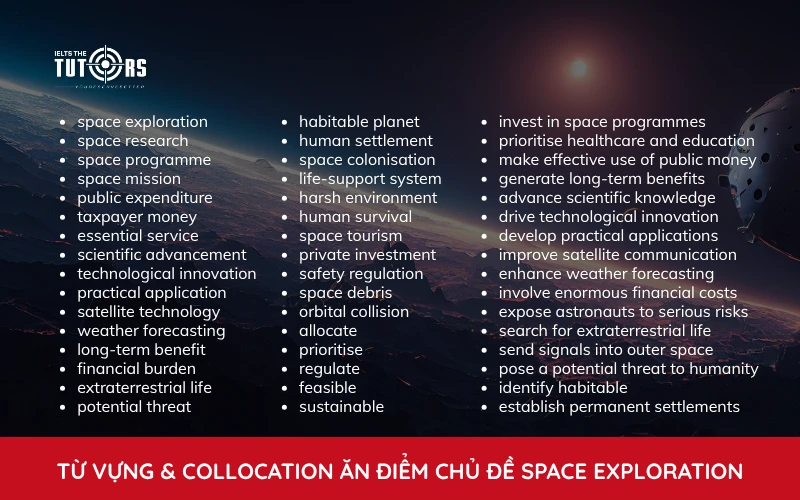
Từ vựng & collocation ăn điểm chủ đề Space Exploration essay
Từ vựng hay cho Space Exploration essay
Từ vựng
Từ loại
Ý nghĩa
space exploration
noun phrase
hoạt động khám phá không gian
space research
noun phrase
nghiên cứu không gian
space programme
noun phrase
chương trình không gian
space mission
noun phrase
sứ mệnh không gian
public expenditure
noun phrase
chi tiêu công
taxpayer money
noun phrase
tiền thuế của người dân
essential service
noun phrase
dịch vụ thiết yếu
scientific advancement
noun phrase
tiến bộ khoa học
technological innovation
noun phrase
đổi mới công nghệ
practical application
noun phrase
ứng dụng thực tế
satellite technology
noun phrase
công nghệ vệ tinh
weather forecasting
noun phrase
hoạt động dự báo thời tiết
long-term benefit
noun phrase
lợi ích dài hạn
financial burden
noun phrase
gánh nặng tài chính
extraterrestrial life
noun phrase
sự sống ngoài Trái Đất
potential threat
noun phrase
mối đe dọa tiềm tàng
habitable planet
noun phrase
hành tinh có thể sinh sống
human settlement
noun phrase
khu định cư của con người
space colonisation
noun phrase
quá trình định cư ngoài không gian
life-support system
noun phrase
hệ thống duy trì sự sống
harsh environment
noun phrase
môi trường khắc nghiệt
human survival
noun phrase
sự sống còn của loài người
space tourism
noun phrase
du lịch vũ trụ
private investment
noun phrase
nguồn đầu tư tư nhân
safety regulation
noun phrase
quy định an toàn
space debris
noun phrase
rác vũ trụ
orbital collision
noun phrase
vụ va chạm trên quỹ đạo
allocate
verb
phân bổ
prioritise
verb
ưu tiên
regulate
verb
quản lý bằng quy định
feasible
adjective
khả thi
sustainable
adjective
bền vững
Collocations nên học về topic Space Exploration essay
Collocations
Ý nghĩa
allocate public funds to space exploration
phân bổ ngân sách công cho hoạt động khám phá không gian
invest in space programmes
đầu tư vào các chương trình không gian
prioritise healthcare and education
ưu tiên y tế và giáo dục
make effective use of public money
sử dụng ngân sách công hiệu quả
generate long-term benefits
tạo ra lợi ích dài hạn
advance scientific knowledge
mở rộng kiến thức khoa học
drive technological innovation
thúc đẩy đổi mới công nghệ
develop practical applications
phát triển các ứng dụng thực tế
improve satellite communication
cải thiện hoạt động liên lạc bằng vệ tinh
enhance weather forecasting
nâng cao khả năng dự báo thời tiết
expand our understanding of the universe
mở rộng hiểu biết của con người về vũ trụ
involve enormous financial costs
đòi hỏi chi phí tài chính rất lớn
expose astronauts to serious risks
khiến phi hành gia đối mặt với rủi ro nghiêm trọng
search for extraterrestrial life
tìm kiếm sự sống ngoài Trái Đất
send signals into outer space
gửi tín hiệu ra ngoài không gian
pose a potential threat to humanity
gây ra mối đe dọa tiềm tàng đối với nhân loại
identify habitable planets
xác định những hành tinh có thể sinh sống
establish permanent settlements
xây dựng các khu định cư lâu dài
colonise other planets
định cư trên các hành tinh khác
ensure the long-term survival of humanity
bảo đảm sự tồn tại lâu dài của nhân loại
cope with harsh living conditions
thích nghi với điều kiện sống khắc nghiệt
develop reliable life-support systems
phát triển hệ thống duy trì sự sống đáng tin cậy
attract private investment
thu hút nguồn đầu tư tư nhân
reduce the cost of space travel
giảm chi phí du hành không gian
create new employment opportunities
tạo ra những cơ hội việc làm mới
regulate private space companies
quản lý các công ty không gian tư nhân
generate large amounts of space debris
tạo ra lượng lớn rác vũ trụ
increase the risk of orbital collisions
làm tăng nguy cơ va chạm trên quỹ đạo
develop debris-removal technology
phát triển công nghệ loại bỏ rác vũ trụ
strengthen international cooperation
tăng cường hợp tác quốc tế
hold space companies accountable
buộc các công ty không gian chịu trách nhiệm
promote the sustainable use of outer space
thúc đẩy việc sử dụng không gian một cách bền vững
Bài mẫu topic Space Exploration essay
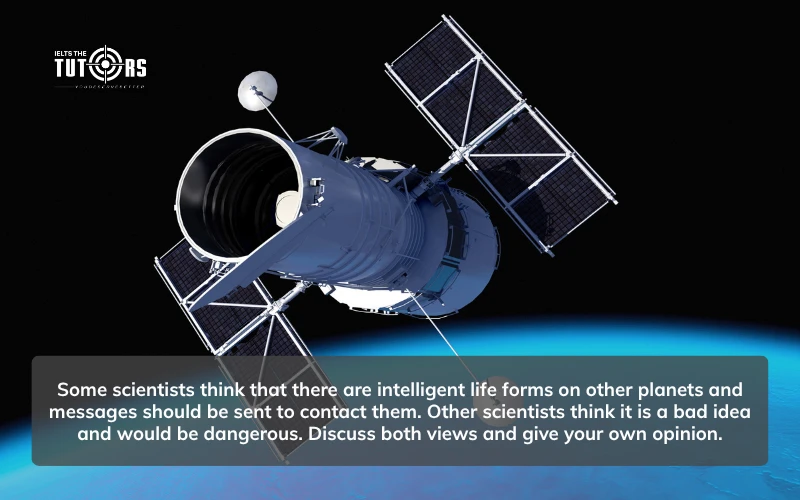
Đề bài: Some scientists think that there are intelligent life forms on other planets and messages should be sent to contact them. Other scientists think it is a bad idea and would be dangerous. Discuss both views and give your own opinion.
Phân tích đề bài:
Dạng bài: Discussion Essay (Discuss both views and give your opinion)
Keyword chủ chốt: intelligent life forms on other planets, send messages to contact them, bad idea and dangerous, extraterrestrial communication, benefits vs. risks of contact
Hướng phát triển: Thảo luận theo hai quan điểm đối lập: một bên ủng hộ việc gửi thông điệp để tìm kiếm sự sống thông minh ngoài Trái Đất vì lợi ích khoa học và văn hóa, bên kia lo ngại về những nguy hiểm tiềm ẩn từ việc để lộ vị trí của chúng ta. Ý kiến cá nhân nên có lập trường rõ ràng với lập luận vững chắc.
Dàn bài gợi ý:
Introduction
Giới thiệu tranh luận về việc con người có nên chủ động liên lạc với sự sống ngoài hành tinh.
Thảo luận cả hai quan điểm và nghiêng về ý kiến nên thận trọng, ưu tiên chờ đợi thay vì gửi thông điệp.
Body 1 – Quan điểm ủng hộ việc gửi thông điệp
Việc liên lạc có thể mở ra những khám phá khoa học quan trọng về vũ trụ.
Con người có thể trao đổi kiến thức và công nghệ với một nền văn minh tiên tiến hơn.
Hoạt động này đáp ứng sự tò mò tự nhiên về sự sống ngoài Trái Đất.
Những phát hiện mới có thể giúp nhân loại hiểu rõ hơn về vị trí của mình trong vũ trụ.
Body 2 – Quan điểm phản đối vì nguy hiểm
Con người chưa thể biết các nền văn minh ngoài hành tinh có ý định hòa bình hay thù địch.
Việc tiết lộ vị trí của Trái Đất có thể dẫn đến nguy cơ bị xâm lược hoặc khai thác tài nguyên.
Lịch sử cho thấy những cuộc tiếp xúc giữa các nền văn minh có khoảng cách công nghệ lớn thường gây bất lợi cho bên yếu hơn.
Vì vậy, con người nên ưu tiên lắng nghe và nghiên cứu tín hiệu trước khi chủ động gửi thông điệp.
Conclusion: Mặc dù việc tìm kiếm sự sống ngoài hành tinh có thể mang lại nhiều giá trị khoa học, chủ động liên lạc vẫn quá rủi ro khi con người chưa hiểu rõ những nguy hiểm tiềm ẩn.
Space Exploration essay sample:
The question of whether humanity should actively send messages to potential extraterrestrial civilizations has generated considerable debate. While some scientists believe that establishing contact could advance human knowledge, others warn that it may expose Earth to serious threats. In my opinion, the risks outweigh the possible benefits, so humanity should adopt a cautious approach.
Supporters argue that communication with alien civilizations could lead to major scientific and technological discoveries. A more advanced society might share knowledge that helps humanity address problems such as disease, climate change and energy shortages. Contact with intelligent life would also be a historic achievement and satisfy our natural curiosity about whether humans are alone in the universe. It could therefore expand our understanding of space and our place within it.
However, actively broadcasting Earth's location could be extremely dangerous. Humans have no way of knowing whether extraterrestrial civilizations would be peaceful or hostile. If they possessed far more advanced technology, they might attempt to conquer Earth or exploit its natural resources. History also shows that encounters between civilizations with unequal technological power have often harmed the weaker side. Although this comparison is not conclusive, it demonstrates why caution is necessary. Rather than announcing our presence, scientists should continue listening for signals and studying them carefully. This approach would allow humanity to gather information without immediately exposing itself to unknown risks.
In conclusion, contacting extraterrestrial life could offer valuable scientific knowledge and answer important questions about the universe. Nevertheless, the possible consequences of revealing Earth's location are too serious to ignore. Until humanity understands these risks and can protect itself effectively, it should listen for signals rather than actively send messages into space.
(277 words, band 8.0)
Kết luận
Hy vọng những ý tưởng, từ vựng và bài mẫu trong bài viết đã giúp bạn hiểu rõ hơn cách triển khai một Space Exploration essay hoàn chỉnh. Khi luyện tập, bạn nên chọn các luận điểm vừa sức, kết hợp từ vựng đúng ngữ cảnh và viết thử theo từng dạng đề để ghi nhớ lâu hơn. Đừng quên theo dõi IELTS The Tutors để tham khảo thêm nhiều chủ đề IELTS Writing Task 2 hữu ích khác nhé!
Phạm Công Danh
Cố vấn học thuật tại IELTS The Tutors
Mình hiện là cố vấn học thuật tại IELTS The Tutors với hơn 2 năm kinh nghiệm giảng dạy tiếng Anh, tập trung vào kỹ năng Speaking. Mình tin rằng những kiến thức và phương pháp mình chia sẻ sẽ giúp bạn cải thiện giao tiếp, xây dựng sự tự tin và tiến bộ rõ rệt trong hành trình luyện thi IELTS.
Bạn còn thắc mắc về bài viết này?
Bấm đăng ký tư vấn ngay để được đội ngũ cố vấn giải đáp sâu hơn về kiến thức bạn đang đọc
Trong bài viết này, IELTS The Tutors sẽ giúp bạn hệ thống các ý tưởng hay, từ vựng hữu ích và cách tiếp cận những dạng đề Art Writing Task 2 thường gặp, giúp bạn có thể tự luyện viết tại nhà mà vẫn đạt hiệu quả.
Trong bài viết này, IELTS The Tutors sẽ cùng bạn khám phá ideas hay, dễ triển khai, từ vựng ghi điểm và bài mẫu tham khảo cho IELTS Writing Task 2 Animal Rights, từ đó xây dựng lập luận rõ ràng và tự tin hơn khi tự luyện viết tại nhà.
Bài viết này từ IELTS The Tutors sẽ giúp bạn hệ thống các dạng đề IELTS Writing Task 2 Food thường gặp, kèm ý tưởng, từ vựng và collocation hữu ích để phát triển bài luận tự tin hơn tại nhà.
Bài viết từ IELTS The Tutors sẽ giúp bạn hệ thống các Science and Technology topics thường gặp, kèm theo ý tưởng và từ vựng hữu ích để tự tin phát triển bài luận ngay tại nhà.
Trong bài viết này, IELTS The Tutors sẽ tổng hợp những ý tưởng, từ vựng và bài mẫu IELTS Writing Task 2 topic Economy, giúp bạn hiểu rõ các vấn đề thường gặp và biết cách triển khai luận điểm phù hợp hơn.
Nếu bạn thường bí ý khi gặp đề IELTS Writing Task 2 Culture, hãy cùng IELTS The Tutors chuẩn bị các ý tưởng cho luận điểm, từ vựng và collocation cần thiết để phát triển bài luận mạch lạc hơn.
Mai Minh Châu
16/10/2026
Đăng ký tư vấn ngay!
Nhận lộ trình 7.0+ IELTS cấp tốc - tiết kiệm 40% thời gian Đăng ký ngay!
Đăng ký thành công!
IELTS THE TUTORS đã nhận thông tin đăng ký của bạn.