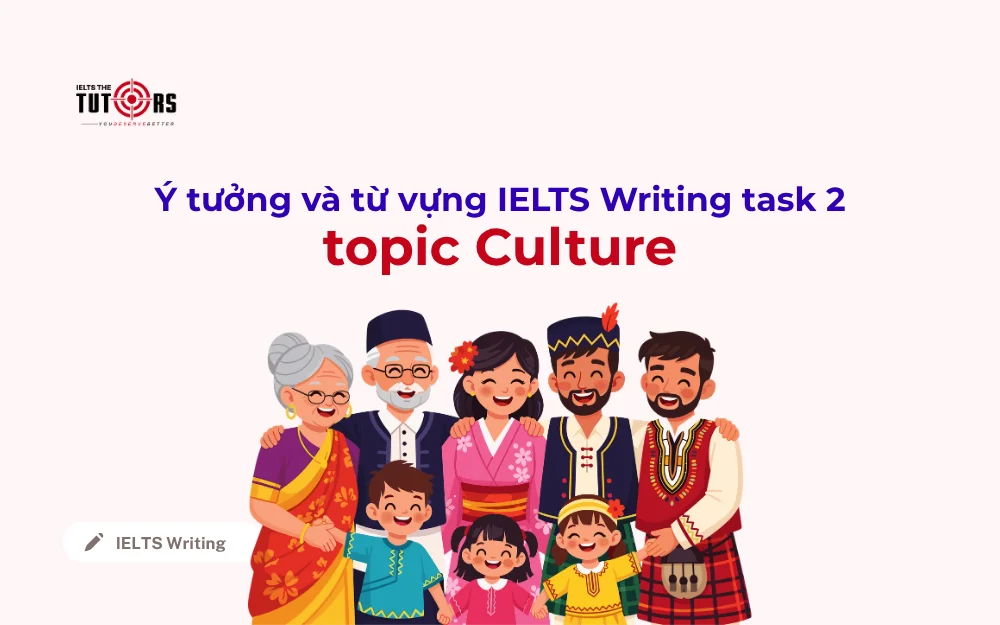
Topic Culture là một chủ đề khá rộng, thường được kết hợp với công nghệ, toàn cầu hóa, du lịch, ngôn ngữ và lối sống hiện đại. Nếu bạn thường bí ý khi gặp IELTS Writing Task 2 topic Culture, hãy cùng IELTS The Tutors chuẩn bị các ý tưởng cho luận điểm, từ vựng và collocation cần thiết để phát triển bài luận mạch lạc hơn.
Các vấn đề thường gặp trong IELTS Writing task 2 Culture topic
Trong IELTS Writing Task 2 topic Culture, đề bài có thể kết hợp văn hóa với công nghệ, toàn cầu hóa, du lịch, ngôn ngữ hoặc nghệ thuật. Thí sinh thường được yêu cầu phân tích sự thay đổi của các giá trị truyền thống, nguy cơ mất bản sắc và cách xã hội bảo tồn văn hóa trong cuộc sống hiện đại.
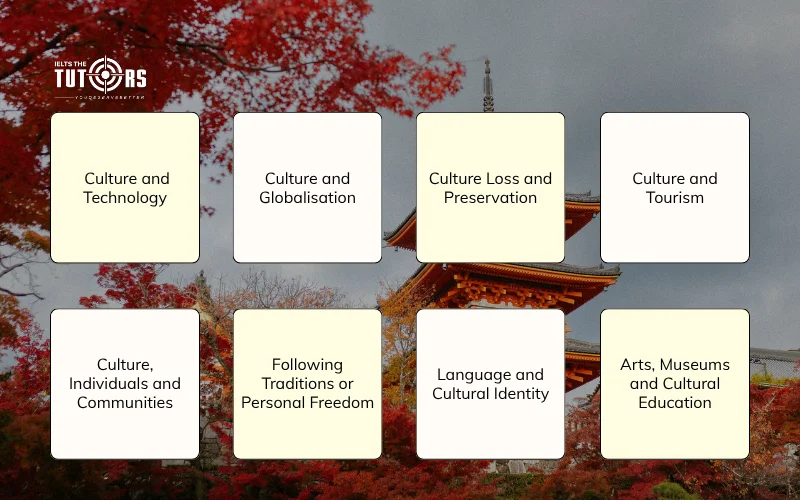
Dưới đây là những vấn đề thường gặp trong chủ đề Culture:
Công nghệ có thể khiến một số phong tục, nghề thủ công và lối sống truyền thống dần bị thay thế.
Toàn cầu hóa tạo điều kiện cho các quốc gia giao lưu về ẩm thực, âm nhạc, thời trang và lối sống.
Nguyên nhân khiến phong tục, lễ hội, nghề truyền thống hoặc lối sống lâu đời dần mai một.
Du lịch thiếu kiểm soát có thể khiến phong tục bị thương mại hóa hoặc mất đi tính nguyên bản.
Văn hóa góp phần hình thành bản sắc cá nhân, tạo cảm giác thuộc về và gắn kết cộng đồng.
Sự xung đột giữa truyền thống và quyền tự do lựa chọn của cá nhân, đặc biệt là người trẻ.
Vai trò của ngôn ngữ trong việc tìm hiểu văn hóa và bảo vệ các ngôn ngữ thiểu số.
Vai trò của nghệ thuật, bảo tàng và phòng trưng bày trong giáo dục và bảo tồn văn hóa.
Ý tưởng triển khai chủ đề Culture trong IELTS Writing task 2
Để làm tốt bài IELTS Writing Task 2 topic Culture, bạn cần chuẩn bị trước các luận điểm phù hợp với từng dạng đề. Dưới đây là một số ideas theo những vấn đề văn hóa thường gặp, giúp bạn xây dựng bài luận logic và phát triển ý đầy đủ hơn.
Culture and Technology
Đề bài: It is inevitable that traditional cultures will be lost as technology develops. Technology and traditional cultures are incompatible. To what extent do you agree or disagree with this view?
Dạng đề: Agree or Disagree
Yêu cầu đề bài:
Đánh giá hai quan điểm: văn hóa truyền thống chắc chắn sẽ biến mất khi công nghệ phát triển và công nghệ không thể tồn tại song song với văn hóa truyền thống.
Xem xét mối quan hệ giữa sự phát triển công nghệ và các giá trị văn hóa truyền thống.
Phân tích liệu công nghệ chỉ làm mai một văn hóa hay cũng có thể hỗ trợ việc lưu giữ và quảng bá văn hóa.
Đưa ra lập trường rõ ràng về việc văn hóa truyền thống có tất yếu biến mất và liệu hai yếu tố này có thể cùng tồn tại hay không.
Ý tưởng triển khai bài Writing task 2:
Agree
Disagree
Modern lifestyles can gradually replace traditional customs. Urbanisation, busy schedules and the preference for convenience may reduce participation in rituals, festivals and community activities.
Globalisation may make cultures more similar. International brands, Western lifestyles and dominant languages can weaken local traditions and national identity.
Traditional crafts and occupations may disappear when machines and mass production replace skilled artisans. Younger people may also be less interested in learning these skills.
Digital communication may reduce face-to-face interaction between family members. As a result, storytelling, oral traditions and knowledge passed down by older generations may become less common.
Modern entertainment such as streaming services and video games may replace folk performances, traditional music and local activities.
Modern society often values individualism, material success and instant gratification. These values may conflict with community traditions, spiritual practices and slower ways of life.
Minority languages may decline because most digital content is produced in widely spoken languages. Young people may therefore use their mother tongue less frequently.
Traditional buildings may be replaced by modern architecture, causing cities to lose their cultural character and become increasingly similar.
Technology can preserve cultural heritage through digital archives, virtual museums, 3D scans and recordings of traditional stories, music and ceremonies.
Online platforms allow traditional practices, local languages and cultural knowledge to reach a global audience. Social media and video platforms can also raise awareness of lesser-known cultures.
Technology can help revive traditional crafts by connecting artisans with international customers. Modern design, online lessons and e-commerce can make cultural products more relevant and profitable.
Online courses, language-learning apps and educational videos can help younger generations learn traditional skills, languages and family history. Digital platforms can also connect people living abroad with their cultural roots.
Technology can promote cultural festivals, performances and heritage sites through livestreams, virtual tours and online publicity. This can attract both local and international audiences.
Technology does not automatically replace traditional values. Communities can choose how to use it while continuing to practise customs, celebrate festivals and maintain strong cultural identities.
Digital dictionaries, language apps, online communities and recorded materials can support endangered languages and encourage younger people to learn them.
Modern development can include traditional design elements. Countries such as Japan and South Korea show that technological progress can exist alongside strong cultural traditions.
Culture and Globalisation
Đề bài: Some people say that the increasing business and cultural contact between countries has positive effects. Others say it would lead to the loss of national identities. Discuss both views and give your own opinion.
Dạng đề: Discussion Essay and Opinion
Yêu cầu đề bài:
Thảo luận quan điểm 1: Việc tăng cường giao lưu kinh doanh và văn hóa giữa các quốc gia mang lại nhiều tác động tích cực.
Thảo luận quan điểm 2: Quá trình này có thể làm suy yếu hoặc khiến bản sắc dân tộc dần mai một.
Đưa ra ý kiến cá nhân về ảnh hưởng của toàn cầu hóa đối với văn hóa.
Cần thảo luận cân bằng cả hai quan điểm trước khi trình bày lập trường cá nhân.
Ý tưởng triển khai bài Writing task 2:
Positive Effects of Globalization
Loss of National Identity
Globalization can increase trade, attract foreign investment, create jobs and help poorer countries access international markets, technology and specialist knowledge.
Greater contact between countries allows people to learn about different cultures, build international friendships and become more tolerant of unfamiliar beliefs and traditions.
International competition gives consumers access to a wider range of products and services, often at better prices and higher quality.
Students can study abroad, join international research projects, take online courses and gain access to scholarships and better educational resources.
Countries can share scientific knowledge, medical discoveries and new technologies, helping them respond more effectively to diseases and environmental problems.
International tourism can generate income, create jobs and provide funding for the protection of cultural sites and public infrastructure.
Economic interdependence and international organisations can strengthen diplomatic relations, support humanitarian aid and encourage countries to solve shared problems peacefully.
Global communication can spread awareness of human rights, gender equality and social justice, placing pressure on governments to improve their policies.
The exchange of ideas can inspire new forms of art, music, food and technology, leading to greater creativity and innovation.
International cooperation helps countries address climate change, pandemics, poverty, terrorism and refugee crises more effectively.
Global brands and Western lifestyles may gradually replace local customs, making cultures around the world more similar.
Minority languages may decline as English and other major languages dominate education, business, entertainment and online communication.
Small local businesses, craft industries and traditional occupations may struggle to compete with large international companies.
Traditional values may weaken as materialism, individualism and consumer culture become more influential, especially among younger people.
Modern development may replace traditional buildings with similar designs, causing cities to lose their local character and architectural heritage.
Global fast-food chains and imported products may change eating habits, while traditional recipes, local ingredients and family meals become less common.
Global films, music and entertainment may dominate local markets, reducing interest in traditional performances, festivals and indigenous art forms.
Western fashion may replace traditional clothing, causing textile skills, national costumes and local styles to lose their everyday importance.
Weddings, festivals, religious ceremonies and other social customs may be simplified, commercialised or replaced by foreign practices.
Younger generations may feel less connected to their history, national symbols and cultural roots, weakening their sense of identity and belonging.
Culture Loss and Preservation
Đề bài: In many countries, traditional customs and practices are gradually disappearing. Why is this happening? What can governments, schools and local communities do to preserve them?
Dạng đề: Causes and Solutions
Yêu cầu đề bài:
Giải thích nguyên nhân khiến các phong tục truyền thống dần biến mất.
Đề xuất giải pháp cụ thể từ ba phía: chính phủ, nhà trường và cộng đồng địa phương.
Đảm bảo mỗi giải pháp giải quyết trực tiếp một nguyên nhân đã nêu.
Phân tích các yếu tố xã hội, kinh tế và giáo dục ảnh hưởng đến việc bảo tồn văn hóa.
Ý tưởng triển khai bài Writing task 2:
Causes
Solutions
Modernisation and urbanisation weaken traditional lifestyles. Rural-to-urban migration, apartment living, smaller families and busy schedules reduce community ties and make some customs harder to maintain.
Globalisation exposes young people to dominant foreign cultures through films, social media, global brands and English-language content. Local products, languages and customs may gradually lose influence.
Traditional occupations often provide low incomes and cannot compete with cheap, mass-produced goods. As a result, young people may choose better-paid modern careers instead of learning traditional skills.
Many education systems give little attention to cultural knowledge because they focus more heavily on academic subjects, examinations and career-related skills.
A growing gap between generations prevents cultural knowledge from being passed on. Young people may see traditions as outdated, while older people may struggle to connect with modern lifestyles.
Traditional community structures are disappearing. Neighbours interact less, festivals are no longer celebrated collectively and social media increasingly replaces face-to-face communication.
Some traditions are viewed as old-fashioned, restrictive or linked to gender and social inequality. This negative image can make younger generations unwilling to follow them.
Long working hours, school pressure and modern entertainment leave people with little time for cultural activities. Convenience is often prioritised over traditional practices.
Migration and life abroad can weaken people’s connection with their homeland, language and customs. Assimilation pressures and mixed cultural environments may also change traditional practices.
Global entertainment often overshadows local content. Streaming platforms, video games and social media trends may seem more attractive than traditional performances or games.
Governments should protect heritage sites, restore historical buildings, fund cultural activities and create clear policies for cultural preservation.
Schools and public media should promote local history, traditional languages, arts and customs through lessons, documentaries, campaigns and cultural programmes.
Governments and local organisations should support artisans through subsidies, tax incentives, craft cooperatives, fair-trade markets and cultural tourism.
Schools should include cultural studies, local history, folk music, traditional crafts and native-language lessons in the curriculum.
Schools and communities can organise mentoring programmes, storytelling sessions, oral-history projects and workshops led by older residents.
Local communities should organise festivals, traditional markets, neighbourhood events, cultural clubs and activities that encourage residents to participate together.
Harmful or unfair elements should be updated while meaningful cultural values are preserved. Campaigns should present traditions in a more relevant and inclusive way.
Cultural activities should be made easier to access through weekend events, school clubs, community centres and short practical workshops.
Diaspora communities can maintain cultural centres, language classes, heritage celebrations and exchange programmes that help younger generations stay connected to their roots.
Cultural content should be adapted for digital platforms through films, online campaigns, youth-focused programmes and creative projects that make traditions more engaging.
Culture and Tourism
Đề bài: Some believe that tourism does more to create tension between countries rather than helping individuals better understand other cultures. To what extent do you agree or disagree?
Dạng đề: Agree or Disagree
Yêu cầu đề bài:
Đánh giá liệu du lịch làm gia tăng căng thẳng hay thúc đẩy sự thấu hiểu văn hóa.
Xem xét những tác động tiêu cực của du lịch đối với quan hệ giữa các quốc gia.
Phân tích lợi ích của du lịch trong việc tăng cường giao lưu văn hóa.
Đưa ra lập trường rõ ràng về tác động chính của du lịch.
Ý tưởng triển khai bài Writing task 2:
Agree
Disagree
Some tourists ignore local customs, dress inappropriately at religious sites, behave loudly or treat local people disrespectfully.
Traditional rituals and customs may be changed to suit tourists, turning local culture into a form of entertainment and reducing its authenticity.
Large differences in wealth can create resentment, especially when tourism raises prices or makes housing and services less affordable for local people.
Overcrowding, pollution, littering and pressure on natural resources can reduce residents’ quality of life and cause conflict with visitors.
Language barriers and a lack of cultural awareness may lead tourists to offend local people or impose their own values on the host community.
Overtourism may cause noise, traffic, housing shortages and public protests in popular destinations such as major European cities.
Some forms of tourism can exploit local communities, reinforce stereotypes or present cultures as exotic attractions.
Peak-season tourism can disrupt daily life, place pressure on services and weaken community cohesion.
International chains and tourist-oriented businesses may replace local shops, food and traditions, making destinations less distinctive.
Political disputes, travel boycotts and visa restrictions can turn tourism into a source of tension between countries.
Travellers can experience local lifestyles, traditions and history directly, helping them understand cultures beyond books or media reports.
Conversations, homestays and shared activities allow tourists and residents to exchange ideas, practise languages and build genuine relationships.
Tourism creates jobs, supports local businesses and provides funding for public facilities, heritage sites and cultural projects.
Visits to museums, historical sites and cultural centres can deepen knowledge of local art, architecture and traditions.
Direct contact can challenge stereotypes, reduce fear of unfamiliar cultures and encourage greater tolerance.
Tourism can encourage communities to preserve traditional crafts, restore historic buildings and maintain local customs.
Positive travel experiences can improve the image of a country and support peaceful relations between people from different nations.
Student exchanges, gap years and responsible volunteer programmes can help young people develop a broader global perspective.
Translation tools, travel guides and reliable online information can help visitors understand local rules and avoid cultural misunderstandings.
Repeat visits, study-abroad programmes and international partnerships can create lasting friendships and long-term cultural connections.
Culture, Individuals and Communities
Đề bài: Multicultural societies, in which there is a mixture of different ethnic groups, bring more benefits than drawbacks to a country. To what extent do you agree or disagree?
Dạng đề: Agree or Disagree
Yêu cầu đề bài:
Đánh giá liệu xã hội đa văn hóa mang lại nhiều lợi ích hơn bất lợi.
Phân tích những lợi ích về kinh tế, xã hội và văn hóa của sự đa dạng dân tộc.
Xem xét các thách thức và vấn đề có thể phát sinh trong một xã hội đa văn hóa.
Đưa ra lập trường rõ ràng về tác động tổng thể của sự đa văn hóa.
Ý tưởng triển khai bài Writing task 2:
Agree
Disagree
A diverse workforce can fill labour shortages, support business growth and bring new skills, ideas and international connections to the economy.
Multicultural societies give people access to a wider range of food, music, festivals, languages and traditions, creating a richer cultural environment.
Students can develop cross-cultural understanding, language skills and a broader global perspective, which prepares them for an international workplace.
Regular contact with people from different backgrounds can reduce prejudice, encourage empathy and create a more tolerant society.
Cultural diversity can strengthen diplomatic ties, trade partnerships and international cooperation through migrant and diaspora communities.
People with different experiences often approach problems in different ways, which can encourage creativity, innovation and new forms of art or design.
Immigration can provide workers for healthcare, construction, agriculture and other sectors facing staff shortages. It can also support countries with ageing populations.
A multicultural population can improve the variety and quality of restaurants, attract tourists and introduce healthier or unfamiliar food choices.
Accepting refugees and immigrants gives people safety, supports family reunification and reflects a country’s commitment to human rights.
International students and researchers support knowledge exchange, strengthen universities and improve the quality of academic research.
Countries such as Canada, Australia and Singapore show that cultural diversity can support economic development and social stability when integration policies are effective.
Different ethnic or cultural groups may live separately, which can limit interaction and weaken social cohesion.
Differences in religion, social values and cultural practices may lead to tension, disagreement or conflict.
Language barriers can make it harder for immigrants to study, work and use public services, while also increasing the risk of misunderstanding.
Some people may feel uncertain about their cultural identity or worry that national traditions are being weakened.
Competition for jobs, housing, healthcare and education may create resentment, especially when public services are already under pressure.
Poor integration may contribute to social isolation, gang activity, radicalisation or other security concerns in some communities.
Cultural and ethnic divisions may influence voting patterns, encourage identity-based politics and make political agreement more difficult.
Some groups may be unwilling or unable to learn the local language or adapt to local customs, making long-term integration more difficult.
Schools may struggle to meet different language, religious and educational needs, particularly when funding and staff are limited.
Persistent discrimination, inequality and neighbourhood conflict may lead to protests, hate crimes or wider social unrest.
Problems in some European cities show that multiculturalism may fail when communities remain segregated and governments do not support integration effectively.
Following Traditions or Personal Freedom
Đề bài: Some people think young people should follow the traditions of their society. Others think young people should be free to behave as individuals. Discuss both views and give your own opinion.
Dạng đề: Discussion Essay and Opinion
Yêu cầu đề bài:
Thảo luận quan điểm 1: Giới trẻ nên tuân theo các truyền thống và chuẩn mực của xã hội.
Thảo luận quan điểm 2: Giới trẻ nên được tự do đưa ra lựa chọn và sống theo cách riêng.
Đưa ra ý kiến cá nhân về cách cân bằng giữa truyền thống và quyền tự do cá nhân.
Ý tưởng triển khai bài Writing task 2:
Follow Traditions
Individual Freedom
Traditions help preserve cultural heritage, strengthen national identity and pass shared values from one generation to the next.
Shared customs create a sense of belonging and bring families and communities closer together.
Traditional values can provide moral guidance, clear expectations and lessons based on the experience of previous generations.
Following family traditions can show respect for parents, reduce conflict and help maintain harmony within the household.
Established customs create stability because people understand their roles, responsibilities and expected behaviour.
Traditions can teach respect, discipline, responsibility, humility and commitment to the wider community.
Guidance from older generations may help young people avoid harmful decisions and learn from past experience.
Religious traditions can preserve spiritual beliefs, connect members of a faith community and provide a sense of purpose.
Cultural ceremonies such as weddings, festivals and funerals give meaning and structure to important stages of life.
Traditional languages, forms of address and communication customs help protect linguistic heritage and respectful behaviour.
Personal freedom allows people to express themselves, develop their own identity and choose a life that reflects their values.
Freedom encourages new ideas, creativity and social progress by allowing people to question outdated norms.
Modern problems often require new approaches, so people should be able to adapt rather than follow customs without question.
People may feel happier when they can choose their own career, partner and future instead of living according to family expectations.
Individual rights should take priority when traditions limit equality, freedom of belief or basic human dignity.
A society that accepts different lifestyles, beliefs and backgrounds is often more inclusive and culturally diverse.
Making personal choices helps people develop critical thinking, independent judgement and confidence.
Forced conformity may harm mental health, while autonomy and self-determination can improve confidence and emotional well-being.
People should have the freedom to choose their education, profession, place of residence and preferred way of life.
People should be free to choose their relationships, set personal boundaries and leave relationships that make them unhappy.
Language and Cultural Identity
Đề bài: In order to learn a language well, people should also learn about the culture and lifestyle of those who speak that language. To what extent do you agree or disagree?
Dạng đề: Agree or Disagree
Yêu cầu đề bài:
Đánh giá mối liên hệ giữa việc học ngôn ngữ và sự hiểu biết về văn hóa, lối sống.
Xem xét liệu người học có cần tìm hiểu văn hóa để sử dụng ngôn ngữ thành thạo hay không.
Phân tích vai trò của bối cảnh văn hóa trong việc giao tiếp và sử dụng ngôn ngữ hiệu quả.
Đưa ra lập trường rõ ràng về mức độ quan trọng của văn hóa đối với quá trình học ngôn ngữ.
Ý tưởng triển khai bài Writing task 2:
Agree
Disagree
Language reflects the culture in which it is used. Idioms, proverbs, humour, metaphors and wordplay often carry meanings that cannot be understood through direct translation alone.
Cultural knowledge helps learners choose suitable expressions for different situations. Levels of formality, politeness, directness and acceptable conversation topics vary across societies.
Communication also involves gestures, eye contact, personal space, facial expressions and tone of voice. Understanding these differences helps learners communicate more naturally.
Cultural awareness reduces the risk of causing offence or misunderstanding others. It helps learners recognise taboos, respect social norms and build trust with native speakers.
Background knowledge makes it easier to understand literature, films, music, news and historical references. Learners can recognise implied meanings and cultural allusions more accurately.
Learners who understand culture are more likely to speak naturally, use the correct register and follow the rhythm of real conversations. They can also use slang and informal expressions more appropriately.
Cultural understanding supports social integration. It helps learners make friends, take part in community life and handle unfamiliar social situations with greater confidence.
In professional settings, cultural knowledge helps people understand business etiquette, workplace hierarchy, negotiation styles, meeting behaviour and email formality.
Learning about history and society explains how political events, social movements and cultural changes have shaped modern language use.
Cultural content can make language learning more interesting. Films, stories, music and real-life materials often encourage learners to remain engaged and continue improving.
Grammar and vocabulary can be studied independently. Learners can develop strong technical skills through textbooks, exercises and language tests without exploring culture in depth.
Cultural study requires extra time and resources. Learners with limited time may prefer to focus on grammar, pronunciation and vocabulary before exploring cultural details.
Some people learn a language for a specific purpose, such as travel, examinations, academic study or basic workplace communication. Functional language skills may be enough for these goals.
A single language may be used across many different cultures. English, Spanish, Arabic and French are spoken in numerous countries, making it difficult to decide which culture learners should study.
Modern technology can explain unfamiliar expressions and references. Translation tools, search engines and AI can provide cultural context whenever learners need it.
Many areas of communication use standardised or universal language. Scientific terms, numbers, dates, airport language and basic business expressions can often be understood without deep cultural knowledge.
Interest in culture depends on the learner. Some people only want basic language skills, and forcing them to study cultural topics may reduce their motivation.
Language and culture can be treated as separate fields. Learners may first study how the language works and explore cultural knowledge later when it becomes relevant.
Full cultural immersion is not available to everyone. Many learners study online or independently and may have little contact with native speakers or the target country.
Basic competence may be the main goal. Beginners can manage travel, emergencies and everyday tasks with simple phrases without needing detailed cultural knowledge.
Arts, Museums and Cultural Education
Đề bài: Some people think that museums should be enjoyable places to entertain people, while others believe that the purpose of museums is to educate. Discuss both views and give your own opinion.
Dạng đề: Discussion Essay and Opinion
Yêu cầu đề bài:
Thảo luận quan điểm 1: Bảo tàng nên mang đến trải nghiệm thú vị và hấp dẫn cho khách tham quan.
Thảo luận quan điểm 2: Mục đích chính của bảo tàng là cung cấp kiến thức và giáo dục công chúng.
Đưa ra ý kiến cá nhân về vai trò và mục đích phù hợp của bảo tàng.
Ý tưởng triển khai bài Writing task 2:
Entertainment
Education
Fun and interactive experiences can attract more visitors, especially families and young people. Higher attendance can also increase ticket revenue and public engagement.
Hands-on exhibits, games and virtual reality can make difficult topics easier to understand. Enjoyable activities may also help visitors remember what they learn.
Museums compete with theme parks, streaming services and social media for public attention. Adding entertaining features can help them remain relevant to modern audiences.
Popular exhibitions, events, cafés and gift shops can generate income. This extra revenue can support museum operations and reduce dependence on public funding.
A relaxed and family-friendly atmosphere can make museum visits more enjoyable. Positive childhood experiences may also encourage people to visit museums throughout their lives.
Eye-catching displays and shareable activities can attract attention on social media. Online exposure may encourage younger audiences to visit.
Simulations, role-playing and sensory activities allow visitors to learn through direct experience. Active participation can make exhibitions more memorable.
Concerts, festivals and special events can turn museums into community spaces. These activities may help museums reach people from different backgrounds.
Entertainment can make museums feel less formal or exclusive. A more welcoming approach may attract visitors who are unfamiliar with art, history or academic culture.
Apps, multimedia displays, augmented reality and virtual reality can improve the visitor experience. Modern technology can also make exhibitions more appealing to younger people.
Museums have a responsibility to preserve knowledge and teach visitors about history, culture and society. Their educational purpose should remain the main priority.
Museums should provide detailed information, historical context and careful analysis. Too much entertainment may make important subjects seem superficial.
Historical objects should be treated with care and respect. Sacred or culturally important items should not be used merely as entertainment
Exhibitions should be designed by trained curators and based on reliable research. Academic standards are necessary to protect the quality of information presented.
Visitors need a calm environment to observe objects and reflect on their meaning. Loud or crowded entertainment may interrupt this experience.
Museums should offer authentic experiences based on original objects and accurate information. Historical value should not be replaced by visual spectacle.
Educational content should be organised clearly by topic or historical period. Structured programmes can also support school learning and build knowledge step by step.
Museums also carry out research, documentation and conservation work. Protecting collections for future generations is one of their most important duties.
Professional standards, ethical guidelines and trained staff are essential. They help museums maintain public trust and protect their reputation.
Proper storage, security, climate control and accurate records are necessary to protect museum collections. These responsibilities should not be overlooked in the pursuit of entertainment.
Tóm lại, để làm tốt chủ đề IELTS Writing Task 2 Culture, bạn không cần học thuộc quá nhiều ý tưởng phức tạp. Hãy tập trung vào một số nhóm vấn đề quen thuộc, chọn luận điểm phù hợp và luyện cách sử dụng từ vựng trong từng ngữ cảnh cụ thể. Khi có nền tảng ý tưởng rõ ràng, bạn sẽ tự tin hơn và tránh mất thời gian suy nghĩ trong phòng thi.
Đừng quên theo dõi IELTS The Tutors để có thêm nhiều ý tưởng hay về các chủ đề IELTS Writing khác nhé.
Mai Minh Châu
Giáo viên tại IELTS The Tutors
Mình hiện đang giảng dạy tại IELTS The Tutors và từng bắt đầu với vai trò IELTS Coach. Trong quá trình dạy, mình nhận ra nhiều bạn chưa hiểu bản chất kiến thức, nên mình xây dựng các bài viết học thuật theo hướng dễ hiểu, sát thực tế, dựa trên trải nghiệm giảng dạy và sửa bài mỗi ngày.
Bạn còn thắc mắc về bài viết này?
Bấm đăng ký tư vấn ngay để được đội ngũ cố vấn giải đáp sâu hơn về kiến thức bạn đang đọc
Bài viết này từ IELTS The Tutors sẽ giúp bạn hệ thống các dạng đề IELTS Writing Task 2 Food thường gặp, kèm ý tưởng, từ vựng và collocation hữu ích để phát triển bài luận tự tin hơn tại nhà.
Bài viết từ IELTS The Tutors sẽ giúp bạn hệ thống các Science and Technology topics thường gặp, kèm theo ý tưởng và từ vựng hữu ích để tự tin phát triển bài luận ngay tại nhà.
Trong bài viết này, IELTS The Tutors sẽ tổng hợp những ý tưởng, từ vựng và bài mẫu IELTS Writing Task 2 topic Economy, giúp bạn hiểu rõ các vấn đề thường gặp và biết cách triển khai luận điểm phù hợp hơn.
Trong bài viết dưới đây, IELTS The Tutors sẽ giúp bạn hệ thống những chủ đề Media IELTS Writing Task 2 thường gặp, kèm theo hướng triển khai và nhóm từ vựng dễ ứng dụng.