Bạn đang ôn luyện IELTS Writing task 2 topic Globalization nhưng chưa có idea hay? Hãy cùng IELTS The Tutors tìm hiểu những vấn đề thường gặp trong chủ đề này, các ý tưởng hữu ích giúp bạn phát triển bài viết mạch lạc, logic và những từ & cụm từ dễ áp dụng để tạo ấn tượng với giám khảo. Cùng đọc nhé!
Các vấn đề thường gặp trong chủ đề Globalization Writing task 2
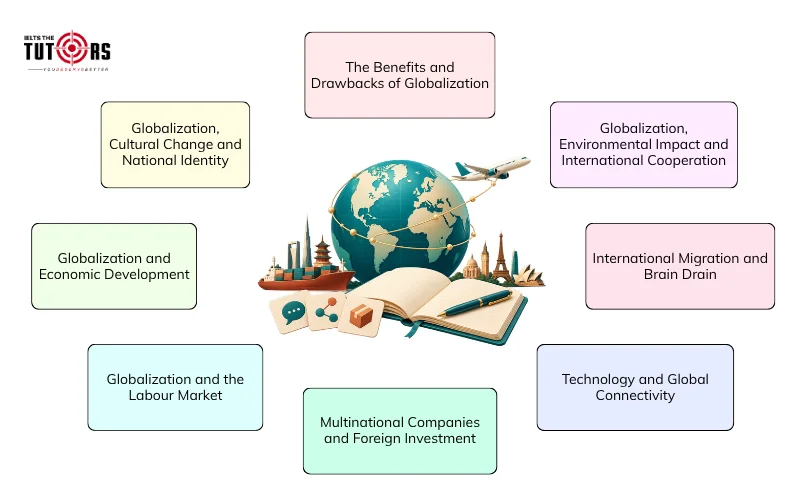
Trong IELTS Writing Task 2, topic Globalization thường xoay quanh việc các quốc gia ngày càng gắn kết về kinh tế, văn hóa, công nghệ và lao động. Tùy từng đề, thí sinh có thể được yêu cầu phân tích lợi ích, hạn chế hoặc tác động của toàn cầu hóa đến một lĩnh vực cụ thể.
Một số vấn đề thường gặp gồm:
Những lợi ích như mở rộng thương mại, tạo việc làm và tiếp cận công nghệ, đi kèm với bất bình đẳng và sự phụ thuộc giữa các nền kinh tế.
Ảnh hưởng của văn hóa quốc tế đến ngôn ngữ, lối sống và giá trị truyền thống, từ đó đặt ra câu hỏi liệu bản sắc dân tộc có bị mai một hay không.
Tác động của thương mại quốc tế, đầu tư nước ngoài và chuỗi cung ứng toàn cầu đến Ảnh hưởng của việc chuyển hoạt động sản xuất sang các quốc gia có chi phí thấp, bao gồm cơ hội việc làm, cạnh tranh lao động và nguy cơ mất việc.
Vai trò của các tập đoàn đa quốc gia trong việc cung cấp vốn, công nghệ và việc làm, đồng thời gây sức ép lên doanh nghiệp trong nước.
Cách Internet và nền tảng số hỗ trợ giao tiếp, chia sẻ thông tin và hợp tác quốc tế, cùng những vấn đề như khoảng cách số và tin sai lệch.
Nguyên nhân người lao động có chuyên môn ra nước ngoài và tác động của xu hướng này đến cả quốc gia xuất cư lẫn quốc gia tiếp nhận.
Ảnh hưởng của sản xuất, vận chuyển và tiêu dùng toàn cầu đến môi trường, cũng như vai trò của hợp tác quốc tế trong việc giảm ô nhiễm.
Nếu bạn chưa biết cách phát triển ý cho chủ đề Globalization trong IELTS Writing Task 2, hãy tham khảo phần gợi ý dưới đây để xây dựng luận điểm rõ ràng, logic và thuyết phục hơn.
Ý tưởng triển khai chủ đề Globalization trong IELTS Writing task 2
The Benefits and Drawbacks of Globalization
Đề bài: Globalization is positive for economies, but its negative sides should not be ignored. To what extent do you agree or disagree?
Ý tưởng phát triển bài Writing task 2:
Positive
Negative
Economic growth accelerated; international trade increases GDP; access to larger markets enables economies of scale.
Exploitation and labor abuse; sweatshops, child labor, unsafe conditions; workers in developing nations exploited.
Loss of sovereignty; international corporations and institutions constrain national policy autonomy; democratic accountability weakened.
Small business destruction; local enterprises cannot compete with multinationals; economic diversity reduced; monopolization increases.
Food security threats; dependence on global supply chains risky; disruptions cause shortages; agricultural diversity lost.
Dàn bài gợi ý:
Introduction: Globalization brings major economic benefits, but I agree that its social, environmental, and cultural costs must also be addressed.
Body 1: It promotes economic growth by increasing trade, attracting foreign investment, creating jobs, lowering prices, and encouraging innovation.
Body 2: However, it can widen inequality, cause job losses, damage the environment, weaken local cultures, exploit workers, and harm small businesses.
Conclusion: Although globalization supports economic development, governments must regulate it carefully to reduce its negative effects.
Globalization, Cultural Change and National Identity
Đề bài: Some people think that increasing business and cultural contact between countries is a positive development. Others, however, believe that it leads to the disappearance of national identity. Discuss both views and give your own opinion.
Ý tưởng phát triển bài Writing task 2:
Increasing Contact Is Positive Development
Leads to Loss of National Identity
Cultural enrichment; exposure to diverse perspectives, arts, cuisines, traditions broadens understanding and appreciation.
Reduces prejudice and xenophobia; personal contact breaks stereotypes; mutual understanding promotes tolerance and peace.
Economic opportunities expanded; international business partnerships create jobs; trade benefits both nations.
Innovation through cross-pollination; combining ideas from different cultures sparks creativity; hybrid innovations emerge.
Language learning motivated; cultural contact encourages multilingualism; communication skills valuable globally.
Global citizenship developed; awareness of interconnected world; responsibility for shared challenges like climate change.
Educational benefits; student exchanges, international collaboration advance knowledge; research partnerships strengthen universities.
Tourism growth; cultural interest drives travel; economic benefits for destination countries; employment generated.
Cultural homogenization; Western consumerism dominates; unique traditions, languages, customs disappear globally. Traditional values eroded; local practices replaced by global commercial culture; intergenerational transmission broken.
Language extinction; dominant languages (English) replace minority languages; linguistic diversity lost permanently.
Identity crisis; younger generations disconnected from heritage; confusion about belonging and cultural roots.
Commercial exploitation; authentic traditions commodified for profit; sacred practices become tourist entertainment.
Loss of autonomy; international cultural standards imposed; nations lose distinctiveness becoming indistinguishable.
Media imperialism; Hollywood, Western media dominate; local film, music, literature industries struggle; cultural production controlled externally.
Generational conflict; youth adopt foreign values; traditional elders feel alienated; social cohesion damaged.
Introduction: Global contact promotes cultural diversity and understanding but may weaken national identity, so integration should be balanced with preservation.
Body 1: Greater international contact enriches cultures, reduces prejudice, creates economic and educational opportunities, encourages innovation, and strengthens global awareness.
Body 2: However, it can also cause cultural homogenization, weaken traditions and local languages, create identity conflicts, and threaten cultural heritage.
Conclusion: Countries should remain globally connected while protecting local cultures through education, support for traditional arts and languages, and responsible cultural exchange.
Globalization and Economic Development
Đề bài: Some people think that countries should produce most of the food consumed by their citizens and import as little as possible. To what extent do you agree or disagree?
Ý tưởng phát triển bài Writing task 2:
Agree
Disagree
Food security ensured; independence from volatile global markets; supply disruptions, embargoes, price spikes avoided
Climate constraints; northern countries cannot grow certain crops year-round; seasonal limitations reduce availability.
Economic inefficiency; resources wasted producing unsuitable crops; opportunity costs high; better to specialize and trade.
Developing nations harmed; agricultural exports crucial for poor countries; protectionism denies income opportunities.
Technology and scale; specialized producers more efficient; economies of scale reduce waste; innovation concentrated.
Global interdependence benefits; trade relationships promote peace; economic ties discourage conflict; cooperation strengthened.
Impossible for small nations; limited land, population, resources make self-sufficiency unrealistic; trade essential.
Dàn bài gợi ý:
Introduction: Although food self-sufficiency can strengthen national food security, I only partly agree because relying entirely on domestic production is costly and impractical.
Body 1: Producing more food domestically can protect countries from supply disruptions, support local farmers, reduce transport emissions, and improve food quality and freshness.
Body 2: However, complete self-sufficiency may raise prices, reduce consumer choice, waste resources, and disadvantage countries that rely on agricultural exports.
Conclusion: Countries should produce essential foods at home while continuing to import seasonal and specialised products to balance security, affordability, and variety.
Globalization and the Labour Market
Đề bài: Many companies are moving jobs and production to countries where labour costs are lower. Do the advantages of this development outweigh the disadvantages?
Ý tưởng phát triển bài Writing task 2:
Advantages
Disadvantages
Consumer prices reduced; lower production costs translate to cheaper goods; purchasing power increased; living standards improved.
Political instability; displaced workers anger fuels populism, extremism; social trust declines; democratic institutions threatened.
Dàn bài gợi ý:
Introduction: Although offshoring can lower prices and support developing economies, its wider social and economic harms mean the disadvantages outweigh the advantages.
Body 1: Offshoring reduces production costs, increases business competitiveness, creates jobs, attracts investment and supports economic growth in developing countries.
Body 2: However, it can cause unemployment, wage pressure and community decline in developed nations while also encouraging worker exploitation, environmental damage and greater economic inequality.
Conclusion: Overall, the disadvantages are more serious, so governments should enforce labour and environmental standards while providing retraining and financial support for affected workers.
Multinational Companies and Foreign Investment
Đề bài: The growth of multinational companies and the resulting rise of globalization create positive effects for everyone. To what extent do you agree or disagree?
Ý tưởng phát triển bài Writing task 2:
Positive Effects for Some Groups
Negative Effects for Many Groups
Consumers benefit; lower prices from economies of scale; wider product variety; consistent quality standards globally.
Shareholders and investors profit; multinational growth generates returns; wealth accumulation for those owning stocks.
Some developing nation workers; employment opportunities created; wages higher than local alternatives; skills training provided.
Host governments; tax revenue from foreign investment; infrastructure development; GDP growth statistics improved.
Entrepreneurs in supply chains; local businesses supplying multinationals benefit; stable contracts; technology access.
Highly skilled migrants; professionals can work internationally; brain circulation opportunities; higher salaries abroad.
Displaced workers in developed nations; manufacturing jobs lost permanently; unemployment, poverty, retraining challenges; communities devastated.
Small and medium local businesses; cannot compete with multinational pricing, marketing, resources; bankruptcies widespread; economic diversity destroyed.
Exploited workers in developing nations; sweatshops, unsafe conditions, poverty wages, union suppression; human rights abused systematically.
Rural communities; agricultural workers displaced by corporate farming; traditional livelihoods destroyed; migration to urban slums forced.
Indigenous populations; land seized for resource extraction; cultural sites destroyed; traditional economies undermined; forced displacement.
Environment and future generations; pollution, resource depletion, climate change; costs externalized; long-term damage for short-term profit.
Women workers; concentrated in lowest-paid positions; exploitation disproportionate; gender inequality reinforced.
Dàn bài gợi ý:
Introduction: Although multinational companies and globalization bring clear benefits, these gains are not shared equally, so I disagree that everyone benefits.
Body 1: Consumers, investors, skilled workers, some employees in developing countries, local suppliers, and host governments may benefit from lower prices, profits, jobs, training, contracts, tax revenue, and better infrastructure.
Body 2: However, displaced workers, small businesses, low-paid employees, rural and indigenous communities, and the environment may suffer from unemployment, unfair competition, exploitation, land loss, wage pressure, and pollution.
Conclusion: Overall, globalization does not benefit everyone because its advantages are concentrated among certain groups, while many others bear the social, economic, and environmental costs.
Technology and Global Connectivity
Đề bài: Many people around the world use social media every day to keep in touch with other people and obtain news. Do the advantages of this development outweigh the disadvantages?
Ý tưởng phát triển bài Writing task 2:
Advantages
Disadvantages
Instant global communication; maintain relationships across distances; families separated by geography stay connected; real-time updates.
Breaking news immediacy; events reported instantly; citizen journalism captures footage traditional media misses; awareness increased.
ost-free connection; no charges for messaging, video calls; accessible to poor populations; democratizes communication.
Community building; people with shared interests, rare conditions, marginalized identities find belonging; support networks formed.
Social movements organized; activism coordinated rapidly; protests, fundraising, awareness campaigns amplified; political change enabled.
Business opportunities; networking, marketing, customer engagement; entrepreneurs reach global markets; economic activity generated.
Information access; diverse news sources; perspectives unavailable in traditional media; censorship circumvented in authoritarian states.
Misinformation epidemic; fake news spreads faster than truth; conspiracy theories radicalize; public discourse poisoned; democratic decisions undermined.
Mental health crisis; social comparison triggers anxiety, depression; addiction designed into platforms; sleep disruption; body image issues; cyberbullying.
Privacy erosion; personal data harvested, sold; surveillance capitalism; manipulation through targeted content; autonomy threatened.
Introduction: Social media improves communication and access to information, but its growing harm to mental health, privacy, and democracy means the disadvantages outweigh the advantages.
Body 1: Its main benefits include instant communication, easier access to news and educational content, stronger online communities, and more opportunities for activism and business.
Body 2: However, misinformation, addiction, cyberbullying, privacy loss, political division, shallow relationships, and harm to young people are more serious and widespread.
Conclusion: Overall, the disadvantages outweigh the benefits, so stricter regulation is needed to reduce harmful content, data exploitation, and addictive platform design.
International Migration and Brain Drain
Đề bài: Some people believe that professionals, such as doctors and engineers, should be required to work in the country where they received their training. Others believe that they should be free to work in another country if they wish. Discuss both views and give your own opinion.
Ý tưởng phát triển bài Writing task 2:
Professionals Should Work Where Trained
Professionals Should Have Freedom to Migrate
Public investment justification; governments fund medical schools, engineering programs; taxpayers deserve return on investment; obligation exists.
Family considerations; personal circumstances require relocation; family reunification, spousal employment, quality of life matter.
Professional networks; international collaboration advances knowledge; restricting movement hinders scientific progress; isolationist approach harmful.
Remittances benefit; migrants send money home; families, communities economically supported; net positive for origin countries.
Enforcement impossible; mandatory service creates resentment; quality suffers; black markets for exit permits; unworkable practically.
Global citizenship; talent belongs to humanity; artificial restrictions inefficient; brain circulation benefits all nations.
Dàn bài gợi ý:
Introduction: Some argue that trained professionals should serve the countries that educated them, while others support free migration; I favour freedom of movement, with brain drain addressed through incentives rather than restrictions.
Body 1: Mandatory service may protect public investment, reduce professional shortages and ensure skilled workers contribute to national development.
Body 2: Freedom of movement respects individual rights, supports career growth and allows professionals to seek better pay, working conditions and opportunities abroad.
Conclusion: Professionals should be free to migrate, while governments reduce brain drain by offering competitive salaries, better workplaces, research funding and stronger career prospects.
Globalization, Environmental Impact and International Cooperation
Đề bài: Environmental problems such as climate change and cross-border pollution cannot be solved by individual countries acting alone. International cooperation is the only effective solution. To what extent do you agree or disagree?
Ý tưởng phát triển bài Writing task 2:
Agree
Disagree
Transboundary nature; pollution, emissions cross borders; one country's actions affect all; unilateral efforts insufficient by definition.
Free-rider problem; countries tempted to avoid costs while benefiting from others' efforts; collective action framework prevents this.
Global commons tragedy; atmosphere, oceans shared resources; without cooperation, overexploitation inevitable; binding agreements necessary.
Economic competitiveness concerns; industries relocate to countries with lax regulations unless standards harmonized internationally.
Technology and resource sharing; developed nations must help developing nations afford green technology; international frameworks enable this.
Enforcement mechanisms; international agreements create accountability; sanctions, monitoring, verification necessary; national actions lack teeth.
Scientific consensus; IPCC, international bodies coordinate research; global problems require global scientific cooperation.
Historical responsibility; developed nations caused most emissions; justice requires international framework for burden-sharing.
Individual leadership inspires; pioneering nations demonstrate feasibility; others follow example; race to top rather than bottom.
Waiting for consensus wastes time; countries should act unilaterally immediately; collective action paralysis dangerous.
Subnational actors important; cities, states, provinces implement policies; international cooperation not only level of action.
Consumer and business action; individual choices, corporate responsibility significant; grassroots movements drive change.
Technology breakthrough; innovation in one country benefits all; doesn't require coordination; market forces drive adoption.
National self-interest; renewable energy independence, health benefits from clean air; countries benefit from unilateral action.
International cooperation difficult; sovereignty conflicts, enforcement challenges; shouldn't wait for perfect agreement before acting.
Complementary approaches; both national action AND international cooperation needed; not either/or; multilevel governance optimal.
Dàn bài gợi ý:
Introduction: Environmental problems cross national borders, so I strongly agree that international cooperation is the most effective solution.
Body 1: Global cooperation is essential because climate change, pollution, and resource depletion cannot be solved by individual countries acting alone.
Body 2: National governments, cities, businesses, and consumers can still make important contributions, but their efforts are most effective when supported by international agreements.
Conclusion: Although local and national action matters, coordinated global policies, shared responsibilities, and effective enforcement are necessary to address environmental problems successfully.
Từ vựng & collocation ăn điểm chủ đề Globalization
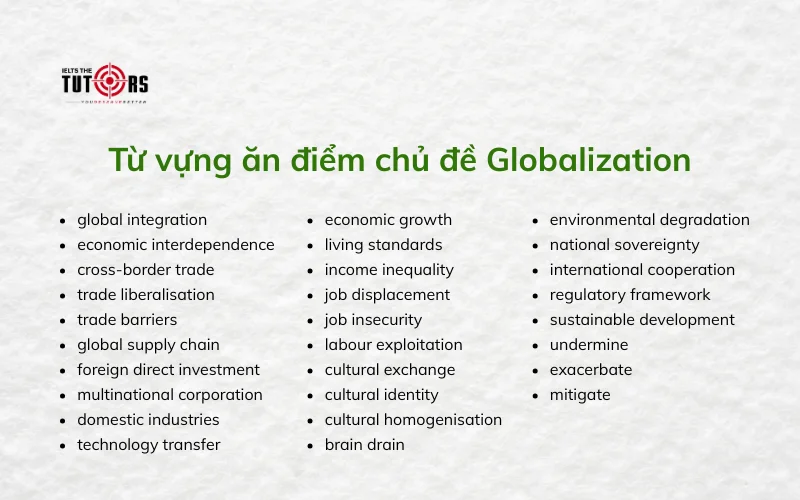
Từ vựng ghi điểm topic Globalization trong IELTS Writing task 2
Từ/cụm từ
Từ loại
Nghĩa
global integration
noun phrase
sự hội nhập toàn cầu
economic interdependence
noun phrase
sự phụ thuộc kinh tế lẫn nhau
cross-border trade
noun phrase
thương mại xuyên biên giới
trade liberalisation
noun phrase
quá trình tự do hóa thương mại
trade barriers
noun phrase
các rào cản thương mại
global supply chain
noun phrase
chuỗi cung ứng toàn cầu
foreign direct investment
noun phrase
đầu tư trực tiếp nước ngoài
multinational corporation
noun phrase
tập đoàn đa quốc gia
domestic industries
noun phrase
các ngành sản xuất trong nước
technology transfer
noun phrase
sự chuyển giao công nghệ
economic growth
noun phrase
tăng trưởng kinh tế
living standards
noun phrase
mức sống
income inequality
noun phrase
bất bình đẳng thu nhập
job displacement
noun phrase
tình trạng người lao động mất việc do thay đổi cơ cấu việc làm
job insecurity
noun phrase
sự thiếu ổn định về việc làm
labour exploitation
noun phrase
sự bóc lột người lao động
cultural exchange
noun phrase
sự giao lưu văn hóa
cultural identity
noun phrase
bản sắc văn hóa
cultural homogenisation
noun phrase
sự đồng nhất hóa văn hóa
brain drain
noun phrase
tình trạng chảy máu chất xám
environmental degradation
noun phrase
sự suy thoái môi trường
national sovereignty
noun phrase
chủ quyền quốc gia
international cooperation
noun phrase
sự hợp tác quốc tế
regulatory framework
noun phrase
khuôn khổ pháp lý
sustainable development
noun phrase
phát triển bền vững
undermine
verb
làm suy yếu
exacerbate
verb
làm trầm trọng hơn
mitigate
verb
giảm nhẹ tác động tiêu cực
Collocation chủ đề Globalization nên học thuộc
Collocation
Ý nghĩa
facilitate cross-border trade
tạo điều kiện thuận lợi cho hoạt động thương mại xuyên biên giới
remove trade barriers
xóa bỏ các rào cản thương mại
integrate into global supply chains
tham gia vào chuỗi cung ứng toàn cầu
attract foreign direct investment (FDI)
thu hút vốn đầu tư trực tiếp nước ngoài (FDI)
stimulate economic growth
thúc đẩy tăng trưởng kinh tế
raise living standards
nâng cao mức sống
facilitate technology transfer
thúc đẩy chuyển giao công nghệ
expose local firms to global competition
khiến các doanh nghiệp trong nước phải cạnh tranh với doanh nghiệp quốc tế
force small businesses out of the market
khiến các doanh nghiệp nhỏ phải rời khỏi thị trường
widen income inequality
làm gia tăng khoảng cách thu nhập
relocate production overseas
chuyển hoạt động sản xuất ra nước ngoài
create job insecurity
làm gia tăng tình trạng việc làm bấp bênh
exploit cheap labour
khai thác nguồn lao động giá rẻ
strengthen labour protection
tăng cường bảo vệ quyền lợi người lao động
promote cultural exchange
thúc đẩy giao lưu văn hóa
lead to cultural homogenisation
dẫn đến sự đồng nhất hóa văn hóa
erode national identity
làm xói mòn bản sắc dân tộc
accelerate environmental degradation
đẩy nhanh tình trạng suy thoái môi trường
strengthen international cooperation
tăng cường hợp tác quốc tế
mitigate the adverse effects of globalization
giảm thiểu những tác động tiêu cực của toàn cầu hóa
Hy vọng những kiến thức trên sẽ giúp bạn biết cách triển khai IELTS Writing Task 2 topic Globalization và tự tin thực chiến với nhiều dạng đề khác nhau. Đừng quên theo dõi IELTS The Tutors để cập nhật thêm nhiều bài mẫu, từ vựng và chiến lược làm bài hữu ích, giúp bạn chinh phục mục tiêu band điểm IELTS mong muốn!
Mai Minh Châu
Giáo viên tại IELTS The Tutors
Mình hiện đang giảng dạy tại IELTS The Tutors và từng bắt đầu với vai trò IELTS Coach. Trong quá trình dạy, mình nhận ra nhiều bạn chưa hiểu bản chất kiến thức, nên mình xây dựng các bài viết học thuật theo hướng dễ hiểu, sát thực tế, dựa trên trải nghiệm giảng dạy và sửa bài mỗi ngày.
Bạn còn thắc mắc về bài viết này?
Bấm đăng ký tư vấn ngay để được đội ngũ cố vấn giải đáp sâu hơn về kiến thức bạn đang đọc
Trong bài viết này, IELTS The Tutors sẽ cùng bạn khám phá ideas hay, dễ triển khai, từ vựng ghi điểm và bài mẫu tham khảo cho IELTS Writing Task 2 Animal Rights, từ đó xây dựng lập luận rõ ràng và tự tin hơn khi tự luyện viết tại nhà.
Bài viết này từ IELTS The Tutors sẽ giúp bạn hệ thống các dạng đề IELTS Writing Task 2 Food thường gặp, kèm ý tưởng, từ vựng và collocation hữu ích để phát triển bài luận tự tin hơn tại nhà.
Bài viết từ IELTS The Tutors sẽ giúp bạn hệ thống các Science and Technology topics thường gặp, kèm theo ý tưởng và từ vựng hữu ích để tự tin phát triển bài luận ngay tại nhà.
Trong bài viết này, IELTS The Tutors sẽ tổng hợp những ý tưởng, từ vựng và bài mẫu IELTS Writing Task 2 topic Economy, giúp bạn hiểu rõ các vấn đề thường gặp và biết cách triển khai luận điểm phù hợp hơn.
Nếu bạn thường bí ý khi gặp đề IELTS Writing Task 2 Culture, hãy cùng IELTS The Tutors chuẩn bị các ý tưởng cho luận điểm, từ vựng và collocation cần thiết để phát triển bài luận mạch lạc hơn.