Bài thi IELTS Writing Task 2 topic Government thường xoay quanh nhiều vấn đề quen thuộc như giáo dục, y tế, kinh tế và an sinh xã hội. Trong bài viết này, IELTS The Tutors sẽ tổng hợp những dạng vấn đề nổi bật thường xuất hiện trong đề, đồng thời gợi ý các ý tưởng hay và từ vựng hữu ích để bạn cải thiện khả năng viết luận và tự tin hơn khi bước vào kỳ thi IELTS.
Các vấn đề thường gặp trong chủ đề Government Writing task 2
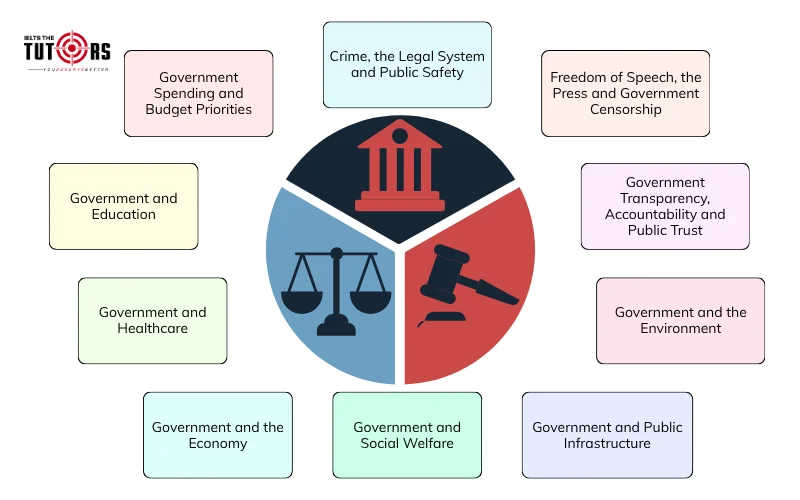
Trong IELTS Writing Task 2, Government topic thường được lồng ghép với giáo dục, y tế, kinh tế, môi trường hoặc an sinh xã hội. Đề bài chủ yếu yêu cầu bạn đánh giá trách nhiệm của nhà nước, cách phân bổ ngân sách và mức độ chính phủ nên can thiệp vào đời sống người dân.
Dưới đây là những vấn đề thường gặp trong đề thi Government Writing task 2:
Chi tiêu và phân bổ ngân sách: Chính phủ nên ưu tiên ngân sách cho giáo dục, y tế, quốc phòng, nghệ thuật, môi trường hay phúc lợi xã hội khi nguồn lực có hạn.
Chính phủ và giáo dục: Các đề bài thường bàn về giáo dục miễn phí, học phí đại học, cơ hội học tập bình đẳng và vai trò của nhà nước trong việc xây dựng chương trình giảng dạy.
Chính phủ và y tế: Trọng tâm là trách nhiệm đầu tư cho bệnh viện, phòng ngừa bệnh tật và việc dịch vụ y tế nên miễn phí hoàn toàn hay do người dân cùng chi trả.
Chính phủ và nền kinh tế: Thí sinh có thể phải đánh giá các chính sách về thuế, trợ cấp, tiền lương, hỗ trợ doanh nghiệp hoặc vai trò của tăng trưởng kinh tế đối với một quốc gia.
Chính phủ và an sinh xã hội: Nhóm đề này xoay quanh trợ cấp cho người nghèo, người thất nghiệp, người cao tuổi và nguy cơ người dân phụ thuộc quá nhiều vào phúc lợi.
Chính phủ và cơ sở hạ tầng: Đề bài thường đề cập đến việc đầu tư vào giao thông, nhà ở, điện, nước và tranh luận ai nên chịu chi phí cho các dịch vụ này.
Chính phủ và môi trường: Các biện pháp phổ biến gồm đánh thuế doanh nghiệp gây ô nhiễm, siết chặt quy định và đầu tư vào năng lượng sạch.
Minh bạch và niềm tin của người dân: Nội dung thường liên quan đến tham nhũng, việc sử dụng ngân sách, trách nhiệm giải trình và hiệu quả của các chính sách công.
Tự do ngôn luận và kiểm duyệt: Đề bài yêu cầu cân bằng giữa quyền tự do biểu đạt với việc kiểm soát tin giả, nội dung bạo lực và thông tin gây hại.
Tội phạm và an toàn công cộng: Các vấn đề thường gặp gồm hình phạt, cải tạo phạm nhân, phòng ngừa tội phạm và sự cân bằng giữa an ninh với quyền tự do cá nhân.
Ý tưởng triển khai chủ đề Government trong IELTS Writing task 2
Government Spending and Budget Priorities
Đề bài: It is considered by many that governments should spend more money on public welfare rather than investing in the arts, such as music and theatre. To what extent do you agree or disagree?
Dạng bài: Agree/Disagree
Yêu cầu đề bài:
Chính phủ nên ưu tiên chi tiêu cho phúc lợi xã hội thay vì đầu tư vào các lĩnh vực nghệ thuật như âm nhạc và sân khấu.
Nêu rõ bạn đồng ý với quan điểm này ở mức độ nào.
Ý tưởng phát triển bài Writing task 2:
Agree
Disagree
Governments should prioritise healthcare, education, and housing because they are essential needs.
Welfare spending directly benefits a larger proportion of the population.
When public funds are limited, reducing poverty and inequality should come before supporting the arts.
A healthy and well-educated population is more productive and supports long-term economic growth.
Citizens expect governments to provide public services, infrastructure, and social security.
During crises, public money should be directed towards urgent and essential services.
The results of welfare spending are easier to measure, such as lives saved and children educated.
Protecting citizens’ well-being is one of the government’s main responsibilities.
The arts help preserve national identity, cultural heritage, languages, and traditions.
Creative industries create jobs, attract tourists, and contribute to economic growth.
The arts improve mental well-being, strengthen communities, and enhance quality of life.
Arts education develops creativity, critical thinking, and problem-solving skills.
Shared cultural experiences can promote social cohesion and reduce divisions.
Creativity encouraged by the arts can drive innovation in other industries.
Governments can fund both public services and the arts rather than choosing only one.
Many valuable art forms cannot survive through private funding alone and therefore need public support.
Government and Education
Đề bài: The best way to reduce poverty in developing countries is to provide up to six years of free education so that people can at least read, write and use numbers. To what extent do you agree or disagree?
Dạng bài: Agree/Disagree
Yêu cầu đề bài:
Đánh giá quan điểm cho rằng cách hiệu quả nhất để giảm nghèo ở các nước đang phát triển là cung cấp 6 năm giáo dục miễn phí, tập trung vào các kỹ năng cơ bản như đọc, viết và tính toán.
Nêu rõ bạn đồng ý với quan điểm này ở mức độ nào.
Ý tưởng phát triển bài Writing task 2:
Agree
Disagree
Basic education provides essential literacy and numeracy skills, helping people participate in the economy.
Educated people can access better employment, earn higher incomes, and escape poverty.
Education enables people to make informed decisions about health, family planning, and personal finances.
Literate parents are more likely to understand hygiene, nutrition, and medical advice.
Educating girls can promote gender equality, delay marriage, and improve outcomes for future generations.
Educated citizens are more likely to participate in politics and demand government accountability.
Education offers a long-term solution by helping people become financially independent.
Basic education is relatively affordable and can provide strong social and economic returns.
Education alone is ineffective if there are not enough jobs or economic opportunities.
Healthcare and nutrition must also be improved because sick or malnourished children cannot learn effectively.
Roads, electricity, transport, and markets are also necessary for economic development.
Many poor families cannot afford uniforms, transport, or the loss of income when children attend school.
Poor teaching, overcrowded classrooms, and limited materials can reduce the value of education.
Corruption and weak institutions may still prevent educated people from improving their lives.
People also need access to land, credit, and business capital to use their knowledge effectively.
Cultural barriers, including gender discrimination and child marriage, must be addressed alongside education.
Poor families may need immediate food, healthcare, and financial support, so a broader approach is necessary.
Government and Healthcare
Đề bài: Some people think that governments should tax unhealthy foods to encourage people to eat more healthily. To what extent do you agree or disagree?
Dạng bài: Agree/Disagree
Yêu cầu đề bài:
Đánh giá quan điểm cho rằng chính phủ nên chịu trách nhiệm cung cấp dịch vụ y tế, thay vì giao việc này cho các công ty tư nhân.
Nêu rõ bạn đồng ý với quan điểm này ở mức độ nào.
Ý tưởng phát triển bài Writing task 2:
Agree
Disagree
Government-funded healthcare guarantees access regardless of income.
A universal system promotes equality and prevents a two-tier healthcare system.
Governments can prioritise prevention, vaccination, and public health education.
A single-payer system can reduce administrative costs and negotiate lower medicine prices.
Universal healthcare protects families from medical debt and financial hardship.
Governments can provide comprehensive care, including treatment for existing conditions.
Public systems support long-term planning based on the health needs of the whole population.
A healthier population is more productive and supports economic growth.
Governments are accountable to citizens rather than private shareholders.
Private competition can improve efficiency, service quality, and patient experience.
Private healthcare often offers greater choice of doctors, hospitals, and treatments.
Private providers may reduce waiting times and provide faster treatment.
Market incentives can encourage hospitals to maintain high standards.
Private funding reduces pressure on public budgets and taxpayers.
Private companies often invest heavily in medical research and new technology.
The government can regulate healthcare without directly providing every service.
Requiring individuals to contribute may discourage unnecessary use of medical services.
People should have the freedom to choose their own insurance and level of coverage.
Government and the Economy
Đề bài: In some countries, a few people earn extremely high salaries. Some people think that this is good for the country, while others believe that the government should control salaries and limit how much people can earn. Discuss both views and give your opinion.
Dạng bài: Discussion Essay with Opinion
Yêu cầu đề bài:
Phân tích quan điểm 1: Vì sao mức lương rất cao có thể mang lại lợi ích cho một quốc gia.
Phân tích quan điểm 2: Lý do chính phủ nên kiểm soát hoặc giới hạn thu nhập.
Đưa ra quan điểm cá nhân rõ ràng và nhất quán trong cả mở bài lẫn kết bài.
Ý tưởng phát triển bài Writing task 2:
High salaries are beneficial to the country
The government should control salaries
High salaries help companies attract and retain highly skilled workers.
People with specialised skills, major responsibilities, or outstanding ability deserve higher pay.
Financial rewards motivate employees to improve their skills, work harder, and develop new ideas.
Successful entrepreneurs and professionals can create jobs, encourage investment, and contribute more through taxes.
Salary limits may encourage talented workers to move to countries where they can earn more.
Excessive income gaps can increase inequality and social dissatisfaction.
Some senior executives receive extremely high salaries despite making limited contributions to their companies.
Large pay gaps within the same company may reduce employee morale and motivation.
When wealth is concentrated among a small group, many ordinary workers may struggle to improve their living standards.
Governments can reduce income inequality through progressive taxation and fair pay regulations.
Government and Social Welfare
Đề bài: The government should give each citizen a basic income so that they have enough money to live on, even if they are unemployed. To what extent do you agree or disagree?
Dạng bài: Agree/Disagree
Yêu cầu đề bài:
Đánh giá quan điểm cho rằng chính phủ nên cung cấp cho mỗi công dân một khoản thu nhập cơ bản, để họ có đủ tiền trang trải cuộc sống ngay cả khi thất nghiệp.
Đưa ra quan điểm đồng ý hay không đồng ý với quan điểm này.
Ý tưởng phát triển bài Writing task 2:
Agree
Disagree
Wealthy societies have a moral duty to protect vulnerable people and provide support during hardship.
Welfare promotes social stability by reducing poverty, crime, and social unrest.
People contribute through taxes when employed, so they should receive support when facing unemployment or disability.
Financial assistance protects children from the effects of poverty and improves their future opportunities.
A strong safety net gives people the confidence to pursue education, start businesses, or take career risks.
Unemployment and poverty are not always caused by personal choices, so wider social problems require public solutions.
Support for housing, nutrition, and healthcare improves public health and benefits society as a whole.
Access to food, shelter, and healthcare can be viewed as basic human rights that governments should protect.
Individuals should take responsibility for supporting themselves, as excessive welfare may create dependency.
Generous benefits may reduce people’s motivation to work and create a welfare trap.
Welfare programmes place a heavy burden on public finances and may require higher taxes.
Welfare systems may be exploited through fraud, resulting in a waste of taxpayers’ money.
Charities, families, and local communities may provide more targeted support than government programmes.
High taxation to fund welfare limits personal freedom and reduces individuals’ control over their income.
Government welfare can be bureaucratic and may not meet the different needs of each recipient.
A guaranteed safety net may encourage irresponsible behaviour by reducing the consequences of poor decisions.
Government and Public Infrastructure
Đề bài: As the number of cars increases, more money has to be spent on road systems. Some people think the government should pay for this. Others, however, think that drivers should cover the costs. Discuss both views and give your opinion.
Dạng bài: Discussion Essay with Opinion
Yêu cầu đề bài:
Phân tích quan điểm 1: Chính phủ nên chi trả cho hệ thống đường bộ.
Phân tích quan điểm 2: Người lái xe nên chịu các khoản chi phí này.
Nêu quan điểm cá nhân của bạn.
Ý tưởng phát triển bài Writing task 2:
Government Should Pay for Roads
Drivers Should Cover Costs
Roads benefit the whole of society by supporting trade, public transport, emergency services, and daily travel.
A reliable road network is essential for economic growth and the movement of goods and workers.
Citizens already contribute through income, property, and other taxes, so road provision should be a public service.
Government funding ensures that low-income people are not prevented from travelling because of high road charges.
A publicly managed road network is simpler and more convenient than multiple toll systems.
Even non-drivers benefit because roads support deliveries, public services, and local businesses.
Roads are vital for disaster response, national defence, and emergency access, so governments should control them.
Public ownership can prevent private companies from charging excessive fees for essential routes.
Drivers cause road damage and congestion, so they should pay according to how much they use the roads.
Road charges can encourage people to use public transport, cycle, or walk instead of driving.
Driver-funded systems reduce pressure on government budgets and other taxpayers.
Direct payment may make road authorities more accountable for maintenance and service quality.
Drivers produce air pollution and carbon emissions, so they should help cover the environmental costs.
Electronic tolls and distance-based charging make it easier to collect fees fairly and efficiently.
Private car use is often a personal choice, so drivers should contribute to the infrastructure they use.
Higher charges during peak hours can reduce congestion and improve traffic flow.
Government and the Environment
Đề bài: Climate change is a phenomenon that affects countries all over the world. Many people strongly believe that it is the responsibility of individuals, rather than corporations and governments, to deal with this problem. To what extent do you agree?
Dạng bài: Agree/Disagree
Yêu cầu đề bài:
Bàn luận về quan điểm cho rằng mỗi cá nhân, chứ không phải doanh nghiệp hay chính phủ, mới là bên chịu trách nhiệm chính trong việc giải quyết biến đổi khí hậu.
Nêu rõ bạn đồng ý với quan điểm này ở mức độ nào.
Ý tưởng phát triển bài Writing task 2:
Agree
Disagree
Consumer choices influence market demand and encourage companies to offer greener products.
Small actions can create significant change when millions of people adopt them.
People can reduce their environmental impact immediately without waiting for new policies.
Everyone contributes to environmental problems and should therefore share responsibility for solving them.
Using less energy, driving less, and reducing consumption can lower an individual’s carbon footprint.
Individuals can raise awareness and encourage others to adopt more sustainable lifestyles.
Citizens can vote for green policies and pressure governments to take stronger action.
Consumer demand can support the development and wider adoption of green technology.
Governments and large corporations have a much greater environmental impact than individuals.
Individuals cannot directly change energy systems, transport networks, or industrial production.
Governments and corporations have the financial resources needed for large-scale environmental projects.
Only governments can enforce emission limits, carbon taxes, and pollution regulations.
Environmental problems often result from market failures that require government intervention.
Major industries should take responsibility for the environmental damage caused by their operations.
Renewable energy, carbon capture, and cleaner infrastructure require major public and corporate investment.
Climate change requires international agreements that only governments can negotiate and enforce.
Government Transparency, Accountability and Public Trust
Đề bài: Governments should make detailed information about public spending available to all citizens. To what extent do you agree or disagree?
Dạng bài: Agree/Disagree
Yêu cầu đề bài:
Đánh giá quan điểm cho rằng chính phủ nên công khai đầy đủ thông tin về các khoản chi tiêu công cho toàn thể người dân.
Nêu rõ bạn đồng ý đến mức độ nào.
Ý tưởng phát triển bài Writing task 2:
Agree
Disagree
Citizens pay taxes and therefore have the right to know how public money is spent.
Transparency helps prevent corruption, fraud, and the misuse of public funds.
Access to spending data allows voters to evaluate government performance and make informed choices.
Openness can strengthen public trust and improve the legitimacy of government decisions.
Public scrutiny can expose wasteful spending and encourage better use of resources.
Transparent spending records allow citizens to compare the performance of different authorities.
Journalists and independent organisations can use public data to investigate government activities.
Spending data can support research and lead to more effective public policies.
Detailed information about defence and intelligence spending may threaten national security.
Full disclosure may weaken government negotiations and affect commercial contracts.
Personal information about welfare recipients and public employees should remain private.
Producing highly detailed reports can be costly and time-consuming.
Complex budget data may be misunderstood by people who lack financial knowledge.
Political parties may use selected figures to mislead the public or attack their opponents.
Some areas, such as diplomacy and law enforcement, require confidentiality to operate effectively.
Too much information may overwhelm the public, while clear summaries may be more useful.
Freedom of Speech, the Press and Government Censorship
Đề bài: Some people believe that complete freedom of speech is essential in a modern society, while others think that governments should restrict certain forms of expression. Discuss both views and give your opinion.
Dạng bài: Discussion Essay with Opinion
Yêu cầu đề bài:
Phân tích quan điểm 1: Tự do ngôn luận hoàn toàn là điều cần thiết trong xã hội hiện đại.
Phân tích quan điểm 2: Chính phủ nên hạn chế một số hình thức biểu đạt nhất định.
Đưa ra quan điểm cá nhân.
Ý tưởng phát triển bài Writing task 2:
Complete Freedom of Speech Is Essential
Some Forms of Expression Should Be Restricted
Freedom of speech is a basic right and a foundation of democracy.
Open debate allows people to exchange ideas and discover the truth.
Strong legal protection prevents governments from silencing critics and avoiding accountability.
Controversial ideas can encourage creativity, scientific progress, and social change.
Individuals should be free to express their opinions without unnecessary government control.
Once censorship is accepted, governments may gradually expand it and abuse their power.
History shows that authoritarian governments often restrict speech to maintain control.
Open discussion helps societies resolve disagreements peacefully rather than pushing problems underground.
Freedom of speech should be protected even when opinions are unpopular or offensive.
Hate speech and targeted harassment can cause violence and serious psychological harm.
Children should be protected from violent, obscene, or harmful content.
Restrictions may be necessary to protect national security and prevent terrorism.
False information and propaganda can influence elections and weaken democracy.
Extreme speech can divide communities and damage social cohesion.
Vulnerable groups need legal protection from discrimination, threats, and abuse.
Some international laws require restrictions on content that promotes genocide or war crimes.
Social media spreads harmful content quickly, so traditional rules may no longer be sufficient.
Freedom of speech must be balanced with other rights, including safety, dignity, and equality.
Crime, the Legal System and Public Safety
Đề bài: Society is based on rules and laws. It could not function if individuals were free to do whatever they wanted to do. To what extent do you agree or disagree?
Dạng bài: Agree/Disagree
Yêu cầu đề bài:
Phân tích quan điểm cho rằng xã hội chỉ có thể vận hành ổn định khi mọi người tuân theo các quy tắc và luật pháp; nếu ai cũng được tự do làm mọi điều mình muốn, xã hội sẽ khó duy trì trật tự.
Nêu rõ bạn đồng ý với quan điểm này ở mức độ nào.
Ý tưởng phát triển bài Writing task 2:
Agree
Disagree
Laws maintain social order and create a stable environment in which people can live, work, and cooperate.
A strong legal system protects people from crime, exploitation, and unfair treatment.
Rules on traffic, contracts, and property allow society and the economy to function effectively.
Courts provide a peaceful way to resolve conflicts and reduce the risk of violence.
Tax laws ensure that citizens contribute to public services such as education, healthcare, and infrastructure.
Laws establish clear moral boundaries by prohibiting harmful acts such as theft and violence.
Societies without effective laws often experience instability, crime, and social breakdown.
The rule of law promotes equality by applying the same legal standards to everyone.
Individuals have a natural right to freedom and should not face unnecessary restrictions.
Governments may misuse laws to control citizens or protect the interests of powerful groups.
Most people can regulate their behaviour through social norms and personal responsibility.
Voluntary agreements and mutual benefit may guide behaviour more effectively than legal force.
Excessive regulation can discourage entrepreneurship, innovation, and economic progress.
Paternalistic laws may prevent individuals from learning from their own decisions and mistakes.
Uniform laws may fail to respect differences in culture, traditions, and personal values.
Legal systems are costly to operate and may sometimes be slow, ineffective, or unfair.
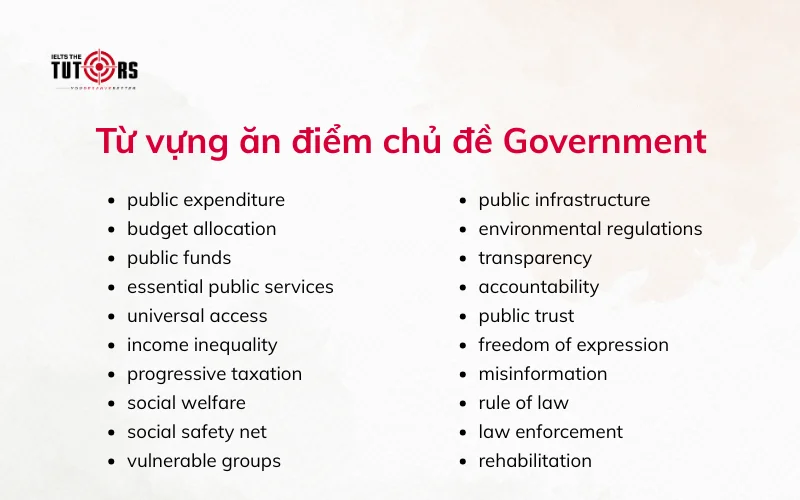
Bên cạnh ideas hay, bạn cũng cần trau dồi vốn từ vựng đa dạng và phù hợp với chủ đề Government trong IELTS Writing Task 2, vì tiêu chí Lexical Resource chiếm ¼ tổng số điểm. Dưới đây là một số từ vựng và collocations hữu ích mà bạn nên học để có nền tảng tốt hơn trước khi bắt tay vào viết bài luận.
Từ vựng/Cụm từ
Loại từ
Ý nghĩa
public expenditure
noun phrase
chi tiêu công
budget allocation
noun phrase
sự phân bổ ngân sách
public funds
noun phrase
ngân sách công
essential public services
noun phrase
các dịch vụ công thiết yếu
universal access
noun phrase
khả năng tiếp cận dành cho mọi người
income inequality
noun phrase
bất bình đẳng thu nhập
progressive taxation
noun phrase
hệ thống thuế lũy tiến
social welfare
noun phrase
phúc lợi xã hội
social safety net
noun phrase
mạng lưới an sinh xã hội
vulnerable groups
noun phrase
các nhóm dễ bị tổn thương
public infrastructure
noun phrase
cơ sở hạ tầng công cộng
environmental regulations
noun phrase
các quy định về môi trường
transparency
noun
sự minh bạch
accountability
noun
trách nhiệm giải trình
public trust
noun phrase
niềm tin của người dân
freedom of expression
noun phrase
quyền tự do biểu đạt
misinformation
noun
thông tin sai lệch
rule of law
noun phrase
nguyên tắc thượng tôn pháp luật
law enforcement
noun phrase
hoạt động thực thi pháp luật
rehabilitation
noun
sự cải tạo, phục hồi
allocate public funds to essential services
verb phrase
phân bổ ngân sách cho các dịch vụ thiết yếu
make efficient use of taxpayers’ money
verb phrase
sử dụng hiệu quả tiền thuế của người dân
ensure equal access to education and healthcare
verb phrase
bảo đảm quyền tiếp cận giáo dục và y tế bình đẳng
place a financial burden on the state
verb phrase
tạo gánh nặng tài chính cho nhà nước
stimulate economic growth
verb phrase
thúc đẩy tăng trưởng kinh tế
protect vulnerable members of society
verb phrase
bảo vệ những người dễ bị tổn thương trong xã hội
invest in public infrastructure
verb phrase
đầu tư vào cơ sở hạ tầng công cộng
enforce strict environmental regulations
verb phrase
thực thi các quy định môi trường nghiêm ngặt
hold public officials accountable
verb phrase
yêu cầu quan chức chịu trách nhiệm giải trình
restore public trust in government
verb phrase
khôi phục niềm tin của người dân vào chính phủ
prevent the spread of misinformation
verb phrase
ngăn chặn sự lan truyền của thông tin sai lệch
address the root causes of crime
verb phrase
giải quyết nguyên nhân gốc rễ của tội phạm
balance public safety with individual rights
verb phrase
cân bằng an toàn công cộng với quyền cá nhân
Nhìn chung, khi viết IELTS Writing Task 2 Government topic, bạn cần hiểu rõ dạng bài, yêu cầu của đề và các từ vựng quan trọng để tìm được ý tưởng phù hợp, phát triển luận điểm logic và tránh bị lạc đề. IELTS The Tutors tin rằng, khi kết hợp tốt kiến thức về vai trò của chính phủ với kỹ năng viết, bạn sẽ có thể trình bày quan điểm rõ ràng và thuyết phục hơn.
Hy vọng bài viết này đã mang đến cho bạn những thông tin hữu ích, giúp rút ngắn thời gian luyện tập mà vẫn đạt được kết quả tốt trong kỳ thi IELTS. Chúc bạn hoàn thành thật tốt bài IELTS Writing Task 2 của mình!
Mai Minh Châu
Giáo viên tại IELTS The Tutors
Mình hiện đang giảng dạy tại IELTS The Tutors và từng bắt đầu với vai trò IELTS Coach. Trong quá trình dạy, mình nhận ra nhiều bạn chưa hiểu bản chất kiến thức, nên mình xây dựng các bài viết học thuật theo hướng dễ hiểu, sát thực tế, dựa trên trải nghiệm giảng dạy và sửa bài mỗi ngày.
Bạn còn thắc mắc về bài viết này?
Bấm đăng ký tư vấn ngay để được đội ngũ cố vấn giải đáp sâu hơn về kiến thức bạn đang đọc
Trong bài viết này, IELTS The Tutors sẽ cùng bạn khám phá ideas hay, dễ triển khai, từ vựng ghi điểm và bài mẫu tham khảo cho IELTS Writing Task 2 Animal Rights, từ đó xây dựng lập luận rõ ràng và tự tin hơn khi tự luyện viết tại nhà.
Bài viết này từ IELTS The Tutors sẽ giúp bạn hệ thống các dạng đề IELTS Writing Task 2 Food thường gặp, kèm ý tưởng, từ vựng và collocation hữu ích để phát triển bài luận tự tin hơn tại nhà.
Bài viết từ IELTS The Tutors sẽ giúp bạn hệ thống các Science and Technology topics thường gặp, kèm theo ý tưởng và từ vựng hữu ích để tự tin phát triển bài luận ngay tại nhà.
Trong bài viết này, IELTS The Tutors sẽ tổng hợp những ý tưởng, từ vựng và bài mẫu IELTS Writing Task 2 topic Economy, giúp bạn hiểu rõ các vấn đề thường gặp và biết cách triển khai luận điểm phù hợp hơn.
Nếu bạn thường bí ý khi gặp đề IELTS Writing Task 2 Culture, hãy cùng IELTS The Tutors chuẩn bị các ý tưởng cho luận điểm, từ vựng và collocation cần thiết để phát triển bài luận mạch lạc hơn.