


Chủ đề Travel & Tourism trong IELTS Writing Task 2 thường tập trung vào sự phát triển của ngành du lịch và ảnh hưởng của nó đến kinh tế, môi trường và văn hóa. Trong bài viết này, IELTS The Tutors sẽ tổng hợp các vấn đề thường gặp trong đề thi và ideas hay kèm từ vựng ghi điểm để bạn viết Writing task 2 đúng hướng và ấn tượng hơn.
Các vấn đề thường gặp trong chủ đề Travel & Tourism Writing task 2
Chủ đề Travel & Tourism trong IELTS Writing Task 2 thường xoay quanh sự phát triển của ngành du lịch và những ảnh hưởng của hoạt động này đến kinh tế, môi trường, văn hóa cũng như đời sống của người dân địa phương. Đề bài có thể yêu cầu thí sinh phân tích lợi ích, hạn chế, nguyên nhân hoặc đề xuất giải pháp để ngành du lịch phát triển theo hướng bền vững hơn.
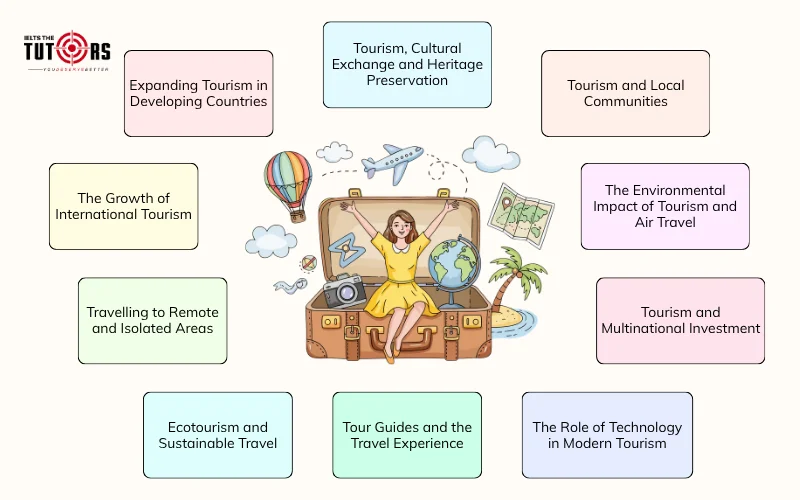
Dưới đây là những vấn đề thường gặp trong chủ đề Travel & Tourism Writing Task 2:
- Expanding Tourism in Developing Countries: Nguyên nhân các quốc gia đang phát triển mở rộng ngành du lịch, cùng những lợi ích về việc làm, thu nhập và cơ sở hạ tầng.
- The Growth of International Tourism: Tác động của việc du lịch nước ngoài ngày càng phổ biến và dễ tiếp cận hơn đối với cá nhân, xã hội và các quốc gia đón khách.
- Travelling to Remote and Isolated Areas: Lợi ích và rủi ro khi khách du lịch đến những vùng xa xôi, môi trường tự nhiên hoang sơ hoặc cộng đồng bản địa.
- Ecotourism and Sustainable Travel: Vai trò của du lịch sinh thái và những biện pháp giúp giảm rác thải, khí thải cũng như thiệt hại đối với hệ sinh thái.
- Tour Guides and the Travel Experience: So sánh giữa việc thuê hướng dẫn viên và du lịch tự túc xét trên các khía cạnh như kiến thức địa phương, sự an toàn, chi phí và quyền tự do.
- The Role of Technology in Modern Tourism: Ảnh hưởng của nền tảng đặt phòng, bản đồ số, đánh giá trực tuyến và mạng xã hội đến cách con người lên kế hoạch cho chuyến đi.
- Tourism and Multinational Investment: Lợi ích của nguồn vốn đầu tư nước ngoài đối với ngành du lịch và nguy cơ doanh nghiệp địa phương bị cạnh tranh hoặc mất nguồn thu.
- The Environmental Impact of Tourism and Air Travel: Ảnh hưởng của máy bay, khu nghỉ dưỡng và lượng khách lớn đến khí hậu, tài nguyên thiên nhiên và mức độ ô nhiễm.
- Tourism and Local Communities: Tác động của du lịch đến việc làm, giá nhà, chi phí sinh hoạt, giao thông và chất lượng cuộc sống của cư dân địa phương.
- Tourism, Cultural Exchange and Heritage Preservation: Vai trò của du lịch trong việc thúc đẩy giao lưu văn hóa, đồng thời xem xét nguy cơ thương mại hóa truyền thống và làm hư hại các di tích lịch sử.
Ý tưởng triển khai chủ đề Travel & Tourism trong IELTS Writing task 2
Để thực hiện bài writing about Travelling & Tourism essay hiệu quả hơn, bạn hãy cách xác định rõ đối tượng chịu ảnh hưởng. Từ đó, mỗi luận điểm cần chỉ ra kết quả cụ thể của hoạt động du lịch. Dưới đây là một số ý tưởng triển khai chủ đề này giúp bạn viết Writing task 2 bám sát đề, có chiều sâu và đáp ứng tốt tiêu chí Task Response:
Expanding Tourism in Developing Countries
Đề bài: Many developing countries are currently expanding their tourist industries. Why is this the case? Is it a positive development?
Phân tích đề bài: Với dạng bài Causes & Opinion, bạn cần làm rõ hai nội dung chính:
- Giải thích vì sao các quốc gia đang phát triển đẩy mạnh ngành du lịch
- Đưa ra quan điểm về việc đây là xu hướng tích cực hay tiêu cực.
Khi kết luận, bạn có thể chọn hướng cho rằng sự phát triển của ngành du lịch nhìn chung là tích cực nhờ những lợi ích về kinh tế và việc làm, nhưng cần được quản lý hiệu quả để hạn chế các tác động đến môi trường và văn hóa.
Dưới đây là những ý tưởng bạn có thể sử dụng để triển khai bài Writing task 2:
| Reasons | Positive | Negative |
|
|
|
Dàn bài gợi ý:
- Introduction: Developing countries increasingly invest in tourism expansion due to economic pressures. This trend offers significant benefits but requires careful management to prevent negative consequences.
- Body 1: Developing nations expand tourism to generate foreign currency, create employment, diversify economies, develop infrastructure, and monetize natural resources; economic necessity drives rapid tourism industry growth.
- Body 2: Tourism expansion is largely positive, accelerates economic growth, generates massive employment, improves infrastructure, preserves culture and environment but risks include environmental damage, cultural commodification, and economic inequality requiring sustainable management.
- Conclusion: Tourism expansion in developing countries is predominantly positive development when managed sustainably; benefits outweigh disadvantages if governments regulate environmental protection and ensure local communities benefit economically.
The Growth of International Tourism
Đề bài: International travel has become more affordable, and many countries are opening their doors to increase the number of tourists. What are the advantages and disadvantages of this development?
Phân tích đề bài: Với dạng bài Advantages/Disadvantages, bạn cần trình bày cân bằng cả ưu điểm và nhược điểm của việc du lịch quốc tế ngày càng trở nên dễ tiếp cận.
Khi kết luận, bạn có thể lựa chọn quan điểm rằng lợi ích hoặc bất lợi chiếm ưu thế, miễn là phù hợp với các lập luận đã trình bày trong bài Writing task 2.
Dưới đây là những ý tưởng bạn có thể sử dụng để triển khai bài viết:
| Advantages | Disadvantages |
|
|
Dàn bài gợi ý:
- Introduction: International travel has become increasingly affordable and accessible. This development brings significant cultural and economic advantages but also serious environmental and social challenges.
- Body 1: Affordable travel enables cultural exchange reducing prejudice, supports local economies through tourist spending, facilitates personal growth and education, maintains family connections across borders, and provides mental health benefits.
- Body 2: Increased tourism causes environmental destruction through pollution and overdevelopment, creates overtourism damaging destinations, erodes authentic culture, triggers housing crises, spreads diseases, and homogenizes global destinations.
- Conclusion: While affordable travel offers valuable cultural and economic benefits, disadvantages are increasingly severe; sustainable tourism practices and visitor limits necessary to preserve destinations for future generations.
Travelling to Remote and Isolated Areas
Đề bài: It is now possible for scientists and tourists to travel to remote natural environments, such as the South Pole. Do the advantages of this development outweigh the disadvantages?
Phân tích đề bài: Ở dạng bài Advantages/Disadvantages, bạn cần phân tích cả lợi ích và hạn chế của việc các nhà khoa học và khách du lịch đến những khu vực hẻo lánh như Nam Cực, sau đó đưa ra đánh giá liệu lợi ích có lớn hơn bất lợi hay không.
Một hướng triển khai hợp lý là thừa nhận giá trị của các hoạt động nghiên cứu khoa học, nhưng kết luận rằng những tác động tiêu cực đến môi trường vẫn đáng lo ngại hơn. Bởi đây là hệ sinh thái rất nhạy cảm, bất kỳ sự can thiệp nào của con người cũng có thể để lại những ảnh hưởng lâu dài.
Dưới đây là những ý tưởng bạn có thể sử dụng để triển khai bài Writing task 2:
| Advantages | Disadvantages |
|
|
Dàn bài gợi ý:
- Introduction: Modern technology enables scientists and tourists to reach remote environments like South Pole while offering research and educational value, serious environmental risks suggest disadvantages outweigh advantages.
- Body 1: Remote area travel enables crucial scientific research on climate change, provides educational experiences raising conservation awareness, drives technological innovation, and fosters international cooperation through shared scientific facilities.
- Body 2: Visiting remote environments causes irreversible ecosystem damage, produces massive carbon emissions contradicting conservation, introduces pollution and invasive species, disrupts wildlife, and commercializes pristine areas that should remain protected.
- Conclusion: Disadvantages outweigh advantages; remote areas should remain restricted to essential scientific research with strict environmental protocols; tourist access should be severely limited to protect irreplaceable ecosystems.
Ecotourism and Sustainable Travel
Đề bài: Ecotourism is defined as responsible travel to natural areas that conserves the environment. What are the advantages of ecotourism? How can it be made more popular?
Phân tích đề bài: Với dạng bài Advantages & Solutions, bạn cần làm rõ hai nội dung:
- Lợi ích của du lịch sinh thái.
- Những cách để loại hình du lịch này được nhiều người lựa chọn hơn.
Hãy phân tích các lợi ích nổi bật như góp phần bảo vệ môi trường, tạo sinh kế cho cộng đồng địa phương và nâng cao nhận thức về thiên nhiên. Sau đó, đề xuất một số giải pháp khả thi, chẳng hạn như chính sách hỗ trợ từ chính phủ, đẩy mạnh quảng bá, tăng cường giáo dục về du lịch bền vững và xây dựng các tiêu chuẩn chứng nhận cho các điểm đến.
Dưới đây là những ý tưởng bạn có thể sử dụng để triển khai bài Writing task 2:
| Advantages | Solutions |
|
|
Dàn bài gợi ý:
- Introduction: Ecotourism, defined as responsible travel conserving environment, offers significant environmental and community benefits, increasing popularity requires policy support, marketing, and consumer education.
- Body 1: Ecotourism advantages include funding conservation efforts, providing sustainable income for local communities, protecting wildlife, educating tourists about environmental issues, and minimizing carbon footprint through sustainable practices.
- Body 2: Making ecotourism popular requires government incentives, certification standards, marketing campaigns, educational programs, price competitiveness, accessibility improvements, corporate partnerships, and technology integration demonstrating local community benefits.
- Conclusion: Ecotourism offers superior environmental and social benefits compared to conventional tourism; combination of policy support, consumer education, and certified standards can increase adoption protecting environment while supporting communities.
Tour Guides and the Travel Experience
Đề bài: The best way to travel is to travel in a group led by a tour guide. To what extent do you agree or disagree?
Phân tích đề bài: Với dạng bài Agree/Disagree, bạn cần nêu rõ mức độ đồng ý hoặc không đồng ý với quan điểm cho rằng đi theo tour có hướng dẫn viên là cách tốt nhất để du lịch.
- Phân tích những lợi ích của hình thức này như sự an toàn, thuận tiện và cơ hội tìm hiểu điểm đến thông qua hướng dẫn viên.
- Cân nhắc những ưu điểm của du lịch tự túc, chẳng hạn như sự linh hoạt, tự do khám phá và những trải nghiệm mang đậm dấu ấn cá nhân.
Khi kết luận, bạn có thể lựa chọn đồng ý, không đồng ý hoặc chỉ đồng ý một phần, miễn là quan điểm nhất quán với các lập luận trong bài.
Dưới đây là những ý tưởng bạn có thể sử dụng để triển khai bài Writing task 2:
| Agree | Disagree |
|
|
Dàn bài gợi ý:
- Introduction: Travel preferences vary widely; while tour guides offer expertise and convenience, independent travel provides freedom and authentic experiences, group tours are not universally “best”.
- Body 1: Guided group travel provides expert knowledge, enhanced safety, logistical convenience, social connections, language assistance, exclusive access, and cost-effectiveness; valuable for first-time travelers or complex destinations.
- Body 2: Independent travel offers personal freedom, authentic local interactions, personal growth, cost control, customized experiences, escape from tourist traps, schedule flexibility, and deeper cultural immersion; often superior experience for confident travelers.
- Conclusion: No single “best” travel method exists; optimal choice depends on destination, traveler personality, experience level, and trip goals; both guided and independent travel offer distinct valuable benefits.
The Role of Technology in Modern Tourism
Đề bài: With the rise of budget airlines and online booking platforms, travel has become more accessible to the general public. Discuss the positive and negative impacts of increased travel on individuals and society.
Phân tích đề bài: Với dạng bài Discussion, bạn cần phân tích cả tác động tích cực và tiêu cực của công nghệ đối với hoạt động du lịch.
- Phân tích những lợi ích mà công nghệ mang lại, chẳng hạn như giúp việc đi lại thuận tiện hơn, giảm chi phí và tạo điều kiện cho giao lưu văn hóa.
- Đề cập đến những mặt hạn chế như ô nhiễm môi trường, tình trạng quá tải tại các điểm du lịch và nguy cơ mất việc làm của các đại lý du lịch truyền thống.
Khi kết luận, không nhất thiết phải khẳng định bên nào vượt trội, nhưng nên đưa ra đánh giá tổng thể dựa trên các lập luận đã trình bày.
Dưới đây là những ý tưởng bạn có thể sử dụng để triển khai bài Writing task 2:
| Positive impacts | Negative impacts |
|
|
Dàn bài gợi ý:
- Introduction: Budget airlines and online booking platforms democratized travel while offering accessibility and economic benefits, increased tourism creates environmental, cultural, and social challenges.
- Body 1: Technology enables affordable travel for ordinary people, increases price transparency and convenience, facilitates cultural exchange, generates economic opportunities for locals, and maintains family connections across borders.
- Body 2: Mass tourism from cheap travel causes environmental destruction, overtourism damaging destinations, cultural erosion, traditional industry disruption, housing crises, labor exploitation, and social disruption alienating local residents.
- Conclusion: While technology democratizes travel with positive cultural and economic impacts, negative environmental and social consequences increasingly severe; sustainable tourism practices and visitor management essential.
Tourism and Multinational Investment
Đề bài: Tourism development in many countries attracts investment from multinational hotel and travel companies. Do the advantages of this development outweigh the disadvantages for local businesses and communities?
Phân tích đề bài: Với dạng bài Advantages/Disadvantages, bạn cần phân tích cả mặt lợi và mặt hại của việc các doanh nghiệp đa quốc gia đầu tư vào ngành du lịch tại một quốc gia, sau đó đưa ra quan điểm liệu lợi ích có lớn hơn bất lợi hay không.
Để đạt điểm cao, bài viết của bạn nên đề cập đến:
- Những tác động tích cực như tạo thêm việc làm, cải thiện cơ sở hạ tầng và mang đến kinh nghiệm quản lý.
- Các hạn chế như dòng tiền chảy ra nước ngoài, sự cạnh tranh bất lợi với doanh nghiệp địa phương và nguy cơ cộng đồng mất dần quyền kiểm soát các nguồn lực du lịch.
Khi kết luận, bạn có thể lựa chọn hướng cho rằng những bất lợi đáng được quan tâm hơn nếu hoạt động đầu tư không được quản lý hiệu quả.
Dưới đây là những ý tưởng bạn có thể sử dụng để triển khai bài Writing Task 2:
| Advantages | Disadvantages |
|
|
Dàn bài gợi ý:
- Introduction: Multinational tourism investment brings capital and expertise but raises concerns about local business survival and community benefit, disadvantages ultimately outweigh advantages.
- Body 1: Multinational investment provides massive capital for infrastructure, creates employment, introduces professional standards, offers international marketing reach, transfers technology and expertise, and generates foreign exchange earnings.
- Body 2: Multinational dominance causes severe economic leakage, bankrupts local businesses, homogenizes culture, exploits environment and labor, displaces communities, creates economic dependency, removes local control, and minimizes tax contributions.
- Conclusion: Disadvantages outweigh advantages; while multinationals bring capital, local businesses and communities suffer from profit extraction, cultural erosion, and loss of control; countries should prioritize domestic tourism development.
The Environmental Impact of Tourism and Air Travel
Đề bài: Restricting air travel is the only way to prevent air pollution. To what extent do you agree or disagree?
Phân tích đề bài: Với dạng bài Agree/Disagree, bạn cần nêu rõ mức độ đồng ý hoặc không đồng ý với quan điểm trong đề và bảo vệ lập trường đó bằng những lập luận thuyết phục.
Ở đề bài này, trọng tâm nằm ở cụm từ “the only way”, vì vậy bạn nên phản biện ý kiến cho rằng hạn chế du lịch bằng đường hàng không là giải pháp duy nhất để giảm ô nhiễm không khí.
Bạn có thể lập luận rằng việc phát triển công nghệ xanh, sử dụng nhiên liệu bền vững, áp dụng các chương trình bù đắp carbon và cắt giảm khí thải ở những ngành khác cũng đóng vai trò quan trọng.
Khi kết luận, hãy khẳng định rằng bạn không đồng ý với quan điểm tuyệt đối của đề bài, đồng thời nhấn mạnh cần kết hợp nhiều giải pháp để giải quyết vấn đề một cách hiệu quả.
Dưới đây là các ý tưởng bạn có thể triển khai bài Writing task 2:
| Agree | Disagree |
|
|
Dàn bài gợi ý:
- Introduction: Air travel contributes significantly to pollution. However, restricting aviation is not the only solution; multiple alternative approaches can reduce emissions without eliminating travel.
- Body 1: Aviation produces substantial carbon emissions growing unsustainably; technological solutions remain distant; behavioral restriction appears necessary for meeting climate targets; high-altitude emissions particularly harmful.
- Body 2: Aviation represents small percentage total emissions compared to power, agriculture, manufacturing; technological improvements, sustainable fuels, carbon offsets, and efficiency gains offer viable alternatives to travel restriction with less economic disruption.
- Conclusion: Disagree that restriction is only solution; combination of technological innovation, sustainable fuels, carbon pricing, and efficiency improvements can reduce aviation emissions while preserving travel's social and economic benefits.
Tourism and Local Communities
Đề bài: Over the last few decades, there has been an increase in international tourism. Some people think that tourism is beneficial for local communities and should be encouraged. To what extent do you agree or disagree?
Phân tích đề bài: Với dạng bài Agree/Disagree, bạn cần nêu rõ mức độ đồng ý với quan điểm rằng du lịch quốc tế mang lại lợi ích cho cộng đồng địa phương và nên được khuyến khích.
Một cách tiếp cận hợp lý là đồng ý ở một mức độ nhất định: du lịch có thể tạo việc làm, tăng thu nhập và thúc đẩy phát triển cơ sở hạ tầng. Tuy nhiên, những lợi ích này chỉ bền vững khi ngành du lịch được quy hoạch và quản lý hiệu quả; nếu phát triển thiếu kiểm soát, tình trạng quá tải khách du lịch cùng những tác động đến môi trường và bản sắc văn hóa có thể làm giảm giá trị mà du lịch mang lại.
Dưới đây là những ý tưởng bạn có thể sử dụng để triển khai bài Writing Task 2:
| Agree | Disagree |
|
|
Dàn bài gợi ý:
- Introduction: International tourism growth creates both opportunities and challenges for local communities, benefits materialize only with careful management prioritizing resident wellbeing over profit maximization.
- Body 1: Tourism creates employment, stimulates economic development, improves infrastructure, preserves cultural heritage, develops skills, increases global exposure, funds environmental conservation, and retains youth in rural communities.
- Body 2: Poorly managed tourism causes overtourism, housing crises, economic dependency, cultural commodification, environmental damage, social problems, wealth inequality, loss of community autonomy, and low-quality employment trap.
- Conclusion: Partially agree. Tourism benefits communities when sustainably managed with resident participation, profit-sharing, and protection measures; encouragement should be conditional on ensuring local benefits outweigh costs through proper regulation.
Tourism, Cultural Exchange and Heritage Preservation
Đề bài: Some people think that cultural traditions may be destroyed when they are used as money-making attractions aimed at tourists. Others believe that this is the only way to save these traditions. Discuss both views and give your opinion.
Phân tích đề bài: Với dạng bài Discussion Essay with Opinion, bạn cần phân tích cả hai quan điểm trước khi đưa ra ý kiến của mình.
- View 1: Khai thác văn hóa để phục vụ khách du lịch sẽ làm mai một các giá trị truyền thống.
- View 2: Du lịch là cách hiệu quả nhất để gìn giữ và phát huy những nét văn hóa đó.
Ở phần kết luận, bạn có thể lựa chọn quan điểm rằng du lịch vẫn là một giải pháp tích cực nếu được quản lý hợp lý, chẳng hạn như khuyến khích sự tham gia của cộng đồng địa phương, hạn chế thương mại hóa quá mức và nâng cao nhận thức về bảo tồn văn hóa.
Dưới đây là những ý tưởng bạn có thể sử dụng để triển khai bài Writing Task 2:
| Tourism Destroys Cultural Traditions | Tourism Only Way to Save Traditions |
|
|
Dàn bài gợi ý:
- Introduction: Tourism's relationship with cultural traditions is complex – critics argue commercialization destroys authenticity; supporters claim tourism provides essential preservation funding – truth requires balanced approach.
- Body 1: Tourism-driven commodification destroys authenticity by reducing sacred rituals to entertainment, pressuring modifications for tourist preferences, violating sacred spaces, breaking intergenerational transmission, and homogenizing unique cultural practices.
- Body 2: Tourism provides crucial economic viability for traditions, renews youth engagement, enables documentation and preservation, increases global awareness, funds infrastructure maintenance, restores intergenerational pride, prevents migration, and demonstrates contemporary relevance.
- Conclusion: Both perspectives valid; tourism can preserve traditions when communities control presentation maintaining authenticity, limit commercial pressure, educate tourists about cultural significance, and ensure economic benefits support genuine practitioners; sustainable cultural tourism balances preservation with commercialization.
Xem thêm:
Từ vựng & collocation ăn điểm chủ đề Travel & Tourism
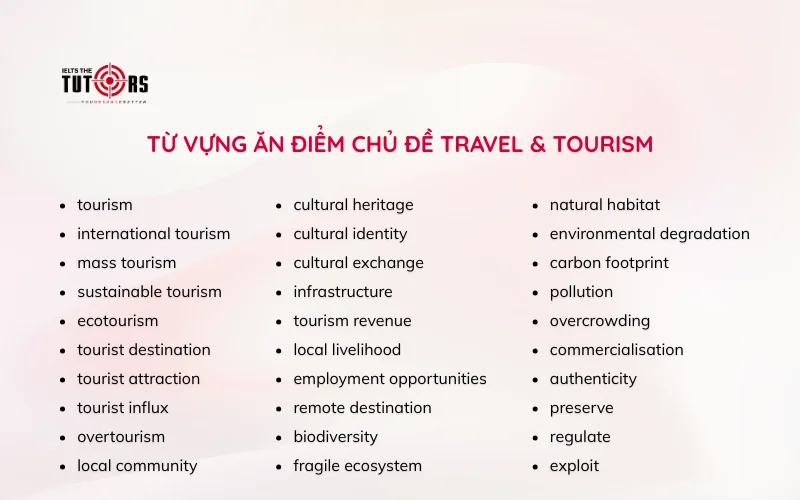
Từ vựng IELTS Writing Task 2 chủ đề Travel & Tourism
| Từ vựng | Từ loại | Ý nghĩa |
| tourism | noun | ngành du lịch |
| international tourism | noun phrase | du lịch quốc tế |
| mass tourism | noun phrase | du lịch đại chúng |
| sustainable tourism | noun phrase | du lịch bền vững |
| ecotourism | noun | du lịch sinh thái |
| tourist destination | noun phrase | điểm đến du lịch |
| tourist attraction | noun phrase | điểm tham quan |
| tourist influx | noun phrase | lượng lớn khách du lịch |
| overtourism | noun | tình trạng quá tải du lịch |
| local community | noun phrase | cộng đồng địa phương |
| cultural heritage | noun phrase | di sản văn hóa |
| cultural identity | noun phrase | bản sắc văn hóa |
| cultural exchange | noun phrase | giao lưu văn hóa |
| infrastructure | noun | cơ sở hạ tầng |
| tourism revenue | noun phrase | doanh thu du lịch |
| local livelihood | noun phrase | sinh kế địa phương |
| employment opportunities | noun phrase | cơ hội việc làm |
| remote destination | noun phrase | điểm đến xa xôi |
| biodiversity | noun | đa dạng sinh học |
| fragile ecosystem | noun phrase | hệ sinh thái mong manh |
| natural habitat | noun phrase | môi trường sống tự nhiên |
| environmental degradation | noun phrase | suy thoái môi trường |
| carbon footprint | noun phrase | lượng phát thải carbon |
| pollution | noun | ô nhiễm |
| overcrowding | noun | quá tải, đông đúc |
| commercialisation | noun | thương mại hóa |
| authenticity | noun | tính nguyên bản |
| preserve | verb | bảo tồn |
| regulate | verb | quản lý bằng quy định |
| exploit | verb | khai thác quá mức |
Collocation hữu ích chủ đề Travel & Tourism
| Collocation | Ý nghĩa |
| generate tourism revenue | tạo ra doanh thu từ du lịch |
| stimulate economic growth | thúc đẩy tăng trưởng kinh tế |
| create employment opportunities | tạo ra cơ hội việc làm |
| improve local infrastructure | cải thiện cơ sở hạ tầng địa phương |
| become heavily dependent on tourism | phụ thuộc quá nhiều vào ngành du lịch |
| promote sustainable tourism | thúc đẩy du lịch bền vững |
| minimise the environmental impact | giảm thiểu tác động đến môi trường |
| protect natural habitats | bảo vệ môi trường sống tự nhiên |
| place pressure on local infrastructure | gây áp lực lên cơ sở hạ tầng địa phương |
| place pressure on natural resources | gây áp lực lên tài nguyên thiên nhiên |
| preserve cultural heritage | bảo tồn di sản văn hóa |
| maintain cultural identity | duy trì bản sắc văn hóa |
| encourage cultural exchange | thúc đẩy giao lưu văn hóa |
| limit visitor numbers | giới hạn số lượng khách du lịch |
| strike a balance between tourism and conservation | cân bằng giữa phát triển du lịch và bảo tồn |
Nhìn chung, viết IELTS Writing task 2 chủ đề Travel & Tourism không khó nếu bạn xác định đúng yêu cầu của đề bài và phát triển từng luận điểm một cách mạch lạc, logic. Hãy sử dụng ví dụ thực tế và từ vựng theo chủ đề du lịch để làm nổi bật quan điểm của bạn.
Nếu cần thêm ideas cho các chủ đề Writing khác, hãy theo dõi IELTS The Tutors để cập nhật nhanh nhất các topic xu hướng, giúp bạn luyện viết hiệu quả và đạt được kết quả tốt nhất trong kỳ thi IELTS.