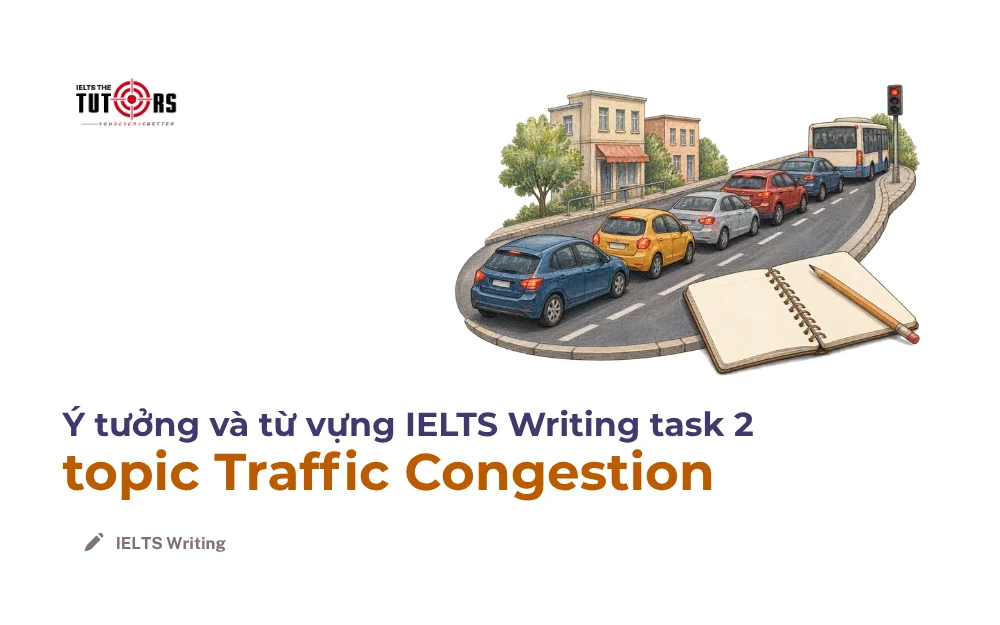
Traffic Congestion thường được xếp trong nhóm chủ đề lớn hơn là Transport and Traffic. Dạng đề này chủ yếu xoay quanh nguyên nhân, hậu quả và các giải pháp giảm ùn tắc tại thành phố lớn. Bài viết dưới đây, IELTS The Tutors sẽ giúp bạn hệ thống những ý tưởng thường gặp trong IELTS Writing Task 2 topic Traffic Congestion, từ đó dễ dàng xây dựng luận điểm và luyện viết hiệu quả hơn tại nhà.
Các vấn đề thường gặp trong chủ đề Traffic Congestion
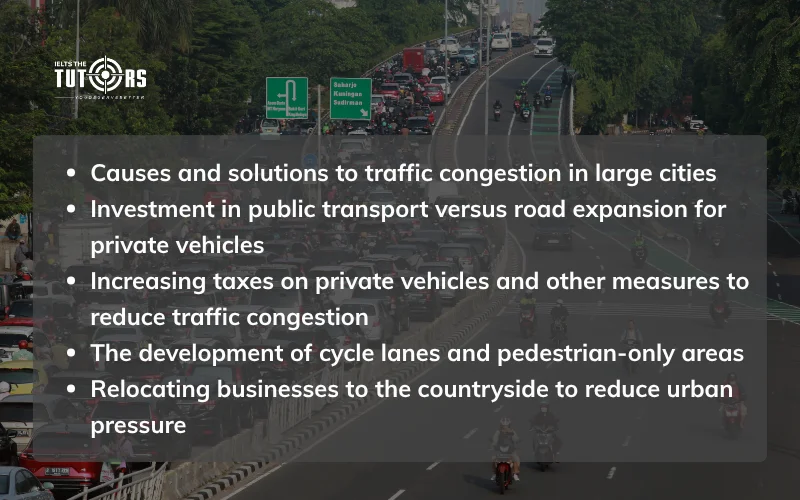
Trong IELTS Writing Task 2, topic Traffic Congestion thường xoay quanh nguyên nhân gây ùn tắc và những giải pháp giúp giảm lượng phương tiện tại các thành phố lớn. Dưới đây là những vấn đề thường gặp trong topic Traffic Congestion:
Nguyên nhân và giải pháp cho tình trạng ùn tắc do số lượng phương tiện tăng, hạ tầng hạn chế và nhu cầu đi lại cao.
Việc đầu tư giao thông công cộng hay mở rộng hệ thống đường bộ để cải thiện tình trạng tắc đường.
Tăng giá nhiên liệu, thuế, phí đỗ xe hoặc phí vào trung tâm nhằm hạn chế việc sử dụng phương tiện cá nhân.
Khuyến khích người dân đi bộ và sử dụng xe đạp bằng cách cải thiện làn đường, độ an toàn và không gian công cộng.
Quy hoạch công ty, nhà ở và các khu dịch vụ để giảm nhu cầu di chuyển đường dài trong giờ cao điểm tại đô thị.
Một số đề bài mẫu trong chủ đề Traffic Congestion
Các đề IELTS Writing Task 2 về Traffic Congestion có thể xuất hiện dưới nhiều dạng bài khác nhau. Dưới đây là một số đề mẫu giúp bạn làm quen với cách ra đề trong topic này:
Dạng bài Causes and Solutions: Traffic congestion has become a serious problem in many large cities. What are the main causes of this problem? What measures can be taken to solve it?
Dạng bài Discuss Both Views and Give Your Opinion: Some countries invest more money in public transport, while other countries invest more money in expanding roads for private vehicles. Discuss both views and give your opinion.
Dạng bài Two-part Question: One way to solve the problem of congestion on the roads is to increase the tax on private vehicles. How could this alleviate congestion? What other measures can you suggest?
Dạng bài Advantages and Disadvantages: Many cities are creating more cycle lanes and pedestrian-only areas. What are the advantages and disadvantages of this development?
Dạng bài Agree or Disagree: Due to the growing population, some people think that companies should be relocated to the countryside. To what extent do you agree or disagree?
Ý tưởng triển khai chủ đề Traffic Congestion
Để làm tốt topic Traffic Congestion, bạn cần xác định đúng yêu cầu của đề và chọn luận điểm phù hợp. Dưới đây là một số ideas dễ áp dụng cho những vấn đề thường gặp về ùn tắc giao thông:
Nguyên nhân và giải pháp cho tình trạng ùn tắc giao thông ở các thành phố lớn
(Causes and solutions to traffic congestion in large cities)
Causes
Solutions
Rapid urbanisation and population growth increase the number of commuters faster than transport infrastructure can expand.
Urban sprawl and the concentration of jobs in city centres force many people to travel long distances at the same time.
Rising incomes, cheaper vehicles and a strong preference for private cars have increased car ownership.
Many people choose cars because they offer greater comfort, privacy and flexibility than other forms of transport.
Public transport networks often lack sufficient capacity, coverage and connections between different areas.
High fares, delays, overcrowding and poor service quality discourage people from using public transport.
Car-centred urban planning leaves limited space for walking, cycling and other alternatives to driving.
Poorly designed roads, narrow intersections and inefficient traffic lights create bottlenecks.
Fixed working and school hours cause large numbers of people to travel during the same peak periods.
Single-occupancy cars use road space inefficiently, while school runs add further pressure during rush hours.
Delivery trucks, taxis and ride-hailing vehicles add to traffic, particularly when they stop or circulate in busy areas.
Ongoing construction, roadworks and major events can temporarily reduce road capacity and cause sudden congestion.
Governments should develop long-term transport plans and invest in infrastructure that can meet future population growth.
Mixed-use development and decentralised business districts can shorten journeys and reduce pressure on city centres.
Congestion charges, higher parking fees and vehicle ownership controls can discourage unnecessary car use.
Public transport should be made cleaner, safer, more reliable and more convenient than driving.
Cities should expand metro and bus networks, increase service frequency and improve connections between transport modes.
Governments can subsidise fares, introduce integrated ticketing and provide real-time travel information.
Protected cycle lanes, wider pavements, pedestrian zones and safe routes to school can encourage active travel.
Smart traffic signals, improved junction design and real-time traffic monitoring can help vehicles move more efficiently.
Flexible working hours, remote work and staggered school schedules can spread travel demand throughout the day.
Carpooling schemes, high-occupancy vehicle lanes, school buses and company shuttles can reduce the number of vehicles.
Cities should regulate loading zones, delivery times and passenger pick-up points to reduce disruption during peak hours.
Better coordination, public travel information and temporary traffic management plans can limit these disruptions.
Đầu tư vào giao thông công cộng hay mở rộng đường cho phương tiện cá nhân
(Investment in public transport versus road expansion for private vehicles)
Investment in public transport
Expansion of the road network
Public transport can reduce traffic congestion by carrying far more passengers than private cars.
Buses and trains produce fewer emissions per passenger, helping improve air quality and reduce environmental damage.
Mass transit uses less energy and can increasingly rely on renewable electricity.
Public transport is more affordable than car ownership and gives low-income groups better access to jobs and services.
Elderly people, children and those who cannot drive can travel more independently when public transport is reliable.
Transit systems use limited urban space more efficiently and leave more land for housing, parks and businesses.
Fewer cars can make cities quieter, safer and more suitable for walking and cycling.
Passengers can work, read or rest during the journey instead of concentrating on driving.
Well-connected transit encourages compact development and reduces the need for long daily commutes.
Public transport provides a stronger long-term solution because its capacity can grow without adding the same number of vehicles to the streets.
Investment in electric buses and rail systems supports climate targets and reduces dependence on fossil fuels.
Governments can convert existing car lanes into bus lanes instead of continuously building new roads.
Public transport generally offers better value in dense cities because it moves more people with less land and infrastructure.
The most suitable approach is to prioritise public transport in urban areas while maintaining roads for freight, rural travel and essential services.
Wider roads may provide short-term relief when existing routes are heavily congested.
Roads remain essential for freight transport, deliveries, emergency vehicles and regional travel.
Private vehicles offer door-to-door travel without fixed routes or schedules.
Cars are often more practical for families carrying children, luggage, groceries or equipment.
Road transport is necessary in rural and low-density areas where public transport may not be financially practical.
Expanding existing roads may initially be cheaper and faster than constructing a new railway or metro system.
Road investment supports industries that depend on vehicles, including logistics, tourism and construction.
Road expansion works with current travel habits and does not require drivers to change their behaviour immediately.
In areas already designed around cars, maintaining and improving roads may be more realistic than replacing the transport system.
New roads often fill up quickly as more people choose to drive, so congestion may return after a short period.
More roads can encourage urban sprawl, increase fuel consumption and damage natural land.
Highways can divide neighbourhoods, displace residents and reduce the quality of urban life.
Roads require continuous maintenance and parking space, creating significant long-term public costs.
Road expansion should be limited to places where it is genuinely necessary rather than treated as the main solution to urban congestion.
Tăng thuế phương tiện cá nhân và các giải pháp giảm ùn tắc
(Increasing taxes on private vehicles and other measures to reduce traffic congestion)
How Higher Taxes on Private Vehicles Could Reduce Congestion
Other Measures to Reduce Congestion
Higher purchase and road taxes make car ownership more expensive, which may discourage people from buying private vehicles.
Increased costs encourage drivers to use their cars only when necessary and combine several errands into one trip.
Higher vehicle taxes can persuade households to give up second or third cars, reducing the total number of vehicles on the road.
When driving becomes more expensive, people are more likely to use public transport, walk, cycle, carpool or share rides.
Higher charges during peak hours can encourage commuters to travel earlier, later or work from home.
Taxes can be designed to charge large, luxury or highly polluting vehicles more heavily while protecting essential commercial transport.
Revenue from vehicle taxes can fund public transport, cycling infrastructure and other sustainable travel options.
Fewer private vehicles can reduce demand for parking and free urban land for public spaces, housing or wider pavements.
A shift towards smaller and more fuel-efficient cars can improve road-space efficiency and reduce pollution.
Although vehicle taxes may reduce congestion, they must be designed fairly so that lower-income drivers are not affected disproportionately.
Governments should expand metro, bus and tram networks so that public transport becomes a practical alternative to driving.
Public transport should be affordable, reliable and comfortable to attract more passengers.
Dedicated bus lanes and better connections between buses, trains, cycling routes and park-and-ride facilities can shorten journey times.
Congestion charges, parking fees and vehicle quotas can discourage private cars from entering crowded city centres.
Safe cycling lanes, pedestrian areas and walkable neighbourhoods can reduce the need for short car journeys.
Mixed-use and transit-oriented development can allow people to live closer to workplaces, schools and essential services.
Developing suburban business centres can distribute jobs more evenly and reduce pressure on central districts.
Flexible working hours, remote work and compressed working weeks can reduce the number of commuters travelling at the same time.
Carpool programmes, high-occupancy vehicle lanes and ride-sharing platforms can increase the number of passengers in each vehicle.
Smart traffic lights, live traffic information and faster accident response can improve traffic flow without building more roads.
Fuel taxes, pay-per-mile insurance and employer benefits for public transport can encourage people to drive less.
Public awareness campaigns can help people understand the social and environmental costs of excessive car use.
Phát triển làn đường dành cho xe đạp và khu vực đi bộ
(The development of cycle lanes and pedestrian-only areas)
Advantages
Disadvantages
Cycle lanes and pedestrian areas reduce car use, which helps lower air pollution and carbon emissions.
Walking and cycling encourage regular physical activity, improving cardiovascular health and reducing obesity.
Quieter streets can reduce noise pollution and create a calmer urban environment.
Separating cyclists and pedestrians from cars can reduce traffic accidents and improve public safety.
Pedestrian-friendly streets provide more space for social interaction, outdoor activities and community events.
Reducing car traffic can make neighbourhoods more attractive, lively and enjoyable to live in.
Walking and cycling are affordable because they involve little or no spending on fuel, insurance or parking.
Cycle lanes use less road and parking space, allowing urban land to be used more efficiently.
Cycling can be faster than driving for short journeys in heavily congested cities.
Cycle lanes can connect residential areas with public transport and make entire journeys more convenient.
Walkable areas can attract visitors and encourage people to spend more time in local shops and cafés.
Roads designed for walking and cycling require less maintenance than roads used heavily by cars.
Children can travel more independently and safely when streets have protected paths and slower traffic.
Successful examples from cities such as Amsterdam and Copenhagen show that these policies can improve urban life.
Removing car lanes may initially worsen congestion and increase travel time on the remaining roads.
These transport options are less practical in extreme heat, heavy rain, snow or hilly areas.
Walking and cycling are unsuitable for long commutes or people living far from city centres.
Poorly designed lanes may create conflicts between cyclists, pedestrians and drivers.
Elderly people, those with disabilities and parents with young children may still depend on cars.
Cars may still be necessary for carrying heavy goods, shopping or transporting large items.
High-quality bicycles and electric bikes may remain unaffordable for some low-income residents.
Building and maintaining safe cycling and pedestrian infrastructure requires considerable public investment.
Bicycle theft and a lack of secure parking may discourage people from cycling regularly.
Delivery vehicles, emergency services and local businesses may face difficulties accessing pedestrianised areas.
Some businesses may experience short-term disruption or fear losing customers because of reduced parking.
Traffic may be diverted to nearby streets, creating congestion and pollution in other neighbourhoods.
Unequal investment may leave poorer neighbourhoods with lower-quality infrastructure.
Public opposition and strong attachment to car use can make such policies politically difficult to introduce.
Di dời doanh nghiệp về nông thôn nhằm giảm áp lực đô thị
(Relocating businesses to the countryside to reduce urban pressure)
Agree
Disagree
Moving companies to rural areas can reduce urban overcrowding by lowering pressure on housing, transport and public services.
Fewer employees travelling into city centres can ease traffic congestion and reduce pressure on public transport.
Relocation can create jobs, reduce rural poverty and stimulate local businesses.
More local employment can slow rural-to-urban migration and help prevent the decline of small communities.
Businesses may encourage investment in roads, digital networks, healthcare and other rural infrastructure.
Rural economies can become less dependent on agriculture by developing manufacturing, logistics and service industries.
Land, rent and property costs are often lower in the countryside, allowing companies to operate larger facilities more cheaply.
Companies that need large sites, such as factories, warehouses and data centres, may have more room to expand in rural areas.
Decentralising economic activity can spread employment and investment more evenly between urban and rural regions.
Reducing commercial activity in cities may free valuable land for housing, green spaces and public facilities.
Less traffic and commercial pressure may improve urban air quality, reduce noise and create a healthier living environment.
Manufacturing, logistics centres, back-office operations and some research facilities are suitable for rural relocation.
Governments can encourage suitable companies to relocate through tax breaks and infrastructure support.
A selective relocation policy can support rural development without removing every business from urban areas.
Many rural areas lack reliable transport, internet, utilities and professional services, which can increase operating costs.
Companies may face higher logistics costs because they are located farther from suppliers, clients, ports and airports.
Rural labour markets are smaller, making it harder to recruit workers with specialised skills.
Skilled professionals may be unwilling to relocate because cities offer better schools, healthcare and social opportunities.
Moving away from cities can limit access to business networks, industry clusters and opportunities for collaboration.
Industries such as finance, consulting and advertising depend heavily on clients, networking and urban business centres.
Relocation involves high upfront costs, including new facilities, staff transfers and temporary disruption to operations.
Large businesses may place pressure on rural housing, roads and public services if local infrastructure is not prepared.
Industrial development may damage natural landscapes, increase pollution and weaken the traditional character of rural communities.
Relocation alone may not solve urban problems because many service-sector jobs and residents will remain concentrated in cities.
If employees continue living in cities, longer commutes may simply move congestion and emissions to rural roads.
Headquarters, financial services, creative industries and customer-facing businesses usually benefit from remaining in cities.
Voluntary incentives are fairer and less disruptive than forcing all companies to move.
Better public transport, remote work and planned satellite cities may address urban congestion more effectively.
Phân tích đề bài và bài mẫu IELTS Writing task 2 topic Traffic Congestion
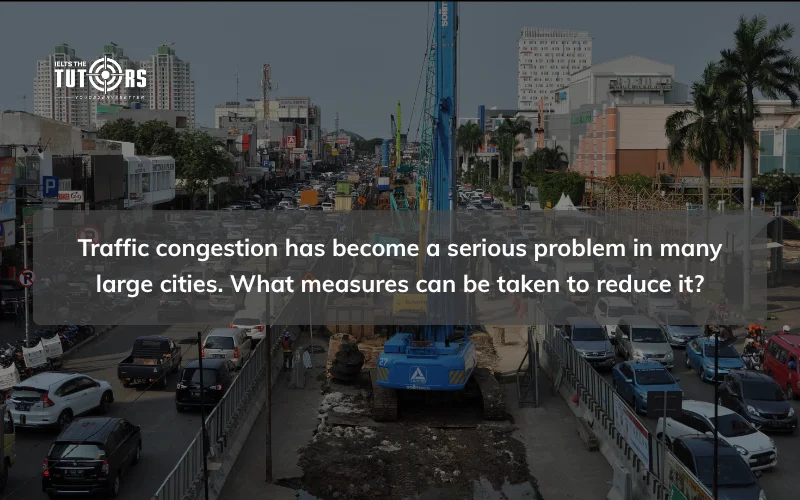
Đề bài: Traffic congestion has become a serious problem in many large cities. What measures can be taken to reduce it?
Phân tích đề bài:
Dạng bài: Solutions Essay
Keyword chủ chốt: traffic congestion, large cities, suggest some measures, reduce traffic
Hướng phát triển: Bài viết chỉ cần tập trung vào các giải pháp thay vì phân tích sâu nguyên nhân. Bạn có thể triển khai theo hai hướng chính, gồm cải thiện các phương tiện thay thế ô tô cá nhân và hạn chế nhu cầu sử dụng ô tô tại những khu vực đông đúc.
Dàn bài gợi ý:
Introduction
Paraphrase đề bài về tình trạng ùn tắc giao thông ngày càng nghiêm trọng tại các thành phố lớn.
Thesis statement: Khẳng định vấn đề có thể được cải thiện bằng việc nâng cấp giao thông công cộng và kiểm soát việc sử dụng xe cá nhân.
Body 1 – Cải thiện phương tiện thay thế
Mở rộng mạng lưới xe buýt và tàu điện.
Tăng tần suất hoạt động vào giờ cao điểm.
Giảm giá vé và áp dụng hệ thống vé liên thông.
Xây dựng làn đường dành cho xe buýt và xe đạp.
Nâng cao nhận thức về lợi ích của phương tiện xanh.
Body 2 – Hạn chế nhu cầu sử dụng ô tô
Thu phí phương tiện đi vào trung tâm thành phố trong giờ cao điểm.
Tăng phí đỗ xe tại những khu vực có giao thông công cộng thuận tiện.
Đầu tư số tiền thu được vào cơ sở hạ tầng giao thông.
Khuyến khích giờ làm linh hoạt và làm việc từ xa.
Phát triển dịch vụ đi chung xe và xe buýt trường học.
Conclusion
Khẳng định cần kết hợp việc cải thiện giao thông công cộng với các chính sách hạn chế xe cá nhân.
Chính phủ nên cung cấp lựa chọn thay thế phù hợp trước khi áp dụng quy định nghiêm ngặt.
Bài mẫu Writing task 2 topic Traffic Congestion:
Traffic congestion has become one of the most serious challenges facing large cities around the world. Although the problem cannot be solved overnight, several practical measures could significantly reduce the number of vehicles on urban roads.
The first solution is to make public transport more reliable, affordable and convenient. Many commuters choose private cars because buses and trains are overcrowded, delayed or unable to reach suburban areas. Governments should therefore expand metro and bus networks, introduce dedicated bus lanes and increase service frequency during peak hours. Lower fares and integrated ticketing systems could also encourage more people to leave their cars at home. In addition, cities should provide safe cycling lanes and secure bicycle parking so that short journeys can be made without motor vehicles. Public campaigns could further highlight the financial and environmental benefits of choosing greener forms of transport.
Another effective approach is to discourage unnecessary car use in crowded areas. Authorities could impose congestion charges on drivers entering city centres at busy times and raise parking fees in locations well served by public transport. The revenue collected should then be reinvested in transport infrastructure. Companies can also help by allowing flexible working hours or remote work, which would spread travel demand across the day and reduce pressure during rush hour. Finally, car-sharing schemes and school bus services could reduce the number of vehicles carrying only one passenger.
In conclusion, traffic congestion can be eased through a combination of better public transport, improved cycling facilities and policies that make private car use less attractive. These measures will be most successful when governments provide practical alternatives before introducing stricter charges or restrictions.
(273 words, band 7.5)
Từ vựng & collocation chủ đề Traffic Congestion
Từ vựng nên học cho IELTS Writing task 2 topic Traffic Congestion
Từ vựng
Từ loại
Ý nghĩa
traffic congestion
noun phrase
tình trạng ùn tắc giao thông
traffic volume
noun phrase
lưu lượng phương tiện
traffic flow
noun phrase
dòng lưu thông của phương tiện
road capacity
noun phrase
khả năng đáp ứng của hệ thống đường
traffic bottleneck
noun phrase
điểm nghẽn giao thông
rush hour
noun phrase
giờ cao điểm
commuter
noun
người thường xuyên đi lại giữa nhà và nơi làm việc
commuting time
noun phrase
thời gian đi lại hằng ngày
private vehicle
noun phrase
phương tiện cá nhân
car dependency
noun phrase
sự phụ thuộc vào ô tô
public transport network
noun phrase
mạng lưới giao thông công cộng
mass transit
noun phrase
hệ thống vận tải công cộng sức chứa lớn
road infrastructure
noun phrase
cơ sở hạ tầng đường bộ
congestion charge
noun phrase
phí phương tiện đi vào khu vực đông đúc
pedestrian zone
noun phrase
khu vực dành cho người đi bộ
cycle lane
noun phrase
làn đường dành cho xe đạp
urban planning
noun phrase
quy hoạch đô thị
vehicle emissions
noun phrase
khí thải từ phương tiện giao thông
carpooling
noun
việc nhiều người đi chung một ô tô
Collocation hữu ích cho topic Traffic Congestion
exceed road capacity: vượt quá khả năng đáp ứng của đường
create traffic bottlenecks: tạo ra các điểm nghẽn giao thông
increase vehicle emissions: làm tăng khí thải từ phương tiện
get stuck in traffic: bị mắc kẹt trong dòng xe
lengthen commuting times: kéo dài thời gian đi lại
reduce peak-hour traffic: giảm áp lực giờ cao điểm
shorten daily commutes: rút ngắn quãng đường/thời gian đi lại hằng ngày
ease traffic congestion: làm giảm ùn tắc giao thông
improve traffic flow: cải thiện dòng lưu thông
expand the public transport network: mở rộng mạng lưới giao thông công cộng
invest in mass transit systems: đầu tư vào hệ thống vận tải công cộng sức chứa lớn
reduce reliance on private vehicles: giảm sự phụ thuộc vào phương tiện cá nhân
encourage a shift to public transport: khuyến khích chuyển sang giao thông công cộng
introduce congestion charges: áp dụng phí vào khu vực ùn tắc
restrict private vehicle access: hạn chế phương tiện cá nhân
promote walking and cycling: khuyến khích đi bộ và đi xe đạp
Nhìn chung, IELTS Writing Task 2 topic Traffic Congestion thường yêu cầu người viết đánh giá nhiều giải pháp và cân nhắc tính khả thi của chúng trong cả ngắn hạn lẫn dài hạn. Khi làm bài, bạn nên chọn những biện pháp cụ thể, giải thích rõ cách chúng giúp giảm lượng phương tiện và tránh liệt kê quá nhiều ý.
Hy vọng những gợi ý trên sẽ giúp bạn tự tin hơn khi gặp chủ đề ùn tắc giao thông trong phòng thi. Đừng quên theo dõi IELTS The Tutors để cập nhật thêm nhiều ý tưởng hữu ích và mẹo làm bài IELTS Writing Task 2 hiệu quả nhé!
Phạm Công Danh
Cố vấn học thuật tại IELTS The Tutors
Mình hiện là cố vấn học thuật tại IELTS The Tutors với hơn 2 năm kinh nghiệm giảng dạy tiếng Anh, tập trung vào kỹ năng Speaking. Mình tin rằng những kiến thức và phương pháp mình chia sẻ sẽ giúp bạn cải thiện giao tiếp, xây dựng sự tự tin và tiến bộ rõ rệt trong hành trình luyện thi IELTS.
Bạn còn thắc mắc về bài viết này?
Bấm đăng ký tư vấn ngay để được đội ngũ cố vấn giải đáp sâu hơn về kiến thức bạn đang đọc
Bài viết này từ IELTS The Tutors sẽ tổng hợp các dạng đề, ý tưởng triển khai, bài mẫu và từ vựng IELTS Writing Task 2 topic History, giúp bạn xây dựng lập luận rõ ràng và tự tin hơn khi làm bài.
Trong bài viết này, IELTS The Tutors sẽ tổng hợp các dạng đề, ý tưởng triển khai, từ vựng và bài mẫu IELTS Writing Task 2 topic Urbanization để giúp bạn chuẩn bị bài viết dễ dàng hơn.
Trong bài viết này, IELTS The Tutors sẽ cùng bạn khám phá những dạng đề thường gặp, các ý tưởng triển khai bài viết và từ vựng hữu ích cho IELTS Writing Task 2 topic Work.
Bài viết từ IELTS The Tutors sẽ tổng hợp những ý tưởng, từ vựng và bài mẫu thường gặp trong IELTS Writing Task 2 Advertising để bạn dễ hiểu đề và biết cách triển khai bài viết hơn.
Nếu chưa biết cách triển khai một Space Exploration essay, hãy cùng IELTS The Tutors tham khảo những ý tưởng, từ vựng và bài mẫu dưới đây để hiểu đề nhanh hơn và tự tin hơn khi viết bài.