History là chủ đề quen thuộc trong IELTS Writing Task 2, thường xoay quanh vai trò của môn Lịch sử, giá trị của quá khứ và việc bảo tồn di sản. Bài viết này từ IELTS The Tutors sẽ tổng hợp các dạng đề, ý tưởng triển khai, bài mẫu và từ vựng IELTS Writing Task 2 topic History, giúp bạn xây dựng lập luận rõ ràng và tự tin hơn khi làm bài.
Các vấn đề thường gặp trong IELTS Writing task 2 topic History
Trong IELTS Writing Task 2, topic History không yêu cầu thí sinh ghi nhớ nhiều sự kiện hay mốc thời gian cụ thể. Đề bài thường tập trung vào vai trò của lịch sử trong giáo dục, giá trị của quá khứ đối với cuộc sống hiện đại và trách nhiệm bảo tồn di sản. Khi làm bài, bạn cần phân tích được lợi ích của việc học lịch sử, đồng thời cân nhắc các nhu cầu phát triển của xã hội ngày nay.
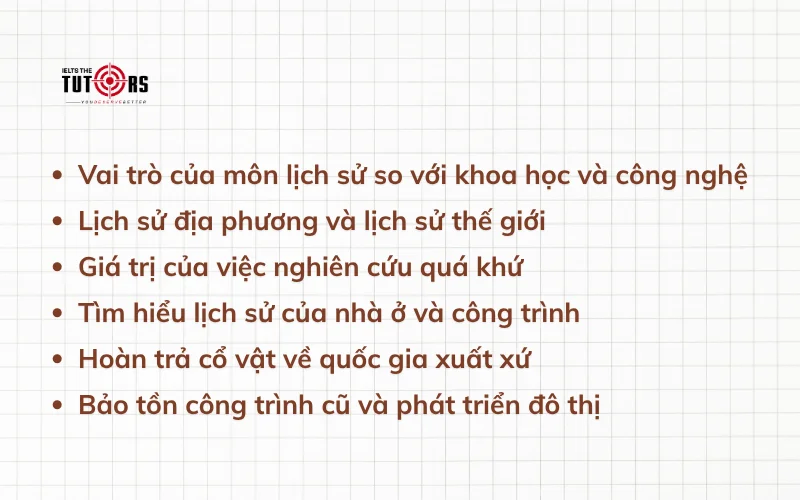
Dưới đây là một số vấn đề thường gặp trong chủ đề History:
- Thảo luận liệu History có phải là một trong những môn học quan trọng nhất hay Science and Technology nên được ưu tiên hơn trong xã hội hiện đại.
- Việc học sinh nên tập trung tìm hiểu lịch sử địa phương hay mở rộng kiến thức về các sự kiện và nền văn minh trên thế giới.
- Quan điểm cho rằng lịch sử không còn nhiều giá trị trong cuộc sống hiện đại, trong khi ý kiến khác cho rằng việc nghiên cứu quá khứ giúp con người hiểu rõ hơn về hiện tại.
- Nguyên nhân khiến ngày càng nhiều người muốn tìm hiểu nguồn gốc, tuổi đời và những người từng sinh sống trong ngôi nhà hoặc công trình của mình.
- Quyền sở hữu các hiện vật lịch sử đang được lưu giữ tại bảo tàng nước ngoài, cũng như mối liên hệ giữa cổ vật với bản sắc quốc gia, công bằng lịch sử, điều kiện bảo quản và quyền tiếp cận của công chúng quốc tế.
- Vấn đề bảo tồn các tòa nhà cũ khi đất đô thị ngày càng có giá trị, trong đó một số người cho rằng nên ưu tiên nhu cầu phát triển, còn những người khác xem các công trình này là một phần quan trọng của di sản quốc gia.
Một số đề bài mẫu trong chủ đề History
Topic History được khai thác bằng nhiều hướng khác nhau, như vai trò của môn học, ý nghĩa của quá khứ, cổ vật và các công trình lâu đời. Dưới đây là một số đề IELTS Writing task 2 tiêu biểu bạn nên tham khảo:
- Some people consider History one of the most important school subjects, while others believe Science and Technology are more important today. Discuss both views and give your opinion.
- It is more important for schoolchildren to learn about local history than world history. To what extent do you agree or disagree?
- Some people believe History tells us little or nothing, while others think studying the past helps us understand the present. Discuss both views and give your opinion.
- In some countries, increasing numbers of people want to learn about the history of the house or building in which they live. Why is this happening, and how can they conduct this research?
- Historical objects should be returned to their country of origin. To what extent do you agree or disagree?
- Some people see no reason to preserve old buildings when urban land is valuable, while others regard them as an important part of national heritage. Discuss both views and give your opinion.
Ý tưởng triển khai chủ đề History Writing task 2

Để xây dựng bài luận Writing Task 2 rõ ràng và thuyết phục hơn, bạn có thể tham khảo một số ý tưởng dưới đây khi triển khai chủ đề History:
Vai trò của môn lịch sử so với khoa học và công nghệ
Đề bài: Some people consider History one of the most important school subjects, while others believe Science and Technology are more important today. Discuss both views and give your opinion.
- Dạng bài: Discussion Essay
- Vấn đề cần làm rõ: Thảo luận cân bằng vai trò của Lịch sử và Khoa học – Công nghệ, so sánh giá trị của từng nhóm môn học, đồng thời đưa ra quan điểm cá nhân rõ ràng và nhất quán.
- Hướng kết luận phù hợp: Có thể cho rằng cả hai nhóm môn học đều cần thiết và đảm nhận những vai trò khác nhau. Lịch sử giúp người học hiểu xã hội và bản sắc văn hóa, trong khi Khoa học và Công nghệ trang bị kiến thức cho tương lai. Vì vậy, một nền giáo dục toàn diện nên cân bằng cả hai thay vì xem nhẹ một bên.
Ý tưởng triển khai bài Writing task 2 topic History:
| History Is One of the Most Important Subjects |
Science and Technology Are More Important Today |
- History helps students understand their national identity, cultural heritage and connection to previous generations.
- Learning about different societies and civilisations can broaden perspectives and reduce cultural prejudice.
- Historical events provide valuable lessons about wars, political failures, economic crises and social conflicts.
- Studying past mistakes can help societies avoid repeating harmful decisions in the future.
- History develops critical thinking by teaching students to evaluate evidence, compare sources and identify bias.
- Examining events from different viewpoints helps students understand that social and political issues are often complex.
- History provides context for current political systems, international conflicts and social changes.
- Knowledge of civil rights movements and past struggles can promote respect for freedom, equality and human rights.
- History helps citizens recognise propaganda, political extremism and threats to democratic institutions.
- Historical knowledge gives meaning and ethical context to scientific and technological progress.
- A society that focuses only on technology may develop powerful tools without understanding their moral and social consequences.
- History remains necessary for a balanced education because it develops cultural awareness, judgement and civic responsibility.
|
- Science and technology prepare students for modern careers in fields such as engineering, medicine, computing and research.
- Scientific and technical skills can improve employment prospects and support long-term economic security.
- Scientific knowledge is essential for addressing climate change, disease, food shortages and energy problems.
- Advances in medicine and public health can prevent disease, extend life expectancy and improve quality of life.
- The scientific method develops logical thinking, problem-solving skills and evidence-based decision-making.
- Digital, data and technology literacy are necessary for studying, working and participating in modern society.
- Understanding artificial intelligence, automation and digital systems helps students prepare for future changes in the workplace.
- Scientific innovation drives economic growth, creates new industries and strengthens a country’s global competitiveness.
- Practical experiments and technical projects allow students to apply knowledge rather than only learn theory.
- Science produces practical and measurable results that can directly improve people’s lives.
- The rapid pace of technological change makes scientific knowledge especially relevant to present and future challenges.
- Science and technology deserve greater attention today because they address urgent global problems and meet changing labour-market demands.
|
Lịch sử địa phương và lịch sử thế giới
Đề bài: It is more important for schoolchildren to learn about local history than world history. To what extent do you agree or disagree?
- Dạng bài: Agree or Disagree
- Vấn đề cần làm rõ: So sánh tầm quan trọng của lịch sử địa phương và lịch sử thế giới, đồng thời đưa ra lập trường rõ ràng về việc học sinh nên ưu tiên nội dung nào.
- Hướng kết luận phù hợp: Nên không đồng ý hoặc chỉ đồng ý một phần, vì cả hai đều cần thiết. Lịch sử địa phương giúp học sinh hiểu cộng đồng của mình, trong khi lịch sử thế giới mang lại góc nhìn rộng hơn trong xã hội toàn cầu hóa.
Ý tưởng triển khai bài Writing task 2 topic History:
| Local History Is More Important |
World History Is More Important |
- Local history is more relevant because it helps students understand the events, people and places that have shaped their own community.
- Nearby historical sites, family stories and local museums make learning more practical and memorable.
- Studying local history strengthens students’ sense of identity, belonging and connection to their cultural roots.
- Learning about local achievements and traditions can build community pride and encourage civic participation.
- Local history helps preserve regional customs, languages and traditional knowledge that may otherwise disappear.
- Familiar examples are often easier for younger students to understand than distant and complex global events.
- Local history can serve as a foundation before students move on to broader national and international topics.
- Students can develop practical citizenship skills by learning about local government, social issues and community development.
- A local focus allows students to conduct interviews, examine primary sources and take part in hands-on learning activities.
- However, teaching only local history may encourage bias or present an overly positive view of the community or nation.
- A balanced approach should begin with local history and gradually connect it to national and global developments.
|
- World history is essential because modern societies are closely connected, and events in one country can affect people worldwide.
- Global knowledge prepares students to study, work and cooperate with people from different cultural backgrounds.
- World history provides the wider context needed to understand how local events were influenced by wars, trade, migration and colonialism.
- Major events such as the World Wars, the Industrial Revolution and the development of human rights have shaped societies across the world.
- Studying different civilizations exposes students to a wider range of ideas, discoveries and cultural achievements.
- Comparing countries and historical systems can strengthen critical thinking and help students form more balanced judgments.
- World history can reduce narrow-mindedness by helping students appreciate different perspectives and shared human experiences.
- Understanding global conflicts, colonial legacies and political systems helps students interpret many present-day international issues.
- World history is often more useful for national examinations, university study and international education programmes.
- However, focusing only on world history may make lessons feel distant and less personally meaningful to younger learners.
- A balanced curriculum should use world history to broaden students’ perspectives while still including relevant local examples.
|
Giá trị của việc nghiên cứu quá khứ
Đề bài: Some people believe History tells us little or nothing, while others think studying the past helps us understand the present. Discuss both views and give your opinion.
- Dạng bài: Discussion Essay
- Vấn đề cần làm rõ: Thảo luận hai quan điểm về giá trị của lịch sử, đồng thời đưa ra ý kiến cá nhân về vai trò của quá khứ trong việc giúp con người hiểu hiện tại.
- Hướng triển khai phù hợp: Nên nghiêng về quan điểm thứ hai, vì lịch sử giúp con người rút kinh nghiệm, tránh lặp lại sai lầm và hiểu sâu hơn về các vấn đề chính trị, văn hóa và xã hội ngày nay.
Ý tưởng triển khai bài Writing task 2 topic History:
| History Tells Us Little or Nothing |
Studying the Past Helps Us Understand the Present |
- Modern society has changed so much that lessons from earlier periods may no longer apply directly.
- New challenges such as artificial intelligence and climate change may have no exact historical precedent.
- Historical records can be incomplete, biased or influenced by those in power.
- Each historical event occurs under unique circumstances, so comparisons with the present can sometimes be misleading.
- Some people believe practical subjects such as science, technology and job-related skills deserve more attention.
- Conflicting interpretations among historians may make the subject appear uncertain or unreliable.
- History may seem disconnected from daily life when it is taught mainly through dates, names and memorisation.
- Focusing too heavily on the past may discourage innovation and forward-looking thinking.
- The past cannot be changed, so some people prefer to focus their time and resources on future problems.
- Historical knowledge may have limited direct value in certain modern careers.
- Looking backward can sometimes encourage nostalgia rather than realistic decision-making.
- History cannot predict the future with certainty.
|
- Many current political, social and economic issues have historical causes that cannot be understood without examining the past.
- Although events do not repeat exactly, similar patterns in human behaviour, conflict and economic crises often appear again.
- Studying different sources and viewpoints teaches people to identify bias, evaluate evidence and think critically.
- Historical examples help governments and individuals recognise warning signs and avoid repeating serious mistakes.
- History develops transferable skills such as research, reasoning, argumentation and source analysis.
- Different interpretations encourage learners to consider complexity rather than accept a single explanation without question.
- Understanding how institutions, laws and social values developed helps people make sense of the systems they live under today.
- Historical knowledge provides perspective, allowing societies to adapt to change without ignoring previous successes and failures.
- Past wars, dictatorships, pandemics and environmental disasters provide practical lessons for public policy and crisis management.
- History strengthens cultural identity, preserves collective memory and helps citizens understand their rights and responsibilities.
- Learning about different cultures and historical experiences can promote empathy, tolerance and global awareness.
- It cannot provide exact predictions, but it can reveal long-term trends and help people make more informed decisions.
|
Tìm hiểu lịch sử của nhà ở và công trình
Đề bài: In some countries, increasing numbers of people want to learn about the history of the house or building in which they live. Why is this happening, and how can they conduct this research?
- Dạng bài: Two-part Question
- Vấn đề cần làm rõ: Giải thích lý do người dân muốn tìm hiểu lịch sử nơi ở và trình bày những cách tra cứu phù hợp như xem hồ sơ, tìm tài liệu, hỏi người dân lâu năm hoặc tìm kiếm trên internet.
- Hướng kết luận phù hợp: Tóm tắt những động lực chính và nhấn mạnh rằng người dân có thể kết hợp nhiều nguồn thông tin để tìm hiểu lịch sử nơi ở một cách hiệu quả.
Ý tưởng triển khai bài Writing task 2 topic History:
| Why People Want to Learn About Their Home’s History |
How They Can Research It |
- Learning about a home’s past can strengthen a person’s sense of belonging and emotional connection to the place.
- The history of a home may become part of the owner’s personal or family identity, especially when several generations have lived there.
- New residents may study local history to understand their community and feel more connected to their adopted home.
- Natural curiosity encourages people to discover who lived there before and whether any unusual events occurred.
- Researching hidden stories and previous residents can be an enjoyable hobby that offers a sense of discovery.
- Understanding the original design and materials can help owners renovate the property without damaging its character.
- Historical importance may increase a property’s appeal, market value or chances of receiving heritage protection.
- Research can help owners understand planning rules, heritage restrictions and other legal responsibilities.
- Learning about a house can also deepen people’s understanding of the development and culture of the wider neighbourhood.
- Owners may wish to preserve stories about the property and pass them on to their children or future residents.
- Greater interest in heritage, restoration and sustainable reuse has encouraged more people to explore the past of older buildings.
- Spending more time at home may lead people to notice unusual details and become curious about the building’s origins.
|
- Land registries, title deeds and tax records can reveal previous owners and changes in property ownership.
- Historical census records and city directories can show who lived in the property, along with their occupations and family details.
- Building permits, architectural plans and municipal archives can provide information about the property’s construction and renovation history.
- Local libraries, museums and historical societies often hold old maps, photographs, newspapers and other useful documents.
- Comparing historical maps and photographs with the present building can reveal how the property and surrounding area have changed.
- Examining construction materials, architectural features, inscriptions and layers of decoration can provide clues about the building’s age.
- Long-term neighbours, previous owners and local historians may provide personal memories and details that do not appear in official records.
- Online archives, genealogy websites and digitised newspapers make historical records easier to access from home.
- Local history groups and social media communities can connect researchers with people who have relevant knowledge or documents.
- Attics, basements and storage areas may contain old documents, objects or building materials left by previous occupants.
- Professional house or architectural historians can be hired when the property is particularly old, valuable or difficult to research.
- Findings should be organised into a timeline, supported by photographs and source records, and preserved for future reference.
|
Hoàn trả cổ vật về quốc gia xuất xứ
Đề bài: Historical objects should be returned to their country of origin. To what extent do you agree or disagree?
- Dạng bài: Agree or Disagree
- Vấn đề cần làm rõ: Đánh giá việc hoàn trả di vật lịch sử về quốc gia xuất xứ, đồng thời cân nhắc quyền sở hữu, nguồn gốc, điều kiện bảo tồn và những khó khăn có thể phát sinh.
- Hướng triển khai phù hợp: Nên đồng ý một phần, vì những di vật bị lấy đi trái phép hoặc trong thời kỳ xâm lược nên được hoàn trả, nhưng mỗi trường hợp vẫn cần được xem xét dựa trên điều kiện bảo tồn và giá trị chung đối với thế giới.
Ý tưởng triển khai bài Writing task 2 topic History:
| Agree |
Disagree |
- Objects proven to have been stolen, looted during wars or taken through colonial force should be returned to their rightful owners.
- Repatriation can help correct historical injustices and acknowledge the exploitation experienced by former colonies.
- Cultural objects form an important part of a nation’s heritage, identity and collective memory.
- Sacred objects, human remains and ceremonial items should be returned because they still hold spiritual meaning for local communities.
- Returning artefacts allows them to be understood within their original historical, religious and cultural setting.
- Local museums can use returned objects to educate citizens and allow communities to tell their own history.
- Repatriation can strengthen national dignity and give countries greater control over how their heritage is presented.
- The return of important objects can improve diplomatic relations and support reconciliation between countries.
- Returned artefacts may attract tourists and provide economic benefits to their countries of origin.
- International agreements increasingly support the return of objects obtained through illegal excavation, trafficking or recent conflict.
- A case-by-case approach should prioritise clearly stolen objects, human remains and items that remain central to living traditions.
- Repatriation is most appropriate when the country of origin has the facilities and expertise needed to protect the object.
|
- Objects that were legally purchased, officially gifted or acquired through documented agreements may remain in their current museums.
- The history of ownership is often complex, and incomplete records may make it difficult to identify the rightful recipient.
- Some objects have connections to several cultures and may be better viewed as part of humanity’s shared heritage.
- International museums allow large and diverse audiences to learn about different civilizations in one place.
- Comparative collections support academic research and help visitors understand links between different cultures.
- Some museums have greater conservation expertise, funding and facilities to protect fragile objects from deterioration.
- Returning artefacts to countries affected by war, political instability or weak museum infrastructure may place them at risk.
- Competing claims between countries, ethnic groups or successor states may make repatriation difficult and unfair.
- Returning every disputed object could lead to endless legal claims and significantly weaken major museum collections.
- Transportation, insurance and conservation requirements can make repatriation expensive and technically challenging.
- Long-term loans, rotating exhibitions, shared ownership and digital replicas can provide access without permanently transferring ownership.
- Temporary retention may be justified when ownership is unclear or the object would face a serious risk of damage or destruction.
|
Bảo tồn công trình cũ và phát triển đô thị
Đề bài: Some people see no reason to preserve old buildings when urban land is valuable, while others regard them as an important part of national heritage. Discuss both views and give your opinion.
- Dạng bài: Discussion Essay
- Vấn đề cần làm rõ: Thảo luận hai quan điểm về việc tái phát triển đất đô thị và bảo tồn công trình cũ, đồng thời so sánh lợi ích kinh tế với giá trị lịch sử, văn hóa và đưa ra ý kiến cá nhân rõ ràng.
- Hướng triển khai phù hợp: Nên ưu tiên bảo tồn những tòa nhà có ý nghĩa đặc biệt về lịch sử hoặc kiến trúc. Một số công trình xuống cấp và ít giá trị có thể được thay thế, nhưng không nên phá bỏ hàng loạt chỉ vì lợi ích kinh tế trước mắt.
Ý tưởng triển khai bài Writing task 2 topic History:
| No Need to Preserve Old Buildings |
Old Buildings Should Be Preserved |
- Old buildings often occupy valuable urban land that could be used for housing, offices or public facilities.
- Replacing low-rise structures with modern high-density buildings can accommodate more people and make better use of limited land.
- New developments can create jobs, attract investment and generate more tax revenue for local governments.
- Many old buildings are expensive to repair and maintain, placing pressure on public funds.
- Deteriorating structures may fail to meet modern standards for safety, accessibility and energy efficiency.
- Cities need modern infrastructure and buildings that can support current technology, transport and business needs.
- Not every old building has genuine historical or architectural value, so preservation should be selective.
- Photographs, records and museum exhibits can preserve historical information without keeping every original structure.
- Property owners should have reasonable freedom to redevelop buildings that are no longer useful or financially viable.
- A modern skyline can strengthen a city’s image and help it compete for international business and investment.
- Demolishing inefficient buildings may allow cities to replace them with greener and more functional structures.
|
- Old buildings preserve a physical connection to the past and help maintain national and cultural identity.
- Historic architecture gives cities a distinctive character that modern buildings often cannot reproduce.
- Historic buildings provide valuable lessons about architecture, social history and the way earlier generations lived.
- Traditional craftsmanship and architectural features may be permanently lost if historic buildings are demolished.
- Heritage sites can attract tourists, support local businesses and provide a lasting source of income.
- Historic districts can increase property values and attract cafés, shops, artists and other creative businesses.
- Reusing existing buildings can reduce demolition waste, save construction materials and lower carbon emissions.
- Adaptive reuse allows historic buildings to serve modern purposes while retaining their external character.
- Once an important historic building is destroyed, its authenticity cannot be fully recreated.
- Governments have a responsibility to protect important heritage and pass it on to future generations.
- Preservation and development do not have to conflict, as careful planning can combine historic areas with modern construction.
|
Phân tích đề bài và bài mẫu IELTS Writing task 2 topic History
Đề bài: Some people consider History one of the most important school subjects, while others believe Science and Technology are more important today. Discuss both views and give your opinion.
Phân tích đề bài:
- Dạng bài: Discussion Essay
- Từ khoá chính: history, science and technology, most important school subjects
- Hướng triển khai: Bài viết sẽ lần lượt làm rõ vai trò của môn Lịch sử và Khoa học – Công nghệ. Theo đó, Lịch sử giúp học sinh hiểu quá khứ, rút ra bài học và hình thành bản sắc, còn Khoa học – Công nghệ mang lại nhiều cơ hội nghề nghiệp và góp phần giải quyết các vấn đề hiện đại. Nhìn chung, cả hai đều quan trọng, nhưng mức độ ưu tiên nên phù hợp với nhu cầu thực tế của xã hội.
Dàn ý mẫu:
Introduction
- Paraphrase đề bài: Có nhiều ý kiến khác nhau về việc Lịch sử hay Khoa học và Công nghệ nên được xem là nhóm môn học quan trọng hơn.
- Thesis statement: Bài viết sẽ thảo luận cả hai quan điểm trước khi đưa ra ý kiến cá nhân.
Body Paragraph 1: Quan điểm ủng hộ History
- Lịch sử giúp học sinh hiểu quá khứ và nguyên nhân của các vấn đề hiện tại.
- Người học có thể rút kinh nghiệm từ những sai lầm trước đây.
- Môn học này góp phần xây dựng bản sắc văn hóa và phát triển tư duy phản biện.
Body Paragraph 2: Quan điểm ủng hộ Science and Technology + ý kiến cá nhân
- Khoa học và Công nghệ trang bị kiến thức cần thiết cho thị trường lao động hiện đại.
- Hai nhóm môn này góp phần giải quyết các vấn đề như biến đổi khí hậu, dịch bệnh và năng lượng.
- Cuối đoạn, khẳng định quan điểm rằng cả hai đều cần thiết nhưng Khoa học và Công nghệ nên được ưu tiên hơn đôi chút vì có tính ứng dụng cao hơn hiện nay.
Conclusion
- Tóm tắt: Lịch sử và Khoa học – Công nghệ đều đóng vai trò quan trọng trong sự phát triển của người học.
- Khẳng định: Nhà trường có thể dành nhiều sự chú ý hơn cho Khoa học và Công nghệ, nhưng vẫn cần đảm bảo môn Lịch sử giữ một vị trí phù hợp trong chương trình.
Bài mẫu Writing task 2 topic History:
Some people believe that history is one of the most important subjects at school, whereas others argue that science and technology are more valuable in the modern world. Although both areas contribute to a balanced education, I believe science and technology should receive slightly greater emphasis because of their practical importance today.
Those who support history point out that it helps students understand how societies have developed and why many present-day issues exist. By examining wars, political decisions and social change, young people can learn from past mistakes and become more thoughtful citizens. History also strengthens cultural identity by connecting learners with their national heritage and traditions. In addition, comparing sources and different interpretations encourages students to question information, recognise bias and develop critical thinking skills that are useful far beyond the classroom.
On the other hand, science and technology are directly linked to many of the challenges and opportunities people face today. Scientific knowledge drives progress in medicine, engineering, communication and renewable energy, while technological skills are increasingly required in the labour market. These subjects also help students understand issues such as climate change, public health and artificial intelligence. For this reason, I believe they should be given slightly more attention in schools. However, this should not come at the expense of history, since technical progress without cultural awareness or ethical judgement may lead to poor decisions. A sensible curriculum should therefore prioritise science and technology while continuing to provide all students with a solid historical education.
In conclusion, history develops cultural understanding and critical awareness, whereas science and technology prepare learners for future employment and practical global challenges. Both are essential, but modern schools should place somewhat greater emphasis on science and technology.
(285 words, band 8.0)
Xem thêm:
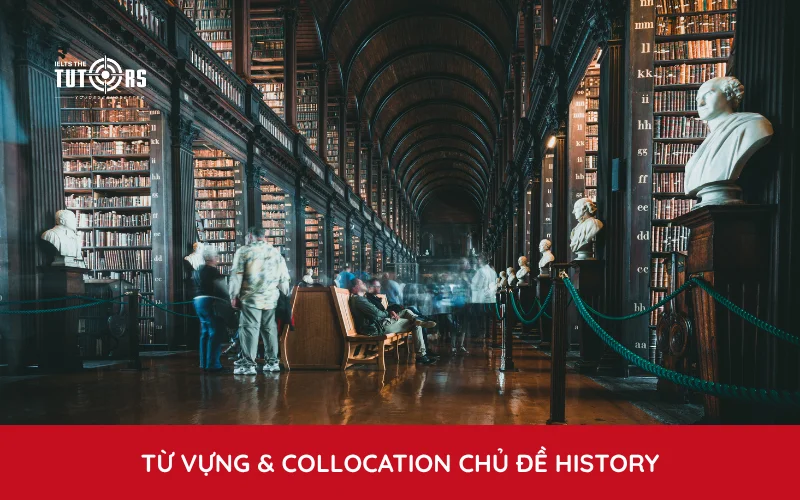
Từ vựng & collocation chủ đề History
Từ vựng nên học cho IELTS Writing Task 2 topic History
| Từ vựng |
Từ loại |
Ý nghĩa |
| historical knowledge |
noun phrase |
kiến thức lịch sử |
| historical awareness |
noun phrase |
nhận thức về lịch sử |
| historical perspective |
noun phrase |
góc nhìn dựa trên bối cảnh lịch sử |
| critical thinking |
noun phrase |
tư duy phản biện |
| practical relevance |
noun phrase |
tính hữu ích trong thực tế |
| local history |
noun phrase |
lịch sử địa phương |
| national history |
noun phrase |
lịch sử quốc gia |
| world history |
noun phrase |
lịch sử thế giới |
| cultural identity |
noun phrase |
bản sắc văn hóa |
| national identity |
noun phrase |
bản sắc dân tộc |
| global perspective |
noun phrase |
góc nhìn toàn cầu |
| past events |
noun phrase |
những sự kiện trong quá khứ |
| historical evidence |
noun phrase |
bằng chứng lịch sử |
| cultural heritage |
noun phrase |
di sản văn hóa |
| national heritage |
noun phrase |
di sản quốc gia |
| historic building |
noun phrase |
công trình có giá trị lịch sử |
| heritage conservation |
noun phrase |
hoạt động bảo tồn di sản |
| urban redevelopment |
noun phrase |
quá trình tái phát triển đô thị |
| restoration costs |
noun phrase |
chi phí trùng tu |
| land scarcity |
noun phrase |
tình trạng khan hiếm đất |
Collocation hữu ích cho IELTS Writing Task 2 topic History
| Collocation |
Ý nghĩa |
| develop historical awareness |
phát triển nhận thức về lịch sử |
| broaden students’ historical knowledge |
mở rộng kiến thức lịch sử của học sinh |
| provide a historical perspective |
mang lại góc nhìn lịch sử |
| develop critical thinking skills |
phát triển kỹ năng tư duy phản biện |
| strengthen cultural identity |
củng cố bản sắc văn hóa |
| foster a sense of belonging |
nuôi dưỡng cảm giác gắn bó với cộng đồng |
| develop a global perspective |
phát triển góc nhìn toàn cầu |
| understand relations between nations |
hiểu mối quan hệ giữa các quốc gia |
| learn from past mistakes |
rút kinh nghiệm từ những sai lầm trong quá khứ |
| avoid repeating past mistakes |
tránh lặp lại những sai lầm trong quá khứ |
| draw lessons from past events |
rút ra bài học từ các sự kiện đã qua |
| understand present-day problems |
hiểu các vấn đề trong xã hội hiện nay |
| examine historical evidence |
xem xét các bằng chứng lịch sử |
| compare different interpretations |
so sánh những cách diễn giải khác nhau |
| prioritise science and technology subjects |
ưu tiên các môn khoa học và công nghệ |
| strike a balance between different subjects |
cân bằng giữa các môn học |
| preserve historic buildings |
bảo tồn các công trình lịch sử |
| protect national heritage |
bảo vệ di sản quốc gia |
| retain a city’s cultural character |
duy trì nét văn hóa đặc trưng của thành phố |
| make efficient use of urban land |
sử dụng hiệu quả quỹ đất đô thị |
| meet growing housing demand |
đáp ứng nhu cầu nhà ở ngày càng tăng |
| balance heritage preservation with urban development |
cân bằng giữa bảo tồn di sản và phát triển đô thị |
Tóm lại, để làm tốt IELTS Writing Task 2 topic History, bạn cần xác định đúng dạng bài, chọn lập luận phù hợp và phát triển ý theo hướng rõ ràng, có giải thích. Hãy tập trung vào vai trò của lịch sử quá khứ trong giáo dục, đời sống hiện đại, bản sắc văn hóa và việc bảo tồn di sản.
Bên cạnh các ý tưởng gợi ý, bạn nên học từ vựng và collocation theo từng nhóm vấn đề, sau đó luyện áp dụng vào câu và đoạn văn hoàn chỉnh. Hy vọng những đề mẫu, dàn ý và bài mẫu trong bài viết sẽ giúp bạn tự tin hơn khi gặp chủ đề History. Đừng quên theo dõi IELTS The Tutors để cập nhật thêm nhiều tài liệu và hướng dẫn viết IELTS Writing hữu ích khác!