
Bạn đang chuẩn bị cho phần IELTS Writing Task 2 – Education topics nhưng chưa biết bắt đầu từ đâu? Bài viết này sẽ giúp bạn tìm hiểu những vấn đề phổ biến liên quan đến giáo dục, học tập và xã hội. Bên cạnh đó, IELTS The Tutors cũng sẽ cung cấp những ý tưởng triển khai cụ thể cho từng dạng bài, giúp bạn tự tin hơn khi thực hành Writing.
Các vấn đề thường gặp trong chủ đề Education Writing task 2
Trong IELTS Writing Task 2, topic Education (Giáo dục) không chỉ xoay quanh trường học hay học tập mà còn bao gồm nhiều vấn đề liên quan đến chương trình giảng dạy, phương pháp đánh giá, công nghệ và cơ hội tiếp cận giáo dục. Đề bài thường yêu cầu thí sinh phân tích hai quan điểm, đánh giá lợi ích – hạn chế hoặc đề xuất giải pháp cho một vấn đề giáo dục cụ thể.
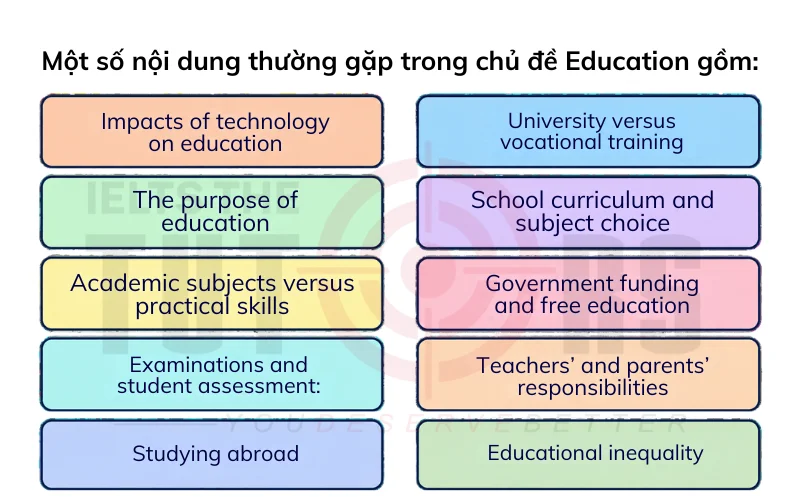
Một số nội dung thường gặp trong chủ đề Education gồm:
- Impacts of technology on education: Tác động của công nghệ, học trực tuyến và các công cụ kỹ thuật số đến chất lượng giáo dục.
- University versus vocational training: So sánh giáo dục đại học với đào tạo nghề và khả năng đáp ứng nhu cầu việc làm.
- The purpose of education: Giáo dục nên chuẩn bị cho nghề nghiệp, phát triển cá nhân hay đào tạo công dân có trách nhiệm.
- School curriculum and subject choice: Học sinh nên học tất cả các môn hay được lựa chọn môn học theo sở thích và định hướng nghề nghiệp.
- Academic subjects versus practical skills: Nhà trường nên ưu tiên kiến thức học thuật hay các kỹ năng cần thiết cho cuộc sống và công việc.
- Government funding and free education: Trách nhiệm của chính phủ trong việc tài trợ giáo dục, miễn học phí và hỗ trợ người học.
- Examinations and student assessment: Hiệu quả của thi cử so với đánh giá liên tục, bài tập, dự án và hoạt động thực hành.
- Teachers’ and parents’ responsibilities: Vai trò của giáo viên và phụ huynh trong việc giáo dục kiến thức, hành vi và đạo đức.
- Studying abroad: Lợi ích, khó khăn và những ảnh hưởng của việc du học đối với cá nhân và quốc gia.
- Educational inequality: Nguyên nhân, hậu quả và giải pháp cho sự chênh lệch về cơ hội học tập giữa các nhóm học sinh.
Tham khảo: 30 chủ đề IELTS Writing task 2 thường gặp
Ý tưởng triển khai chủ đề Education trong IELTS Writing task 2
Để xử lý tốt đề bài trong chủ đề Education, bạn cần xác định đúng vấn đề trung tâm, phân chia ý theo từng khía cạnh và phát triển mỗi luận điểm theo trình tự: ý chính – giải thích – kết quả – ví dụ. Dưới đây là một số idea được cụ thể hoá theo từng subtopic mà bạn có thể gặp trong Education topic IELTS Writing task 2:
Impacts of technology on education
Đề bài: Some people believe that advances in technology have greatly improved the quality of education, while others argue that they have created new problems for students and teachers. Discuss both views and give your own opinion.
Phân tích đề bài: Với đề bài dạng Discuss Both Views and Give Your Own Opinion này, bạn có thể đưa ra hai góc nhìn:
- View 1: Technological advances have significantly improved the quality of education.
- View 2: Technology has caused new difficulties for students and teachers.
Bạn hãy phân tích cả hai quan điểm và đưa ra ý kiến cá nhân rõ ràng như sau:
| Technology improves education | Technology creates new problems |
|
|
Dàn ý mẫu:
- Introduction: Paraphrase the topic and state your opinion.
- Body 1: Explain how technology improves access and learning quality.
- Body 2: Discuss distraction, inequality and pressure on teachers.
- Conclusion: Restate that technology is beneficial when used appropriately.
Academic subjects versus practical skills
Đề bài: Some people believe that schools should teach practical skills such as financial management, cooking and basic repairs, instead of focusing mainly on academic subjects. Do you agree or disagree?
Phân tích đề bài: Đây là dạng bài Agree or Disagree, bạn nên làm rõ quan điểm “Trường học nên ưu tiên kỹ năng thực tế hay các môn học thuật?”. Cách phát triển ideas cho subtopic Academic subjects versus practical skills như sau:
| Reasons to teach practical skills | Reasons to maintain academic subjects |
|
|
Dàn ý mẫu:
- Introduction: Paraphrase the topic and state partial agreement.
- Body 1: Explain why practical skills are useful for adult life and employment.
- Body 2: Explain why academic subjects must remain central to the curriculum.
- Conclusion: Restate that schools should combine both areas.
Government funding and free education
Đề bài: Some people believe that everyone has a right to have access to university education and the governments should make it free for all students no matter what financial background they have. To what extent do you agree or disagree?
Phân tích đề bài: Với dạng bài Agree or Disagree này, bạn nên tập trung làm rõ quan điểm “Chính phủ có nên miễn học phí đại học cho tất cả sinh viên hay không?” bằng ideas như sau:
| Reasons to support free university education | Reasons against free university education |
|
|
Dàn ý mẫu:
- Introduction: Paraphrase the question and state partial disagreement.
- Body 1: Explain the benefits of wider and more affordable access to university.
- Body 2: Discuss the financial burden and argue for targeted support.
- Conclusion: Restate that support should be based on financial need rather than provided universally.
University education versus vocational training
Đề bài: Many people go to university for academic study. More people should be encouraged to do vocational training because there is a lack of qualified workers such as electricians and plumbers. To what extent do you agree or disagree?
Phân tích đề bài: Đây là dạng đề Agree or Disagree, bạn cần nêu lên quan điểm chính về “More people should be encouraged to choose vocational training” với lý do được nêu là “Many countries lack qualified skilled workers”.
Để xử lý đề bài này, bạn hãy nêu rõ mức độ đồng ý và giải thích vì sao đào tạo nghề nên hoặc không nên được khuyến khích, cụ thể:
| Reasons to encourage vocational training | Limitations and opposing ideas |
|
|
Dàn ý mẫu:
- Introduction: Paraphrase the topic and state that you largely agree.
- Body 1: Explain how vocational training reduces skill shortages and improves employment prospects.
- Body 2: Explain why university education is still necessary for academic and professional careers.
- Conclusion: Restate that both pathways should be equally valued.
Studying abroad and international exchange
Đề bài: Some teachers think that international student exchange would be beneficial for all teenage school students. Do you think its advantages will outweigh the disadvantages?
Phân tích đề bài: Đây là dạng Advantages Outweigh Disadvantages với nội dung chính là “Chương trình trao đổi học sinh quốc tế dành cho thanh thiếu niên”. Để làm tốt bài Writing task 2 này, bạn cần phân tích cả lợi ích và hạn chế, sau đó khẳng định phía nào lớn hơn.
| Advantages | Disadvantages |
|
|
Dàn ý mẫu:
- Introduction: Paraphrase the topic and state that the benefits are greater overall.
- Body 1: Discuss language development, independence and cultural awareness.
- Body 2: Explain financial costs, homesickness and adaptation difficulties.
- Conclusion: Confirm that exchange programmes are beneficial but may not suit every student.
The purpose of education
Đề bài: Some people think that the main purposes of school is to turn children into good citizens and workers, rather to benefit them as individuals. To what extent do you agree or disagree?
Phân tích đề bài: Với dạng bài Agree or Disagree này, bạn nên nêu lên quan điểm rõ ràng về vai trò của trường học, từ đó phát triển ideas theo quan điểm ban đầu.
| Schools should benefit society | Schools should benefit individuals |
|
|
Dàn ý mẫu:
- Introduction: Paraphrase the statement and partly disagree.
- Body 1: Explain why schools should develop good citizens and capable workers.
- Body 2: Explain why individual development is equally important.
- Conclusion: State that schools should balance social needs with personal growth.
Teachers’ and parents’ responsibilities
Đề bài: Some people think that parents should teach children how to be good members of society. Others, however, believe that school is the place to learn this. Discuss both these views and give your own opinion.
Phân tích đề bài: Với dạng bài Discuss Both Views and Give Your Own Opinion, bạn nên nêu 2 góc nhìn về đề tài này:
- View 1: Parents should teach children how to behave responsibly in society.
- View 2: Schools should be responsible for teaching children social values.
Để đạt điểm cao, bạn hãy tập trung phân tích vai trò của cả gia đình và nhà trường, sau đó đưa ra quan điểm cá nhân theo hướng như sau:
| Parents’ responsibility | Schools’ responsibility |
|
|
Dàn ý mẫu:
- Introduction: Paraphrase the topic and state your opinion.
- Body 1: Explain why parents should teach children social values.
- Body 2: Discuss how schools reinforce good behaviour and social skills.
- Conclusion: Restate that parents have the main role, supported by schools.
School curriculum and subject choice
Đề bài: Children should study all subjects at school, while others think they should only study subjects they are find interesting. Discuss and give your opinion.
Phân tích đề bài: Đây là dạng Discuss Both Views and Give Your Own Opinion. Để viết tốt subtopic này, bạn hãy đưa ra hai quan điểm về:
- View 1: Children should study a wide range of subjects.
- View 2: Children should focus only on subjects they find interesting.
Hướng phát triển ideas nên tập trung vào hai vấn đề chính:
| Studying all subjects | Studying subjects of interest |
|
|
Dàn ý mẫu:
- Introduction: Paraphrase both views and state your opinion.
- Body 1: Explain the benefits of studying a broad range of subjects.
- Body 2: Discuss the advantages of allowing students to choose subjects.
- Conclusion: Support a curriculum combining compulsory and optional subjects.
Examinations and student assessment
Đề bài: Exams are the best way to assess students. To what extent do you agree or disagree?
Phân tích đề bài: Với dạng đề Agree or Disagree, bạn cần đưa ra mức độ đồng ý hoặc không đồng ý và bảo vệ quan điểm xuyên suốt bài viết.
Cách triển khai ý tưởng cho đề bài Examinations như sau:
| Reasons why exams are effective | Limitations of exams |
|
|
Dàn ý mẫu:
- Introduction: Paraphrase the topic and state that you partly disagree.
- Body 1: Explain why exams remain useful and reliable.
- Body 2: Discuss their limitations and the benefits of alternative assessment.
- Conclusion: Restate that exams should form only one part of a broader assessment system.
Educational inequality
Đề bài: Some people believe that studying at university or college is the best route to a successful career, while others think that it is better to get a job straight after school. Discuss both views and give your opinion.
Phân tích đề bài: Đây là dạng bài Agree or Disagree, bạn cần đưa ra mức độ đồng ý hoặc không đồng ý về “Có nên tạo điều kiện đặc biệt để học sinh nghèo và học sinh vùng nông thôn tiếp cận đại học hay không” và bảo về quan điểm đó đến cuối cùng.
Để đưa ra những lập luận tốt cho quan điểm của mình, bạn hãy phát triển ideas theo hai hướng sau:
| Reasons to provide special support | Possible concerns |
|
|
Dàn ý mẫu:
- Introduction: Paraphrase the topic and state that you largely agree.
- Body 1: Explain why poor and rural students need targeted support.
- Body 2: Discuss concerns about fairness and argue that standards should remain consistent.
- Conclusion: Restate that equal opportunity requires extra support, not lower expectations.
Từ vựng & collocation ăn điểm chủ đề Education
Sau khi làm quen với các dạng đề thường gặp trong chủ đề Education, dưới đây là hệ thống từ vựng và collocation phổ biến để diễn đạt ý tưởng chính xác, tự nhiên và nâng cao điểm số trong IELTS Writing Task 2:
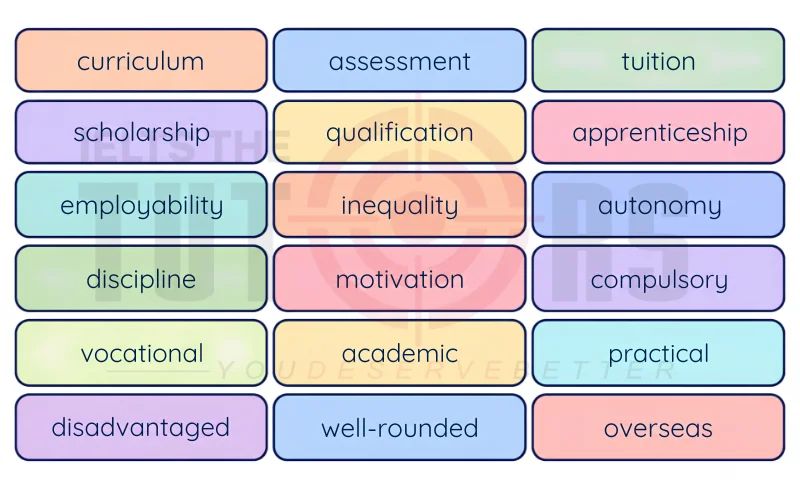
Bảng từ vựng phổ biến cho chủ đề Education
| Từ vựng | Từ loại | Ý nghĩa |
| curriculum | Noun | chương trình giảng dạy |
| assessment | Noun | sự đánh giá |
| tuition | Noun | học phí |
| scholarship | Noun | học bổng |
| qualification | Noun | bằng cấp, chứng chỉ |
| apprenticeship | Noun | chương trình học nghề có thực hành |
| employability | Noun | khả năng tìm được việc làm |
| inequality | Noun | sự bất bình đẳng |
| autonomy | Noun | tính tự chủ |
| discipline | Noun | tính kỷ luật |
| motivation | Noun | động lực học tập |
| compulsory | Adjective | bắt buộc |
| vocational | Adjective | thuộc đào tạo nghề |
| academic | Adjective | thuộc học thuật |
| practical | Adjective | mang tính thực tiễn |
| disadvantaged | Adjective | có hoàn cảnh khó khăn |
| well-rounded | Adjective | phát triển toàn diện |
| overseas | Adjective / Adverb | ở nước ngoài |
Bảng collocation phổ biến cho chủ đề Education
| Collocation | Loại cụm từ | Ý nghĩa |
| personalised learning | Cụm danh từ | phương pháp học được cá nhân hóa |
| digital literacy | Cụm danh từ | năng lực sử dụng công nghệ số |
| the digital divide | Cụm danh từ | khoảng cách trong khả năng tiếp cận công nghệ |
| enhance the learning experience | Cụm động từ | nâng cao trải nghiệm học tập |
| access educational resources | Cụm động từ | tiếp cận tài nguyên giáo dục |
| critical-thinking skills | Cụm danh từ | kỹ năng tư duy phản biện |
| government funding | Cụm danh từ | nguồn tài trợ hoặc ngân sách từ chính phủ |
| tuition-free education | Cụm danh từ | giáo dục miễn học phí |
| financial assistance | Cụm danh từ | hỗ trợ tài chính |
| allocate public funds to education | Cụm động từ | phân bổ ngân sách công cho giáo dục |
| ease the financial burden | Cụm động từ | giảm bớt gánh nặng tài chính |
| skilled workforce | Cụm danh từ | lực lượng lao động có tay nghề |
| international exchange programmes | Cụm danh từ | các chương trình trao đổi quốc tế |
| cultural exposure | Cụm danh từ | cơ hội tiếp xúc với những nền văn hóa khác |
| broaden one’s horizons | Cụm động từ | mở rộng hiểu biết và tầm nhìn |
| gain international experience | Cụm động từ | tích lũy kinh nghiệm quốc tế |
| personal development | Cụm danh từ | sự phát triển cá nhân |
| responsible citizenship | Cụm danh từ | ý thức công dân có trách nhiệm |
| develop independent thinking | Cụm động từ | phát triển tư duy độc lập |
| parental involvement | Cụm danh từ | sự tham gia của phụ huynh vào quá trình giáo dục |
| parental pressure | Cụm danh từ | áp lực từ phụ huynh |
| provide emotional support | Cụm động từ | hỗ trợ về mặt tinh thần |
| instil discipline in children | Cụm động từ | rèn luyện tính kỷ luật cho trẻ |
| a balanced curriculum | Cụm danh từ | chương trình học cân bằng |
| core subjects | Cụm danh từ | các môn học cốt lõi |
| optional subjects | Cụm danh từ | các môn học tự chọn |
| individual strengths and interests | Cụm danh từ | thế mạnh và sở thích cá nhân |
| provide a solid academic foundation | Cụm động từ | cung cấp nền tảng học thuật vững chắc |
Tóm lại, để làm tốt bài Education topic trong IELTS Writing Task 2, bạn cần biết cách triển khai ý tưởng một cách logic để không biến bài viết của mình trở nên lan man, không mục đích. Hãy chú ý đến việc phân tích đề bài, phát triển luận điểm rõ ràng và sử dụng từ vựng phù hợp để nâng cao chất lượng bài Writing.
Hy vọng rằng những thông tin và ý tưởng được chia sẻ trong bài viết sẽ là tài liệu hữu ích cho bạn trong quá trình luyện tập. Đừng quên theo dõi IELTS The Tutors để cập nhật thêm nhiều mẹo và tài liệu hữu ích về IELTS nhé!