


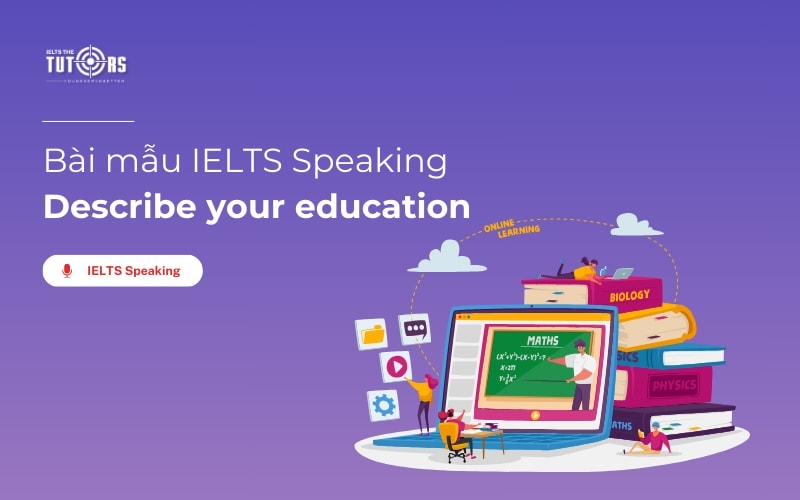
Describe your education trong IELTS Speaking là chủ đề quá quen thuộc và gần gũi đối với những em còn là học sinh, sinh viên. Mặc dù vậy, để chuẩn bị tốt cho kỳ thi thì các bạn nên củng cố và mở rộng kiến thức về từ vựng, ý tưởng cũng như cấu trúc ngữ pháp về chủ đề này.
| Key takeaways |
Từ vựng
Part 1
Part 2
Part 3
|
Từ vựng IELTS Speaking topic about education
Từ vựng về các loại trường học
| Từ vựng | Phiên âm | Loại từ | Ý nghĩa |
| Nursery school | /ˈnɜːsəri skuːl/ | Noun | Trường mầm non |
| Primary school | /ˈpraɪməri skuːl/ | Noun | Trường tiểu học |
| Secondary school | /ˈsekəndri skuːl/ | Noun | Trường trung học |
| High school | /haɪ skuːl/ | Noun | Trường trung học phổ thông |
| Boarding school | /ˈbɔːdɪŋ skuːl/ | Noun | Trường nội trú |
| Vocational school | /vəʊˈkeɪʃənl skuːl/ | Noun | Trường dạy nghề |
| Public school | /ˈpʌblɪk skuːl/ | Noun | Trường công lập |
| Private school | /ˈpraɪvət skuːl/ | Noun | Trường tư thục |
| University | /ˌjuːnɪˈvɜːsəti/ | Noun | Trường đại học |
| Community college | /kəˈmjuːnɪti ˈkɒlɪdʒ/ | Noun | Cao đẳng cộng đồng |
Từ vựng về các môn học
| Từ vựng | Phiên âm | Loại từ | Ý nghĩa |
| Mathematics | /ˌmæθəˈmætɪks/ | Noun | Toán học |
| Physics | /ˈfɪzɪks/ | Noun | Vật lý học |
| Chemistry | /ˈkemɪstri/ | Noun | Hóa học |
| Biology | /baɪˈɒlədʒi/ | Noun | Sinh học |
| History | /ˈhɪstri/ | Noun | Lịch sử |
| Geography | /dʒiˈɒɡrəfi/ | Noun | Địa lý |
| Literature | /ˈlɪtrətʃə(r)/ | Noun | Văn học |
| Economics | /ˌiːkəˈnɒmɪks/ | Noun | Kinh tế học |
| Art | /ɑːt/ | Noun | Nghệ thuật |
| Physical Education | /ˈfɪzɪkl ˌedʒuˈkeɪʃn/ | Noun | Giáo dục thể chất |
Từ vựng về các hoạt động giảng dạy
| Từ vựng | Phiên âm | Loại từ | Ý nghĩa |
| Lecture | /ˈlektʃə(r)/ | Noun | Bài giảng |
| Seminar | /ˈsemɪnɑː(r)/ | Noun | Buổi hội thảo |
| Acquire knowledge | /əˈkwaɪər ˈnɒl.ɪdʒ/ | Tiếp thu kiến thức | |
| Workshop | /ˈwɜːkʃɒp/ | Noun | Buổi thực hành |
| Group discussion | /ɡruːp dɪˈskʌʃn/ | Noun | Thảo luận nhóm |
| Homework | /ˈhəʊmwɜːk/ | Noun | Bài tập về nhà |
| Assignment | /əˈsaɪnmənt/ | Noun | Bài tập lớn |
| Assessment | /əˈsesmənt/ | Noun | Sự đánh giá |
| Presentation | /ˌpreznˈteɪʃn/ | Noun | Bài thuyết trình |
| Examination | /ɪɡˌzæmɪˈneɪʃn/ | Noun | Kỳ thi |
| Feedback | /ˈfiːdbæk/ | Noun | Phản hồi |
Các từ vựng khác về chủ đề
| Từ vựng | Phiên âm | Loại từ | Ý nghĩa |
| Curriculum | /kəˈrɪkjələm/ | Noun | Chương trình giảng dạy |
| Tuition fees | /tjuːˈɪʃn fiːz/ | Noun | Học phí |
| Scholarship | /ˈskɒləʃɪp/ | Noun | Học bổng |
| Dropout | /ˈdrɒpaʊt/ | Noun | Người bỏ học |
| Lifelong learning | /ˈlaɪflɒŋ ˈlɜːnɪŋ/ | Phrase | Học tập suốt đời |
| Educational inequality | /ˌedʒuˈkeɪʃənl ɪnɪˈkwɒləti/ | Phrase | Bất bình đẳng giáo dục |
| Critical thinking | /ˈkrɪtɪkl ˈθɪŋkɪŋ/ | Phrase | Tư duy phản biện |
| Distance learning | /ˈdɪstəns ˈlɜːnɪŋ/ | Phrase | Học từ xa |
Xem thêm:
Idioms về chủ đề Education
| Idioms | Nghĩa tiếng Việt |
| Hit the books | Học chăm chỉ |
| Pass with flying colors | Đạt kết quả xuất sắc |
| Burn the midnight oil | Thức khuya học bài |
| Learn the ropes | Học cách làm việc gì đó |
| Learn by heart | Học thuộc lòng |
| Put one’s thinking cap on | Suy nghĩ nghiêm túc về vấn đề |
| The school of hard knocks | Trường đời |
| Have a good command of sth | Am hiểu về điều gì |
| A quick learner | Người học nhanh |
| Know something inside out | Biết rõ điều gì từ trong ra ngoài |
| Teach someone a lesson | Cho ai đó một bài học (nghĩa bóng) |
| To be a bookworm | Người thích đọc sách |
| Wealth of knowledge | Lượng kiến thức lớn |
Xem thêm: Idioms for IELTS Speaking thông dụng
Bài mẫu topic education IELTS Speaking Part 1
Question 1: What do you like about your major?
What I like most about my major, computer science, is its versatility and relevance in today’s world. It allows me to develop practical skills, such as coding and problem-solving, which are highly sought after in many industries. Additionally, I enjoy the creative aspect of building software and solving complex problems. The field is constantly evolving, so there’s always something new to learn, which keeps me motivated and engaged.
Vocabulary:
- Versatility (n): tính linh hoạt, đa năng
- Relevance (n): sự liên quan, phù hợp
- Practical skills (n): kỹ năng thực tiễn
- Sought after (adj): được săn đón, có nhu cầu cao
- Creative aspect (n): khía cạnh sáng tạo
- Evolving (adj): đang phát triển, tiến hóa
- Motivated (adj): có động lực
- Engaged (adj): hứng thú, gắn bó
Question 2: What was your favorite subject in school? Why?
My favorite subject in school was definitely English. I loved reading novels and analyzing different texts, which helped me develop critical thinking skills. Moreover, learning English gave me the opportunity to explore other cultures through literature and films. The interactive teaching methods used by my English teacher also made the subject incredibly engaging for me
Vocabulary:
- Analyze (v): phân tích
- Critical thinking (n): tư duy phản biện
- Explore (v): khám phá
- Interactive (adj): tương tác
- Teaching methods (n): phương pháp giảng dạy
- Engaging (adj): hấp dẫn
Question 3: Do you think education is important? Why?
Absolutely! Education is the foundation of personal and professional growth. It equips individuals with knowledge and skills that are crucial for success in life. More importantly, education fosters a sense of curiosity and opens doors to endless opportunities. Without education, it would be extremely difficult for people to achieve their potential and contribute meaningfully to society.
- Foundation (n): nền tảng
- Personal and professional growth (n): sự phát triển cá nhân và nghề nghiệp
- Equip (v): trang bị
- Crucial (adj): quan trọng
- Foster (v): nuôi dưỡng
- Curiosity (n): sự tò mò
- Achieve one’s potential (phrase): đạt được tiềm năng
- Contribute meaningfully (phrase): đóng góp ý nghĩa
Question 4: Would you prefer to study alone or with others?
I prefer studying alone because it helps me concentrate better and work at my own pace. When I study alone, I can create a quiet and distraction-free environment, which is essential for tasks that require deep focus, like reading or solving complex problems. That said, I do occasionally enjoy group study sessions for brainstorming or discussing ideas, as it allows me to gain different perspectives and clarify any doubts. So, I would say it depends on the type of task I’m working on.
Vocabulary:
- Concentrate (v): tập trung
- At one’s own pace (phrase): theo tốc độ của bản thân
- Distraction-free (adj): không bị phân tâm
- Deep focus (n): sự tập trung cao độ
- Brainstorming (n): động não, thảo luận ý tưởng
- Perspective (n): góc nhìn, quan điểm
- Clarify (v): làm rõ
- Occasionally (adv): thỉnh thoảng
Question 5: Did you enjoy studying when you were a child?
Yes, I did. I was quite an enthusiastic learner when I was young. I particularly enjoyed subjects that allowed me to be creative, like literature and art. However, I must admit that I found some subjects, such as mathematics, quite challenging because they required a lot of memorization and logical thinking. Overall, studying was an essential part of my childhood, and I always tried to make the most of it.
Vocabulary:
- Enthusiastic (adj): nhiệt tình, hứng thú
- Learner (n): người học
- Creative (adj): sáng tạo
- Challenging (adj): đầy thách thức
- Memorization (n): việc ghi nhớ
- Logical thinking (n): tư duy logic
- Make the most of (idiom): tận dụng tối đa
Bài mẫu topic Describe your education IELTS Speaking Part 2
Question 1: Describe a school you went to as a child
You should say:
- Where it was
- What it was like
- What you liked or disliked about it
And explain how you feel about it now.
The school I attended as a child was located in a small town in the countryside. It was a government-funded primary school, with a modest campus surrounded by lush green fields. The school building was quite basic, with a few classrooms, a library, and a playground. However, despite its simplicity, it was a place where I developed a strong foundation for learning.
One thing I particularly liked about the school was the friendly atmosphere. The teachers were approachable and dedicated, always encouraging us to do our best. The playground was another highlight because we spent countless hours playing games and forming friendships.
On the downside, the school didn’t have advanced facilities like computer labs or air-conditioned classrooms, which are quite common these days. But at the time, I didn’t mind it much.
Looking back, I feel nostalgic about my time there. It wasn’t perfect, but it gave me wonderful memories and shaped who I am today.
Vocabulary:
- Countryside (n): vùng nông thôn
- Modest (adj): khiêm tốn, giản dị
- Lush (adj): xanh tươi, rậm rạp
- Foundation (n): nền tảng
- Approachable (adj): dễ gần
- Dedicated (adj): tận tâm
- Encourage (v): khuyến khích
- Highlight (n): điểm nổi bật
- Nostalgic (adj): hoài niệm
- Facilities (n): cơ sở vật chất
Question 2: Describe a subject you enjoyed studying in school
You should say:
- What the subject was
- Who taught it
- What you learned in that subject
And explain why you enjoyed it.
One subject I thoroughly enjoyed studying in school was history. It was taught by my favorite teacher, Mr. Thomas, who had a remarkable ability to bring the past to life. His storytelling skills made even the most complex historical events seem fascinating and relatable.
In his classes, we learned about significant events like the world wars, the rise and fall of empires, and the cultural achievements of ancient civilizations. Mr. Thomas often used visual aids like maps and videos to make the lessons more engaging.
What I loved most about history was how it helped me understand the present better by examining the past. It gave me a broader perspective on how societies evolve and the importance of learning from past mistakes.
Even now, history remains a topic I’m passionate about. I believe studying it has not only expanded my knowledge but also improved my critical thinking skills.
Vocabulary:
- Thoroughly (adv): hoàn toàn, kỹ lưỡng
- Remarkable (adj): đáng chú ý
- Bring to life (phrase): làm cho sống động
- Fascinating (adj): thú vị
- Relatable (adj): dễ liên hệ, gần gũi
- Significant (adj): quan trọng
- Ancient civilizations (n): các nền văn minh cổ đại
- Visual aids (n): tài liệu trực quan
- Broader perspective (n): góc nhìn rộng hơn
- Critical thinking (n): tư duy phản biện
Bài mẫu topic education IELTS Speaking Part 3
Question 1: Do you think the education system in your country needs to be improved? Why or why not?
Yes, I do believe that the education system in my country needs improvement. While the system provides a solid foundation in basic subjects, there’s a lack of emphasis on practical skills, which are crucial in today’s job market. For example, students often focus on theoretical knowledge without learning essential skills like problem-solving, communication, and critical thinking. Moreover, the curriculum is somewhat outdated, especially in terms of integrating technology. To stay competitive globally, the education system should evolve to prioritize practical learning and incorporate modern tools to better prepare students for the future.
Vocabulary:
- Solid foundation (n): nền tảng vững chắc
- Practical skills (n): kỹ năng thực tế
- Job market (n): thị trường lao động
- Theoretical knowledge (n): kiến thức lý thuyết
- Outdated (adj): lỗi thời, cũ kỹ
- Curriculum (n): chương trình giảng dạy
- Evolve (v): phát triển, tiến hóa
- Prioritize (v): ưu tiên
- Modern tools (n): công cụ hiện đại
Question 2: How do you think the education system will change in the future?
In the future, I think the education system will undergo significant changes, especially with the rapid advancement of technology. Online learning will likely become more prevalent, offering students flexible learning environments that can be tailored to their individual needs. Additionally, there will be a greater focus on personalized learning, where AI and machine learning can help assess students’ strengths and weaknesses and offer customized lessons. I also foresee more emphasis on practical skills and life skills, preparing students not just for exams, but for real-world challenges.
Vocabulary:
- Significant changes (n): thay đổi đáng kể
- Prevalent (adj): phổ biến
- Flexible learning environments (n): môi trường học linh hoạt
- Tailored (adj): được điều chỉnh theo yêu cầu
- Personalized learning (n): học cá nhân hóa
- AI (Artificial Intelligence) (n): trí tuệ nhân tạo
- Machine learning (n): học máy
- Real-world challenges (n): thử thách thực tế
Question 3: Do you think the government should spend more money on education? Why?
Absolutely. I believe the government should allocate more funds to education, as it is the foundation for a country’s future prosperity. Increased investment in education can lead to improvements in learning and teaching resources/facilities, better training for teachers, and the introduction of advanced technologies into classrooms. Moreover, it will ensure that students from all backgrounds have access to quality education. Given the significant role education plays in shaping the workforce, investing in it is essential for driving long-term economic growth and social development.
Vocabulary:
- Allocate funds (v): phân bổ ngân sách
- Foundation (n): nền tảng
- Prosperity (n): sự thịnh vượng
- Infrastructure (n): cơ sở hạ tầng
- Advanced technologies (n): công nghệ tiên tiến
- Social development (n): phát triển xã hội
- Workforce (n): lực lượng lao động
- Long-term economic growth (n): tăng trưởng kinh tế lâu dài
Question 4: What is the role of teachers in education?
Teachers play a vital role in shaping not only students’ academic knowledge but also their values and attitudes toward learning. A good teacher doesn’t just deliver content but also inspires students, helping them discover their potential and passions. They act as mentors, guiding students through challenges and fostering critical thinking. Beyond the curriculum, teachers help develop important life skills, such as communication and teamwork. In today’s fast-paced world, teachers also need to adapt to new technologies and teaching methods to keep students engaged and motivated.
Vocabulary:
- Vital role (n): vai trò quan trọng
- Shaping (v): định hình
- Academic knowledge (n): kiến thức học thuật
- Mentor (n): người hướng dẫn
- Fostering (v): khuyến khích, nuôi dưỡng
- Critical thinking (n): tư duy phản biện
- Adapt (v): thích nghi
- Engaged (adj): tham gia, gắn bó
- Motivated (adj): có động lực
Question 5: How has technology changed the way we learn?
Technology has revolutionized the way we learn, making education more accessible and interactive. With the internet, students can access a wealth of information, learn at their own pace, and explore subjects beyond the traditional curriculum. Online platforms like MOOCs (Massive Open Online Courses) have made higher education accessible to anyone with an internet connection, regardless of location. Additionally, technology facilitates more engaging learning experiences through interactive tools, videos, and simulations. It also allows for personalized learning, where students can receive instant feedback and adjust their learning paths accordingly.
Vocabulary:
- Revolutionized (v): cách mạng hóa
- Accessible (adj): có thể tiếp cận được
- Interactive (adj): tương tác
- MOOCs (Massive Open Online Courses) (n): các khóa học trực tuyến mở lớn
- Higher education (n): giáo dục đại học
- Simulations (n): mô phỏng
- Personalized learning (n): học cá nhân hóa
- Instant feedback (n): phản hồi ngay lập tức
- Learning paths (n): lộ trình học tập
Trên đây là toàn bộ từ vựng, bài mẫu về chủ đề Describe your Education IELTS Speaking mà IELTS The Tutors đã chia sẻ đến bạn. Hy vọng rằng những kiến thức trên đủ để bạn vượt qua kỳ thi một cách dễ dàng. Đừng quên cải thiện khả năng phát âm của mình để tối ưu điểm số hơn nữa nhé, chúc bạn thành công!