




Chia động từ trong ngoặc là dạng bài tập ngữ pháp xuất hiện thường xuyên trong các bài kiểm tra tiếng Anh. Với 10+ bài tập chia động từ trong ngoặc kèm đáp án được IELTS The Tutors biên soạn dưới đây, bạn sẽ vừa ôn lại kiến thức quan trọng, vừa luyện cách áp dụng thì và cấu trúc câu một cách chính xác, dễ hiểu và hiệu quả.
Tóm tắt lý thuyết chia động từ tiếng Anh
Chia động từ là gì?
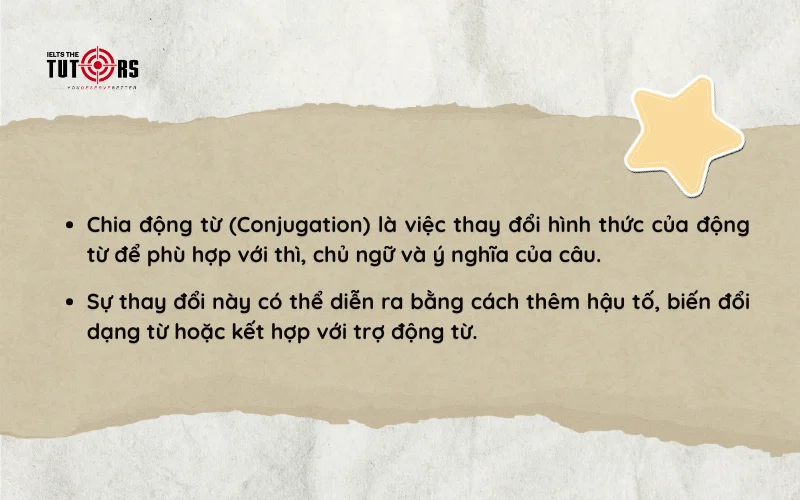
Chia động từ tiếng Anh (Conjugation) là việc thay đổi hình thức của động từ để phù hợp với thì, chủ ngữ và ý nghĩa của câu. Sự thay đổi này có thể diễn ra bằng cách thêm hậu tố, biến đổi dạng từ hoặc kết hợp với trợ động từ. Nhờ chia động từ đúng, người nói và người viết có thể diễn đạt chính xác thời điểm và tính chất của hành động.
Ví dụ: Cách động từ “learn” (học) được chia trong các thì khác nhau:
- Hiện tại đơn: learn / learns
- Quá khứ đơn: learned
- Hiện tại tiếp diễn: am/is/are learning
- Tương lai đơn: will learn
Qua các ví dụ trên, có thể thấy việc chia động từ giúp câu văn rõ nghĩa, đúng ngữ pháp và tránh gây hiểu nhầm về thời gian diễn ra của hành động.
Cách chia động từ trong tiếng Anh
Trong tiếng Anh, động từ thay đổi hình thức tùy theo thì và ngữ cảnh sử dụng. Để chia động từ chính xác, bạn cần nắm rõ mục đích sử dụng của từng thì và các dấu hiệu thường gặp đi kèm.
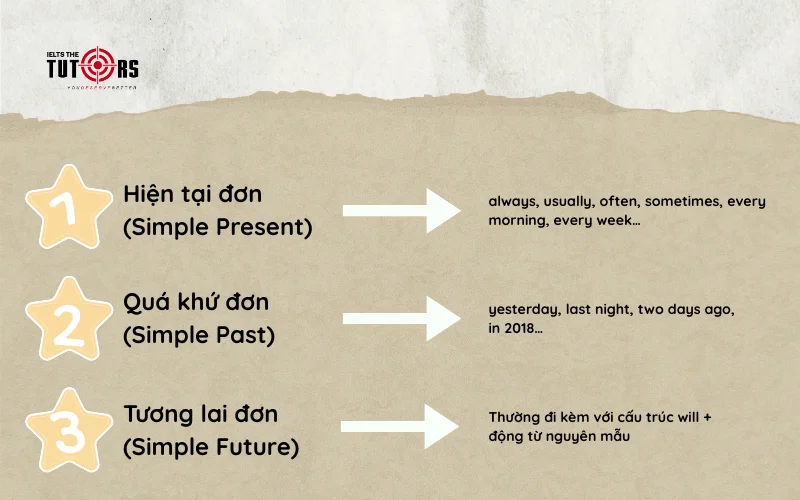
Hiện tại đơn (Simple Present): Dùng để nói về thói quen, lịch trình cố định hoặc những sự thật hiển nhiên.
- Dấu hiệu nhận biết: Thường xuất hiện với always, usually, often, sometimes, every morning, every week…
- Ví dụ: She works in an international company.
Quá khứ đơn (Simple Past): Dùng để diễn tả một hành động đã xảy ra và kết thúc hoàn toàn trong quá khứ.
- Dấu hiệu nhận biết: yesterday, last night, two days ago, in 2018…
- Ví dụ: We visited Da Nang during the summer holiday.
Tương lai đơn (Simple Future): Dùng để nói về một hành động sẽ xảy ra trong tương lai, thường là quyết định tại thời điểm nói hoặc dự đoán.
- Dấu hiệu nhận biết: Thường đi kèm với cấu trúc will + động từ nguyên mẫu
- Ví dụ: I will call you after the meeting.
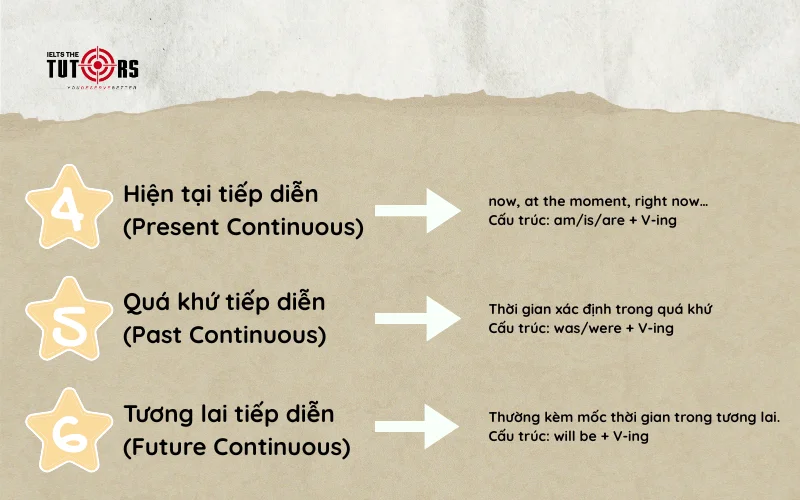
Hiện tại tiếp diễn (Present Continuous): Dùng để diễn tả một hành động đang diễn ra ngay lúc nói hoặc xung quanh thời điểm nói.
- Dấu hiệu nhận biết: Thường đi với now, at the moment, right now…
- Cấu trúc: am/is/are + V-ing.
- Ví dụ: They are discussing the project right now.
Quá khứ tiếp diễn (Past Continuous): Dùng để nói về một hành động đang diễn ra tại một thời điểm xác định trong quá khứ, thường bị một hành động khác xen vào.
- Dấu hiệu nhận biết: Thời gian xác định trong quá khứ
- Cấu trúc: was/were + V-ing
- Ví dụ: I was driving home when it started to rain.
Tương lai tiếp diễn (Future Continuous): Dùng để diễn tả một hành động sẽ đang diễn ra tại một thời điểm cụ thể trong tương lai.
- Dấu hiệu nhận biết: Thường kèm mốc thời gian trong tương lai.
- Cấu trúc: will be + V-ing.
- Ví dụ: At 9 p.m. tonight, she will be preparing for her presentation.
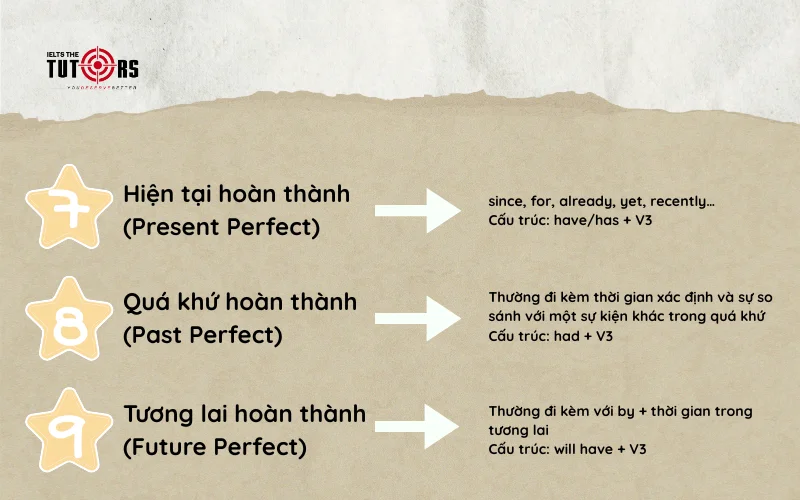
Hiện tại hoàn thành (Present Perfect): Dùng để nói về hành động đã xảy ra trong quá khứ nhưng kết quả vẫn còn ảnh hưởng đến hiện tại, hoặc không nêu rõ thời điểm xảy ra.
- Dấu hiệu nhận biết: Thường đi kèm since, for, already, yet, recently…
- Cấu trúc: have/has + V3
- Ví dụ: He has finished his report, so he can leave early.
Quá khứ hoàn thành (Past Perfect): Dùng để diễn tả một hành động đã xảy ra trước một hành động khác trong quá khứ.
- Dấu hiệu nhận biết: Thường đi kèm thời gian xác định và sự so sánh với một sự kiện khác trong quá khứ
- Cấu trúc: had + V3
- Ví dụ: She had booked the tickets before the prices increased.
Tương lai hoàn thành (Future Perfect): Dùng để nói về một hành động sẽ hoàn thành trước một mốc thời gian xác định trong tương lai.
- Dấu hiệu nhận biết: Thường đi kèm với by + thời gian trong tương lai
- Cấu trúc: will have + V3
- Ví dụ: By the end of this month, they will have completed the training course.
Dưới đây là bảng tóm tắt công thức chia động từ theo các thì đã được hướng dẫn ở trên:
|
Thì |
Công thức |
Ví dụ với work |
|
Hiện tại đơn |
V / V-s |
work → works |
|
Hiện tại tiếp diễn |
am/is/are + V-ing |
working |
|
Hiện tại hoàn thành |
have/has + V3 |
worked |
|
Hiện tại hoàn thành tiếp diễn |
have/has been + V-ing |
been working |
|
Quá khứ đơn |
V-ed / V2 |
worked |
|
Quá khứ tiếp diễn |
was/were + V-ing |
was working |
|
Quá khứ hoàn thành |
had + V3 |
had worked |
|
Quá khứ hoàn thành tiếp diễn |
had been + V-ing |
had been working |
|
Tương lai đơn |
will + V |
will work |
|
Tương lai tiếp diễn |
will be + V-ing |
will be working |
|
Tương lai hoàn thành |
will have + V3 |
will have worked |
|
Tương lai hoàn thành tiếp diễn |
will have been + V-ing |
will have been working |
Bài tập chia động từ trong ngoặc kèm đáp án chi tiết
Bài tập 1: Chia động từ trong ngoặc và điền vào chỗ trống
1. She usually ______ (wake) up early on weekdays.
2. At this time tomorrow, we ______ (fly) to Singapore.
3. If he had more money, he ______ (buy) a bigger house.
4. They ______ (not/finish) their homework yet.
5. The train ______ (arrive) at the station at 6 a.m. every day.
6. He ______ (work) as a teacher for more than 15 years.
7. We ______ (watch) TV when the power suddenly went out.
8. She ______ (never/see) snow before she moved abroad.
9. Water ______ (boil) at 100 degrees Celsius.
10. I think she ______ (pass) the tomorrow’s exam easily.
Bài tập 2: Chọn đáp án phù hợp với động từ trong ngoặc
1. She (cook) _______ dinner in the kitchen right now.
A. cooks
B. cooked
C. is cooking
D. has cooked
2. We (live) _______ in this city since 2018.
A. live
B. lived
C. are living
D. have lived
3. By the time the movie started, they (find) _______ their seats.
A. will find
B. had found
C. have found
D. find
4. He usually (go) _______ jogging in the morning.
A. goes
B. went
C. is going
D. has gone
5. I (never/try) _______ sushi before last year.
A. never try
B. have never tried
C. had never tried
D. didn’t never try
6. Listen! The baby (cry) _______.
A. cries
B. cried
C. is crying
D. has cried
7. They (work) _______ on this project for three months.
A. work
B. worked
C. are working
D. have been working
8. She (not/understand) _______ the question yesterday.
A. doesn’t understand
B. isn’t understanding
C. didn’t understand
D. hasn’t understood
9. The sun (rise) _______ in the east.
A. rose
B. rises
C. is rising
D. has risen
10. We (plan) _______ to visit Hue next summer.
A. plan
B. planned
C. are planning
D. have planned
Bài tập 3: Chia động từ trong ngoặc theo thì
1. She usually (wake) _________ up at 6 a.m. every day.
2. Listen! The baby (cry) _________ in the next room.
3. We (not/see) _________ him since last month.
4. They (visit) _________ their grandparents last weekend.
5. I (work) _________ on my assignment right now.
6. He (live) _________ in this city for more than ten years.
7. My sister often (cook) _________ dinner for the family.
8. When I arrived, the meeting _________ already (start) _________.
9. _________ she (finish) _________ her homework yet?
10. They usually (go) _________ to the gym after work.
Bài tập 4: Chia động từ trong ngoặc để hoàn thành đoạn hội thoại
Anna: Hi Mark! What do you usually 1. (do) ______ after school?
Mark: Hi Anna! I often 2. (go) ______ to the gym or 3. (meet) ______ my friends. What about you?
Anna: I usually 4. (stay) ______ at home and 5. (study) ______. But today, I 6. (prepare) ______ for a group project.
Mark: Really? We 7. (have) ______ a presentation tomorrow, right?
Anna: Yes. Our teacher 8. (ask) ______ us to finish it by tomorrow morning.
Mark: I 9. (not/start) ______ mine yet, but I 10. (work) ______ on it tonight.
Anna: That’s good. By the way, we 11. (meet) ______ at the library later?
Mark: Sure. I 12. (be) ______ free after 6 p.m.
Anna: Great! The library 13. (close) ______ at 9 p.m., so we should be on time.
Mark: No problem. I 14. (see) ______ you there.
Anna: Okay! I 15. (look forward) ______ to studying together.
Bài tập 5: Chia động từ trong ngoặc để hoàn thành đoạn hội thoại
Linh: Hi Nam! You look excited. Where 1. (go) ______ you these days?
Nam: Hi Linh! I 2. (plan) ______ a trip to Da Nang. I 3. (never / visit) ______ that city before.
Linh: Really? When 4. (you / leave) ______?
Nam: I 5. (leave) ______ this Friday evening. I already 6. (book) ______ my flight.
Linh: That’s great! Who 7. (travel) ______ with you?
Nam: My best friend. He 8. (finish) ______ his exams yesterday, so now he’s free.
Linh: Nice! What 9. (you / do) ______ when you arrive there?
Nam: First, we 10. (check in) ______ at the hotel. Then we 11. (explore) ______ the city.
Linh: Sounds fun. How long 12. (you / stay) ______ there?
Nam: We 13. (stay) ______ for four days. I’m sure we 14. (have) ______ a great time.
Linh: I hope the weather 15. (be) ______ good for you!
Bài tập 6: Chia động từ trong ngoặc để hoàn thành đoạn văn
When the Internet (1. become) ______ popular in the late 20th century, it completely changed the way people (2. communicate) ______. Before that, most information (3. share) ______ through books, newspapers, or face-to-face conversations. Today, people often use the Internet for (4. search) ______ information, (5. send) ______ emails, and (6. connect) ______ with others around the world. Over the past few years, social media platforms (7. play) ______ an important role in shaping modern communication, and they continue (8. influence) ______ how people interact every day.
Bài tập 7: Chia động từ trong ngoặc để hoàn thành đoạn văn
Last weekend, my family and I (1. decide) ______ to take a short trip to the countryside. We (2. leave) ______ the city early in the morning because we (3. want) ______ to avoid heavy traffic. While we (4. drive) ______ along the highway, the sun (5. rise) ______ slowly in the sky.
When we (6. arrive) ______ at the small village, the local people (7. prepare) ______ food for a traditional festival. By the time we (8. reach) ______ the village center, the celebration already (9. begin) ______. We (10. enjoy) ______ the music and food so much that we (11. forget) ______ about the time.
After we (12. spend) ______ the whole afternoon there, we (13. return) ______ home in the evening, feeling relaxed and happy.
Bài tập 8: Chia dạng đúng của động từ trong ngoặc
1. By the time I arrive at work, my boss usually ______ (checks / has checked) the schedule.
2. When I was a child, I ______ (played / have played) outside every afternoon.
3. She ______ (doesn’t finish / hasn’t finished) her homework yet.
4. By the time the train arrived, many passengers already ______ (waited / had waited) for over an hour.
5. We ______ (have lived / lived) in this town since 2015.
6. When the phone rang, I ______ (was cooking / had cooked) dinner.
7. He ______ (has never visited / never visited) Japan before his business trip last year.
8. By the end of the lesson, the students ______ (understood / had understood) the main idea.
Bài tập 9: Viết lại câu ở dạng bị động thì hiện tại đơn
1. English / teach / in many countries.
2. This room / clean / every day.
3. Rice / grow / mainly in Asia.
4. The results / announce / at the end of the meeting.
5. These products / export / to Europe.
6. The tickets / sell / online.
7. A lot of coffee / drink / in the morning.
8. The museum / open / to the public on weekends.
Bài tập 10: Cho dạng đúng của động từ trong ngoặc
1. It (seem) __________ obvious that online learning (play) __________ an important role in modern education.
2. My parents usually (wake) __________ up early and (go) __________ for a walk in the morning.
3. This shop (open) __________ at 8 a.m. and (close) __________ at 10 p.m. every day.
4. The reason why he (not drink) __________ coffee is that he (prefer) __________ tea.
5. Most students in my class (be) __________ very hardworking and they often (help) __________ each other with homework.
3. Đáp án bài tập chia động từ trong ngoặc
Bài tập 1:
1. wakes
2. will be flying
3. would buy
4. haven’t finished
5. arrives
6. has worked
7. were watching
8. had never seen
9. boils
10. will pass
Bài tập 2:
1. C. is cooking
2. D. have lived
3. B. had found
4. A. goes
5. C. had never tried
6. C. is crying
7. D. have been working
8. C. didn’t understand
9. B. rises
10. C. are planning
Bài tập 3:
1. wakes
2. is crying
3. haven’t seen
4. visited
5. am working
6. has lived
7. cooks
8. had already started
9. Has she finished
10. go
Bài tập 4:
1. do
2. go
3. meet
4. stay
5. study
6. am preparing
7. have
8. asked
9. haven’t started
10. will work / am going to work
11. are meeting / will meet
12. will be
13. closes
14. will see
15. am looking forward
Bài tập 5:
1. are going
2. am planning
3. have never visited
4. are you leaving
5. am leaving
6. have booked
7. is traveling
8. finished
9. will you do / are you going to do
10. will check in / are going to check in
11. will explore / are going to explore
12. are you staying
13. are staying
14. will have
15. is
Bài tập 6:
1. became
2. communicated
3. was shared
4. searching
5. sending
6. connecting
7. have played
8. to influence / influencing
Bài tập 7:
1. decided
2. left
3. wanted
4. were driving
5. was rising
6. arrived
7. were preparing
8. reached
9. had begun
10. enjoyed
11. forgot
12. had spent
13. returned
Bài tập 8:
1. has checked
2. played
3. hasn’t finished
4. had waited
5. have lived
6. was cooking
7. had never visited
8. had understood
Bài tập 9:
1. English is taught in many countries.
2. This room is cleaned every day.
3. Rice is grown mainly in Asia.
4. The results are announced at the end of the meeting.
5. These products are exported to Europe.
6. The tickets are sold online.
7. A lot of coffee is drunk in the morning.
8. The museum is opened to the public on weekends.
Bài tập 10:
1. seems – plays
2. wake – go
3. opens – closes
4. doesn’t drink – prefers
5. are – help
Tóm lại, bài tập chia động từ trong ngoặc không chỉ giúp bạn ghi nhớ các thì tiếng Anh mà còn rèn khả năng vận dụng ngữ pháp một cách chính xác trong từng ngữ cảnh. Thông qua 10+ bài tập kèm đáp án chi tiết trên, IELTS The Tutors hy vọng bạn đã nắm chắc cách nhận diện thì, chia động từ đúng và hạn chế những lỗi sai thường gặp. Hãy luyện tập thường xuyên để sử dụng tiếng Anh tự tin và hiệu quả hơn trong học tập cũng như các kỳ thi.