



IELTS Writing task 2 topic Language thumbnail

Language là một chủ đề khá rộng trong IELTS Writing Task 2, với nhiều đề bài xoay quanh tiếng Anh toàn cầu, tiếng mẹ đẻ, bản sắc văn hóa và việc học ngoại ngữ từ sớm. Nếu chưa biết nên bắt đầu từ đâu, bạn hãy cùng IELTS The Tutors tham khảo những ý tưởng, từ vựng và bài mẫu IELTS Writing Task 2 topic Language dưới đây để hiểu đề nhanh hơn và triển khai bài viết thuyết phục hơn.

Các vấn đề thường gặp trong IELTS Writing task 2 topic Language

Trong IELTS Writing Task 2, topic Language không yêu cầu thí sinh có kiến thức chuyên sâu về ngôn ngữ học mà chủ yếu tập trung vào vai trò của ngôn ngữ trong giao tiếp, giáo dục và việc duy trì bản sắc văn hóa.

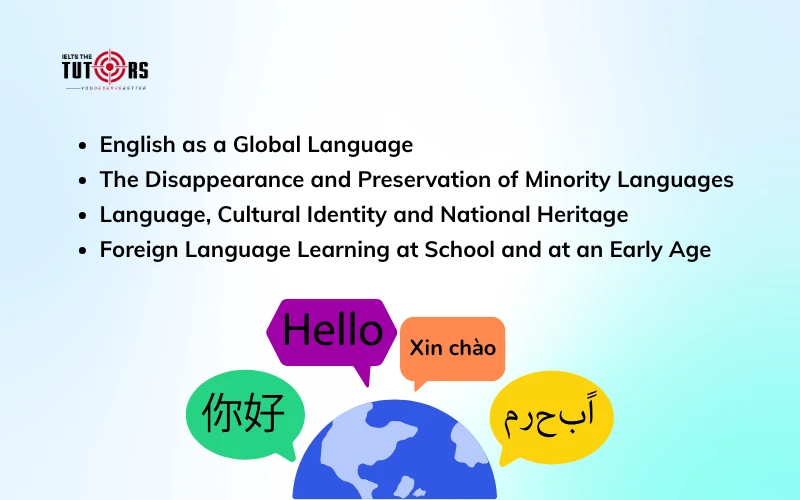
Dưới đây là những vấn đề thường gặp trong chủ đề Language Writing task 2:

  • Sự phổ biến của tiếng Anh có thể khiến các ngôn ngữ địa phương bị xem nhẹ và làm giảm sự đa dạng ngôn ngữ.
  • Nguyên nhân và hậu quả của việc các ngôn ngữ ít người sử dụng dần biến mất do toàn cầu hóa, di cư và ảnh hưởng của các ngôn ngữ lớn.
  • Vai trò của ngôn ngữ trong việc lưu giữ lịch sử, phong tục và bản sắc văn hóa của một cộng đồng.
  • Việc trẻ em nên bắt đầu học ngoại ngữ từ bậc tiểu học hay chờ đến khi lớn hơn.
Các vấn đề thường gặp trong IELTS Writing task 2 topic Language

Ý tưởng triển khai chủ đề Language Writing task 2 

English as a Global Language

Đề bài: Scientists predict that people around the world may eventually choose to communicate in the same global language. Do you think this is a positive or negative development?

Dạng bài: Positive or Negative Development

Yêu cầu đề bài:

  • Vấn đề chính: Việc toàn thế giới sử dụng chung một ngôn ngữ là xu hướng tích cực hay tiêu cực?
  • Đưa ra lập trường: tích cực, tiêu cực hoặc cân bằng giữa cả lợi ích và hạn chế.
  • Phân tích tác động của một ngôn ngữ chung đối với giao tiếp, giáo dục, kinh tế và hợp tác quốc tế.
  • Đồng thời xem xét nguy cơ làm suy giảm sự đa dạng ngôn ngữ, bản sắc văn hóa và các ngôn ngữ bản địa.
  • Hướng triển khai phù hợp: Nên chọn quan điểm cân bằng, thừa nhận lợi ích trong giao tiếp toàn cầu nhưng nhấn mạnh sự cần thiết của việc bảo vệ ngôn ngữ và văn hóa địa phương.

Ý tưởng triển khai topic Language Writing task 2:

  • Positive Aspects of a Global Language
Enhanced Global Communication Economic and Educational Advantages
  • A global language can remove many communication barriers between countries. People can communicate more directly, avoid misunderstandings and rely less on translation services. International travel and mobility also become easier.
  • It can make international cooperation more effective. Governments and organisations can work together more easily on issues such as climate change, public health and emergency response. Diplomatic communication may also become faster and clearer.
  • A common language may strengthen global understanding. It can encourage cultural exchange, international friendship and a stronger sense of global citizenship. It may also reduce prejudice based on language differences.
  • It can support technology and innovation. Developers, researchers and online communities can share ideas, documentation and new discoveries more quickly. International collaboration on software and scientific projects also becomes easier.
  • A shared language can support international business and trade. It simplifies negotiations, lowers translation costs, encourages multinational partnerships and helps create a more connected global market.
  • Students can access academic resources, online courses and research from around the world. They may also study abroad more easily because language is no longer a major barrier.
  • A global language can save time and money. People may not need to learn several foreign languages, while governments and organisations can reduce spending on translation and administrative processes.
  • Career opportunities may increase because people can apply for jobs in different countries without major language restrictions. Remote work and access to international job markets may also become more widely available.
  • Negative Aspects of a Global Language
Cultural and Linguistic Loss Inequality and Practical Concerns
  • The widespread use of one language may threaten minority languages. Over time, unique forms of expression, grammar and vocabulary could disappear, reducing the world’s linguistic diversity.
  • Local languages are closely connected to cultural identity. When they decline, traditional stories, songs, customs and values may also be weakened or lost. This can lead to a more uniform global culture.
  • Different languages reflect different ways of understanding the world. If many languages disappear, some unique ideas and cultural perspectives may become harder to express.
  • Indigenous languages often preserve traditional knowledge about medicine, nature and local history. When these languages disappear, valuable knowledge and oral traditions may be lost as well.
  • Native speakers may have an unfair advantage in education, employment and international communication. Non-native speakers may need years of training but still struggle to compete on equal terms.
  • Adopting a global language would be difficult for elderly people, rural communities and those with limited access to education. The transition could also create communication gaps between generations.
  • Some communities may resist the use of a global language because they see it as a threat to national pride and local identity. It may also be viewed as a form of cultural dominance.
  • The transition would require major investment in education, teacher training, public signs, legal documents and media. Productivity could also fall while people learn and adapt to the new language.

The Disappearance and Preservation of Minority Languages

Đề bài: Learning English at school is often considered more important than learning local languages, placing some local languages at risk of extinction. Is it important for everyone to learn English? How can local languages be protected?

Dạng bài: Two-part Question

Yêu cầu đề bài:

  • Câu hỏi 1: Đánh giá liệu tiếng Anh có thực sự cần thiết đối với tất cả mọi người hay không.
  • Câu hỏi 2: Đề xuất các biện pháp cụ thể để bảo vệ những ngôn ngữ địa phương có nguy cơ biến mất.
  • Cân nhắc vai trò của tiếng Anh trong giao tiếp quốc tế và giá trị của ngôn ngữ bản địa đối với văn hóa.
  • Các giải pháp bảo tồn cần rõ ràng và khả thi, chẳng hạn như đưa ngôn ngữ địa phương vào trường học, hỗ trợ truyền thông bằng tiếng bản địa và khuyến khích người trẻ sử dụng trong đời sống hằng ngày.
  • Hướng kết luận phù hợp: Tiếng Anh quan trọng nhưng không cần thiết với mọi người ở cùng một mức độ; vì vậy, các quốc gia nên vừa phát triển năng lực tiếng Anh vừa bảo tồn ngôn ngữ địa phương.

Ý tưởng triển khai topic Language Writing task 2:

  • Is It Important for Everyone to Learn English?
English Is Important for Most People It Depends on Individual Needs
  • English is widely used in international communication and makes it easier for people from different countries to work together. It is also useful for participating in the global economy.
  • A large amount of scientific research, academic material and online information is available in English. Many universities and international conferences also require English proficiency.
  • English can improve access to multinational companies, international job markets and higher-paying positions.
  • Much of the digital world uses English, including software, websites, apps and programming languages. English skills can therefore support digital literacy.
  • Overall, English is a valuable skill for education, employment and international communication.
  • English is not equally useful in every job. Farmers, craftspeople and other workers who mainly serve local communities may rarely need it.
  • Learning English requires considerable time and effort. For some people, vocational training or stronger skills in their native language may be more useful.
  • Older people and those living in remote areas may have little contact with English speakers, so the practical benefits can be limited.
  • Making English compulsory for everyone may reduce the status of local languages and place further pressure on minority languages.
  • Its importance depends on a person’s career, location, age and daily needs, so it should not always be treated as essential for everyone.
  • How Can Local Languages Be Protected?
Education and Institutional Support Community and Cultural Initiatives
  • Schools can offer bilingual education and teach both English and the local language. Where possible, the mother tongue can also be used as a language of instruction.
  • Governments can recognise minority languages officially and provide public services in these languages. They can also fund preservation agencies and language research.
  • Digital tools such as learning apps, online dictionaries and social media content can make local languages more accessible, especially to young people. Endangered languages should also be recorded and archived.
  • Universities and research institutions can document endangered languages by producing dictionaries, grammar books and teaching materials.
  • Long-term protection requires support from schools, governments and researchers.
  • Communities can organise after-school classes, language immersion programmes and activities in which older speakers pass the language on to younger generations.
  • Television, radio, music, films, theatre and cultural festivals can encourage people to use local languages in everyday life.
  • Public campaigns can build pride in local identity, reduce the stigma attached to minority languages and present multilingualism as a strength.
  • Governments and businesses can create jobs that require local language skills, support native-language publications and develop cultural tourism.
  • A language is more likely to survive when families and communities continue using it in daily communication.

Language, Cultural Identity and National Heritage

Đề bài: Some people think that students must travel to or live in another country in order to learn its language and customs properly. To what extent do you agree or disagree?

Dạng bài: Agree or Disagree

Yêu cầu đề bài:

  • Vấn đề chính: Học sinh có nhất thiết phải đi du lịch hoặc sống ở nước ngoài mới có thể học tốt ngôn ngữ và phong tục hay không?
  • Cần chú ý hai từ khóa “must” và “properly” để xác định liệu trải nghiệm ở nước ngoài có phải điều kiện bắt buộc hay chỉ là một lợi thế.
  • Đưa ra lập trường rõ ràng về mức độ đồng ý với quan điểm trên.
  • Phân tích lợi ích của việc sống hoặc du lịch ở nước ngoài đối với khả năng sử dụng ngôn ngữ và hiểu văn hóa.
  • So sánh với các cách học khác như lớp học, tài liệu trực tuyến, giao tiếp với người bản xứ và môi trường học trong nước.
  • Hướng triển khai phù hợp: Nên không đồng ý một phần vì sống ở nước ngoài mang lại nhiều lợi ích nhưng không phải điều kiện bắt buộc để học ngôn ngữ và văn hóa hiệu quả.

Ý tưởng triển khai topic Language Writing task 2:

Traveling or living abroad is essential Living abroad is beneficial but not essential
  • Learners are constantly exposed to native speakers, which helps them improve pronunciation, intonation and natural expressions.
  • Daily communication forces learners to use the language actively instead of relying on their first language. This can improve confidence and fluency more quickly.
  • Real-life situations help learners understand how formal and informal language is used in different contexts. They can also pick up body language, accents and regional expressions.
  • Living abroad allows learners to experience local customs, traditions and social behaviour directly rather than only reading about them.
  • Building relationships with local people provides a deeper understanding of their values, beliefs and everyday lives.
  • Firsthand experience helps learners notice cultural details and unwritten social rules that are difficult to explain in textbooks.
  • Direct contact with another culture can challenge stereotypes, reduce misunderstandings and develop greater empathy.
  • Continuous exposure and the need to communicate every day can speed up language learning and make new knowledge easier to remember.
  • Learners can practise with native speakers through video calls, language exchange apps and online tutoring platforms.
  • Films, television programmes, podcasts, books and social media provide easy access to authentic language without the need to travel.
  • High-quality language courses, native-speaking teachers and immersion programmes may already be available in the learner’s home country.
  • Culture can also be explored through documentaries, literature, cultural events and international communities at home.
  • International travel and overseas study can be too expensive for many learners, while scholarships are limited.
  • Family responsibilities, health conditions, visa restrictions or work commitments may prevent some people from living abroad.
  • Not every learner needs native-level fluency. Basic communication and professional language skills can be developed through regular study at home.
  • A combination of home study, short trips, summer programmes and exchange courses may be more practical than living abroad for a long period.

Foreign Language Learning at School and at an Early Age

Đề bài: Some people believe that schools should give greater priority to foreign languages than to students’ mother tongues. To what extent do you agree or disagree?

Dạng bài: Agree or Disagree

Yêu cầu đề bài:

  • Vấn đề chính: Trường học có nên dành mức độ ưu tiên cao hơn cho ngoại ngữ so với tiếng mẹ đẻ của học sinh hay không?
  • Từ khóa cần chú ý: greater priority nhấn mạnh việc so sánh mức độ quan trọng giữa hai nhóm ngôn ngữ.
  • Cần đưa ra lập trường rõ ràng về việc có nên ưu tiên ngoại ngữ hơn tiếng mẹ đẻ.
  • Phân tích vai trò của ngoại ngữ trong học tập và hội nhập, đồng thời làm rõ giá trị của tiếng mẹ đẻ đối với tư duy, giao tiếp và bản sắc văn hóa.
  • Xem xét hậu quả nếu nhà trường quá chú trọng một bên và xem nhẹ bên còn lại.
  • Hướng triển khai phù hợp: Nên hoàn toàn không đồng ý, vì ngoại ngữ rất quan trọng nhưng không nên được đặt cao hơn tiếng mẹ đẻ trong chương trình học.

Ý tưởng triển khai topic Language Writing task 2:

Agree Disagree Consequences
  • Foreign language skills are increasingly important in a globalised job market. They help students compete for international study and employment opportunities.
  • Speaking another language can improve employment prospects. Multinational companies often value multilingual workers, while some international roles offer higher salaries and opportunities to work abroad.
  • Foreign languages provide access to international knowledge. Much scientific research, online content and higher education material is available in English or other widely used languages.
  • Supporters may argue that children already learn their mother tongue naturally through family life and daily communication, so schools can spend more time teaching foreign languages.
  • Starting foreign language education early may help students develop stronger pronunciation, confidence and communication skills.
  • Prioritising foreign languages can prepare students for international business, migration and cross-border communication.
  • A strong mother tongue supports cognitive development, reasoning and critical thinking. Children often understand complex ideas more easily in the language they know best.
  • Good literacy in the first language can support the learning of a second language. Reading, writing and organisational skills can transfer from one language to another.
  • Students usually learn complex school subjects more effectively when they first understand them in their native language. Weak first-language skills may affect progress across different subjects.
  • A mother tongue carries a community’s culture, history and traditions. Learning it well helps children stay connected to their family, heritage and cultural roots.
  • Using the mother tongue can strengthen confidence, belonging and emotional security. Neglecting it may cause children to feel disconnected from their identity.
  • Education in the mother tongue can promote equal learning opportunities and reduce discrimination against minority-language speakers.
  • Children may fail to develop strong ability in either language if their mother tongue is neglected. This can limit vocabulary, comprehension and academic performance.
  • Learning mainly through an unfamiliar language may cause confusion, frustration and cognitive pressure, especially among younger students.
  • Students who already speak the chosen foreign language may have an unfair advantage. Minority-language learners may fall behind, which can widen educational inequality.
  • The younger generation may lose contact with traditions, stories and cultural knowledge. They may also find it difficult to communicate with older family members.
  • Weak mother-tongue skills can widen the generation gap, weaken family relationships and reduce social cohesion within local communities.
  • Giving greater status to dominant international languages may make local languages seem less valuable and contribute to cultural homogenisation and language loss.

Xem thêm:

Từ vựng & collocation ăn điểm chủ đề Language

Từ vựng và collocation trong chủ đề Language Writing task 2

Từ vựng hay trong IELTS Writing task 2 topic Language

  • lingua franca (n): ngôn ngữ chung dùng để giao tiếp giữa những người nói các ngôn ngữ khác nhau.
  • linguistic diversity (n.phr.): sự đa dạng về ngôn ngữ.
  • minority language (n.phr.): ngôn ngữ của cộng đồng thiểu số.
  • endangered language (n.phr.): ngôn ngữ có nguy cơ biến mất.
  • mother tongue (n.phr.): tiếng mẹ đẻ.
  • language acquisition (n.phr.): quá trình tiếp thu ngôn ngữ.
  • proficiency (n): trình độ thành thạo.
  • cultural identity (n.phr.): bản sắc văn hóa.
  • cultural heritage (n.phr.): di sản văn hóa.
  • language barrier (n.phr.): rào cản ngôn ngữ.

Collocations nên học trong topic Language Writing task 2

  • overcome language barriers: vượt qua rào cản ngôn ngữ
  • dominate international communication: chiếm ưu thế trong giao tiếp quốc tế
  • threaten linguistic diversity: đe dọa sự đa dạng ngôn ngữ
  • preserve minority languages: bảo tồn ngôn ngữ thiểu số
  • pass a language down to future generations: truyền lại ngôn ngữ cho các thế hệ sau
  • maintain cultural identity: duy trì bản sắc văn hóa
  • preserve cultural heritage: bảo tồn di sản văn hóa
  • provide early exposure to a language: tạo điều kiện tiếp xúc sớm với ngôn ngữ
  • acquire a second language naturally: tiếp thu ngôn ngữ thứ hai một cách tự nhiên
  • achieve a high level of proficiency: đạt trình độ ngôn ngữ cao
  • undermine mother-tongue proficiency: làm suy giảm khả năng sử dụng tiếng mẹ đẻ
  • strike a balance between two languages: tạo sự cân bằng giữa hai ngôn ngữ

Bài mẫu IELTS Writing task 2 topic Language

Đề bài: Some people think that all children in school should learn a foreign language at an early age. What are the advantages and disadvantages of doing this?
Bài mẫu IELTS Writing task 2 topic Language

Phân tích đề bài:

  • Dạng bài: Advantages and Disadvantages
  • Keyword chủ chốt: all children in school, learn a foreign language, at an early age, early language acquisition, benefits and drawbacks
  • Hướng phát triển: Phân tích cả ưu điểm và nhược điểm của việc dạy ngoại ngữ cho trẻ em từ sớm. Không cần đưa ra ý kiến cá nhân mạnh mẽ như dạng Discussion Essay, nhưng có thể kết luận bằng cách nhấn mạnh bên nào quan trọng hơn hoặc cách cân bằng giữa hai mặt.

Dàn bài gợi ý:

Introduction:

  • Paraphrase đề bài về xu hướng cho trẻ em học ngoại ngữ từ khi còn nhỏ.
  • Thesis statement: Thảo luận cả ưu điểm và nhược điểm, đồng thời cho rằng lợi ích sẽ lớn hơn nếu áp dụng đúng cách.

Body 1 – Ưu điểm của việc học ngoại ngữ sớm:

  • Trẻ nhỏ thường tiếp thu phát âm và từ vựng tự nhiên, nhanh hơn người lớn.
  • Việc học ngôn ngữ mới có thể phát triển tư duy, trí nhớ và khả năng nhìn nhận vấn đề từ nhiều góc độ.
  • Trẻ có nền tảng tốt hơn cho học tập và công việc trong môi trường toàn cầu hóa.
  • Ngoại ngữ giúp các em giao tiếp với nhiều người và hiểu thêm về những nền văn hóa khác.

Body 2 – Nhược điểm của việc học ngoại ngữ sớm:

  • Học thêm ngoại ngữ có thể tạo áp lực nếu chương trình quá nặng.
  • Trẻ có thể gặp khó khăn với tiếng mẹ đẻ nếu việc học không được cân bằng.
  • Nhà trường cần giáo viên có chuyên môn và phương pháp phù hợp với trẻ nhỏ, làm tăng chi phí giáo dục.
  • Không phải trẻ nào cũng có hứng thú hoặc khả năng học ngôn ngữ giống nhau.

Conclusion: Dù còn một số khó khăn, việc học ngoại ngữ từ sớm vẫn mang lại nhiều lợi ích hơn nếu chương trình phù hợp với lứa tuổi và không tạo quá nhiều áp lực.

Bài mẫu Writing task 2 topic Language:

Whether young children should be required to learn a foreign language at school remains a widely debated issue. While this policy can bring important educational and practical benefits, it may also create several difficulties. In my view, the advantages are greater if lessons are designed appropriately for children's age and ability.

One major benefit is that young learners generally acquire pronunciation, vocabulary and basic grammar more naturally than adults. Their flexible learning ability allows them to imitate sounds easily and develop confidence in using a new language. Early language education may also strengthen memory, concentration and problem-solving skills. In addition, being able to communicate in another language can provide valuable opportunities in higher education and future employment. It also exposes children to different cultures, helping them become more open-minded and respectful toward people from other backgrounds.

However, compulsory foreign language study can place extra pressure on young children, especially when they already follow a demanding school timetable. Those who have little interest or aptitude for languages may become frustrated and lose motivation. There is also a risk that excessive focus on a foreign language could affect children's development of their mother tongue if the two are not taught in a balanced way. Furthermore, schools need well-trained teachers, suitable materials and engaging activities, which can be expensive for education systems with limited resources.

In conclusion, early foreign language learning may increase academic pressure and require considerable investment. Nevertheless, its cognitive, cultural and career-related benefits are more significant. Schools should therefore use age-appropriate methods, keep lessons enjoyable and ensure that children continue to build a strong foundation in their native language.

(269 words, band 8.0)

Kết luận

Khi luyện IELTS Writing Task 2 topic Language, bạn không cần đưa quá nhiều luận điểm vào bài mà nên chọn những ý phù hợp, giải thích rõ ràng và sử dụng từ vựng đúng ngữ cảnh. Đây cũng là cách giúp bài viết trở nên mạch lạc, tự nhiên và thuyết phục hơn.

Hy vọng những ý tưởng, từ vựng và bài mẫu trong bài viết đã giúp bạn tự tin hơn khi gặp chủ đề ngôn ngữ. Đừng quên theo dõi IELTS The Tutors để cập nhật thêm nhiều chủ đề Writing Task 2 hữu ích, rút ngắn thời gian ôn luyện và từng bước chinh phục band điểm mong muốn nhé!