Housing là chủ đề khá gần gũi nhưng lại có nhiều hướng ra đề, từ giá nhà, nhà ở xã hội đến quy hoạch đô thị và thiết kế bền vững. Trong bài viết này, IELTS The Tutors cùng bạn khám phá những ý tưởng hay và từ vựng ghi điểm trong IELTS Writing Task 2 topic Housing, từ đó bạn sẽ biết cách xây dựng các luận điểm phù hợp với từng dạng đề và triển khai bài viết một cách hiệu quả hơn.
Các vấn đề thường gặp chủ đề Housing trong IELTS Writing task 2
Trong IELTS Writing Task 2, topic Housing không chỉ xoay quanh việc mua hoặc thuê nhà mà còn liên quan đến đô thị hóa, giá bất động sản, chính sách nhà ở và chất lượng môi trường sống.
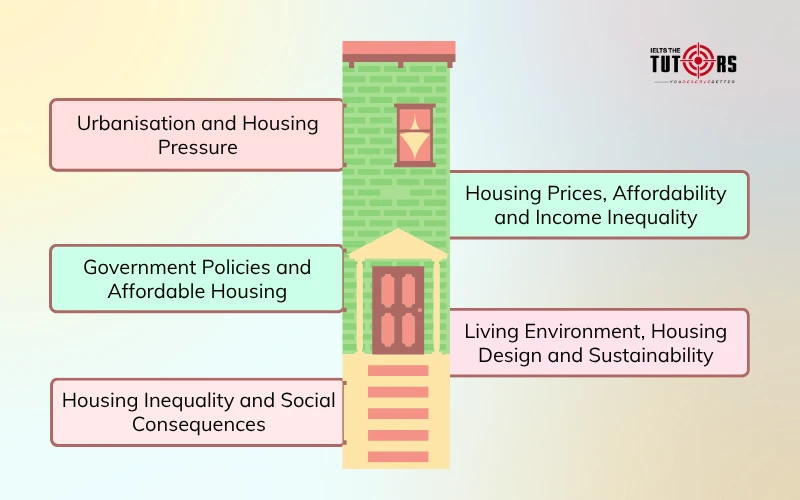
Dưới đây là những vấn đề thường gặp trong chủ đề Housing:
Áp lực nhà ở do dân số đô thị tăng nhanh và nhu cầu lựa chọn giữa xây chung cư cao tầng, mở rộng khu dân cư hoặc phát triển đô thị mới.
Giá mua và thuê nhà tăng cao, khiến người trẻ, người lao động và gia đình thu nhập thấp khó tiếp cận chỗ ở phù hợp.
Vai trò của chính phủ trong việc xây nhà ở xã hội, trợ cấp tiền thuê và hợp tác với doanh nghiệp để tăng nguồn cung.
Tác động của diện tích nhà ở, không gian xanh, mật độ dân cư, độ an toàn và thiết kế tiết kiệm năng lượng đến chất lượng sống.
Tình trạng nhà ở chật chội, xuống cấp hoặc thiếu ổn định ở nhóm thu nhập thấp và những hệ quả đối với sức khỏe, giáo dục, việc làm và bất bình đẳng xã hội.
Ý tưởng triển khai IELTS Writing task 2 topic Housing
Để làm tốt chủ đề Housing, bạn nên chuẩn bị các luận điểm phù hợp với từng dạng đề để bài viết thuyết phục và tránh đi lệch hướng. Dưới đây là một số ideas theo những vấn đề thường gặp trong IELTS Writing Task 2 topic Housing mà bạn có thể tham khảo khi triển khai bài luận:
Urbanisation and Housing Pressure
Đề bài: Some cities create housing areas by constructing taller buildings, while others create housing by building houses over a wider area of land. Which solution is better?
Dạng bài: Problem and Solution
Yêu cầu đề bài:
Vấn đề chính: So sánh hai giải pháp nhà ở gồm xây dựng theo chiều cao và mở rộng khu dân cư theo chiều ngang.
Phương án 1: Phát triển chung cư, căn hộ cao tầng và các khu nhà ở mật độ cao.
Phương án 2: Xây dựng nhà thấp tầng trên diện tích đất lớn hơn, thường phổ biến ở vùng ngoại ô.
Cần phân tích ưu điểm và hạn chế của cả hai phương án trước khi đưa ra lựa chọn.
Có thể chọn một giải pháp phù hợp hơn hoặc lập luận rằng quyết định còn phụ thuộc vào điều kiện của từng khu vực.
Hướng triển khai phù hợp: Xây dựng theo chiều cao thường hiệu quả hơn tại các thành phố đông dân và khan hiếm đất, trong khi phát triển theo chiều ngang phù hợp hơn với những nơi có quỹ đất dồi dào.
Ý tưởng triển khai bài Writing task 2 topic Housing:
High-rise buildings make better use of limited urban land. They can house more people in a smaller area, reduce urban sprawl and help preserve farmland or natural spaces around cities.
Apartment living can be more environmentally sustainable. Shared walls reduce energy use, while higher population density can shorten commuting distances and lower dependence on private cars.
Concentrated housing makes infrastructure and public services easier to provide. Water, electricity, waste collection and public transport can serve more people within a smaller area.
High-density neighbourhoods place shops, workplaces and services within walking distance. This can support local businesses and create more opportunities for social interaction.
Building upwards prevents agricultural land from being converted into housing. This supports long-term urban planning and helps protect green belts around cities.
Tall buildings are expensive to construct and maintain. They require specialised engineering, regular elevator repairs, stricter safety systems and higher insurance costs.
Residents may have less privacy and personal space. The lack of gardens or outdoor areas can also make apartments less suitable for families with young children.
Emergency evacuation can be more difficult, especially during fires, earthquakes or power cuts. Residents also depend heavily on elevators and shared utilities.
Noise can travel between apartments, while close proximity to neighbours may cause disturbance or conflict. Lower floors may also be affected by traffic and street noise.
Large numbers of tall buildings may create an unattractive skyline or a concrete-jungle effect. Some residents may also feel disconnected from nature or experience a sense of isolation.
Suburban houses usually provide more space, privacy and access to private gardens. They may offer a quieter and more comfortable environment for families, children and pets.
Low-rise homes are often cheaper and simpler to build. They usually require less complex foundations, fewer safety systems and lower maintenance costs.
Ground-level housing is easier to access and evacuate. It may be more suitable for older people, people with disabilities and residents living in areas at risk of fires or earthquakes.
Homeowners have greater control over their property and can make changes more easily. Traditional neighbourhoods may also create a stronger sense of ownership and belonging.
Suburban areas may offer cleaner air, more green space and closer contact with nature. Children may also have safer outdoor spaces in which to play.
Low-density housing consumes large areas of land. It can destroy farmland, forests and natural habitats while encouraging cities to spread further outwards.
Detached houses generally use more energy for heating and cooling. Suburban expansion can also increase deforestation, emissions and environmental damage.
Providing roads, electricity, water and other services across large suburban areas is expensive. Public transport may also be difficult to operate efficiently.
People often need to travel long distances to work, study or access services. This increases car dependency, traffic congestion and time spent commuting.
Suburban development can deepen social and economic divisions. Housing may only be affordable to wealthier families, leading to less diverse and more segregated communities.
Housing Prices, Affordability and Income Inequality
Đề bài: In some countries, most people prefer to rent their homes rather than buy them. What are the advantages and disadvantages of renting a home?
Dạng bài: Advantages and Disadvantages
Yêu cầu đề bài:
Vấn đề chính: Phân tích những ưu điểm và nhược điểm của việc thuê nhà.
Cần thảo luận cân bằng cả hai mặt, kèm theo lý do và ví dụ cụ thể.
Có thể nêu quan điểm cá nhân trong phần kết luận, nhưng không bắt buộc.
Đề bài tập trung vào việc thuê nhà, do đó không so sánh trực tiếp với mua nhà.
Hướng triển khai phù hợp: Thuê nhà mang lại sự linh hoạt và giảm áp lực tài chính ban đầu, nhưng cũng có những hạn chế về tính ổn định và quyền sở hữu. Mức độ phù hợp phụ thuộc vào thu nhập, lối sống và giai đoạn cuộc sống của mỗi người.
Ý tưởng triển khai bài Writing task 2 topic Housing:
Advantages
Disadvantages
Renting involves lower upfront costs, making it suitable for people with limited savings who do not want to take out a mortgage.
Landlords usually cover major repairs and maintenance, protecting tenants from unexpected expenses.
Tenants do not directly pay property taxes, leaving more income available for spending and saving.
Money that is not spent on buying a home can be invested in education, business or other financial assets.
Tenants are not affected by falling property prices and can move to a cheaper home when necessary.
Renting makes it easier to relocate when work, study or personal needs change.
Renting is suitable for students, young professionals and people who are not ready to settle down permanently.
Renting allows people to live near city centres, workplaces and essential services without buying an expensive property.
Some rental properties include furniture, gyms, swimming pools and security services.
Renting reduces responsibility for property maintenance and can provide a simpler, less stressful lifestyle.
Rent payments do not help tenants build wealth, benefit from rising property values or leave a home to future generations.
Rental prices may rise over time, making long-term financial planning more difficult.
Tenants must continue paying for housing in retirement and will never have a mortgage-free home.
Tenants cannot receive ownership-related tax benefits or profit from increases in property value.
A rented property cannot be used as collateral, which may limit the tenant’s ability to borrow money.
Renting offers less stability because the lease may be terminated or the property may be sold.
Tenants have limited freedom to renovate, decorate or personalise their living space.
Tenants must follow rules concerning pets, guests, noise and other daily activities.
Tenants depend on landlords for repairs and may face disputes over deposits or lease conditions.
Renting may weaken a person’s sense of stability, community attachment and long-term belonging.
Government Policies and Affordable Housing
Đề bài: The government should focus on building new housing for the growing population rather than renovating existing old buildings. To what extent do you agree or disagree?
Dạng bài: Agree or Disagree
Yêu cầu đề bài:
Vấn đề chính: Chính phủ nên ưu tiên xây nhà mới để đáp ứng dân số tăng hay cải tạo các tòa nhà cũ?
Phương án 1: Xây dựng thêm nhà ở mới.
Phương án 2: Cải tạo và nâng cấp các công trình hiện có.
Cần đưa ra lập trường rõ ràng về phương án nên được ưu tiên.
So sánh lợi ích và hạn chế của cả hai lựa chọn trong bối cảnh nhu cầu nhà ở ngày càng tăng.
Hướng triển khai phù hợp: Nên đồng ý một phần vì xây mới vẫn cần thiết ở khu vực thiếu nhà, nhưng cải tạo các công trình cũ nên được cân nhắc nhiều hơn nhờ tiết kiệm tài nguyên, giảm chất thải xây dựng và góp phần bảo tồn di sản.
Ý tưởng triển khai bài Writing task 2 topic Housing:
Agree
Disagree
New housing can meet rising demand quickly and help prevent serious housing shortages.
Large-scale developments can provide more homes and make better use of limited urban land.
Increasing the housing supply may improve affordability, especially in areas with rapid population growth.
New construction creates jobs, supports related industries and generates additional tax revenue.
New neighbourhoods can be planned with transport links, schools, public services and green spaces from the beginning.
Modern buildings can include energy-efficient materials, smart technology and better insulation.
New homes are built to current safety standards and can offer stronger protection against fires, earthquakes and extreme weather.
Modern materials and warranty protection can reduce maintenance and repair costs in the early years.
New homes can provide better layouts, accessibility features, parking and facilities for modern families.
Governments can build new communities outside crowded city centres and direct future urban growth more effectively.
Standardised construction methods can make project costs, quality and completion times easier to control.
New developments can be expanded more easily to accommodate future population growth and urban migration.
Renovating existing buildings creates less waste and usually has a lower environmental impact than demolition and rebuilding.
Renovation helps reduce urban sprawl by making use of existing buildings and infrastructure.
Reusing old structures supports a circular economy by reducing the need for new materials.
Renovation protects green spaces, farmland and natural habitats from further development.
Older buildings often have architectural and historical value that cannot be replaced once they are demolished.
Renovation helps preserve the character, culture and social connections of established neighbourhoods.
Many older buildings were constructed with durable materials and contain valuable features such as thick walls and high ceilings.
Old buildings are often located in central areas with existing transport, services and amenities.
Renovation may be cheaper than demolition and rebuilding, particularly when the main structure remains in good condition.
Energy performance can be improved by adding insulation, efficient heating systems, modern windows and solar panels.
Preserving existing housing can reduce displacement and help maintain affordable homes for vulnerable residents.
A balanced renovation policy can improve housing quality without destroying established communities or local identity.
Living Environment, Housing Design and Sustainability
Đề bài: With the growing population in cities, more and more people live in homes with little or no outdoor space. Is this a positive or negative development?
Dạng bài: Positive or Negative Development
Yêu cầu đề bài:
Vấn đề chính: Xu hướng ngày càng nhiều người sống trong những ngôi nhà có ít hoặc không có không gian ngoài trời là một sự phát triển tích cực hay tiêu cực?
Bối cảnh: Dân số đô thị tăng nhanh khiến nhiều người phải sống trong căn hộ cao tầng, căn hộ nhỏ hoặc nhà ở có diện tích hạn chế.
Cần đưa ra lập trường rõ ràng: đây là xu hướng tích cực, tiêu cực hay có cả hai mặt.
Phân tích ảnh hưởng đến sức khỏe thể chất, tinh thần, chất lượng sống, môi trường và sự gắn kết xã hội.
Xem xét tác động ở nhiều cấp độ, từ cá nhân, gia đình đến cộng đồng.
Hướng triển khai phù hợp: Nên đánh giá đây là xu hướng tiêu cực nhiều hơn tích cực. Dù mô hình này giúp sử dụng đất hiệu quả hơn, những hạn chế về sức khỏe, không gian sống và chất lượng cuộc sống vẫn đáng lo ngại hơn.
Ý tưởng triển khai bài Writing task 2 topic Housing:
Positive
Negative
Homes with limited outdoor space use scarce urban land efficiently and allow more people to live in central areas.
Compact housing can prevent cities from spreading into surrounding countryside and help preserve natural land.
Smaller homes usually cost less to rent or buy, making them more accessible to lower-income residents.
Compact properties often require less energy for heating and cooling, which can reduce utility bills and environmental impact.
Residents do not need to spend time or money maintaining a garden or yard.
This low-maintenance lifestyle is convenient for busy professionals, older people and those with limited mobility.
Compact urban homes are often located close to workplaces, shops, public transport and entertainment facilities.
Residents can use nearby public parks and walkable neighbourhoods instead of maintaining private outdoor areas.
Shared facilities such as rooftop gardens, gyms and communal spaces can partly replace private outdoor areas.
Modern apartment buildings may also provide security, maintenance services and professional property management.
High-density housing can shorten commuting distances and reduce dependence on private cars.
Living in a compact home may encourage people to use public facilities and participate more actively in urban life.
Limited outdoor space may be acceptable for individuals who value affordability, convenience and a central location.
Limited outdoor space reduces opportunities for exercise and may encourage a more sedentary lifestyle.
Children may lack a safe place to play, which can affect their physical development and increase screen time.
Residents may receive less sunlight and fresh air, increasing the risk of vitamin D deficiency and poor indoor air quality.
A lack of private outdoor space can create feelings of confinement, stress and anxiety.
Limited contact with nature and greenery may negatively affect mood and overall mental well-being.
People have no outdoor area where they can relax, enjoy the weather or take a break from the indoor environment.
Families living in small spaces may experience more conflict because they have fewer private areas.
Homes without gardens or balconies are less suitable for families with children or pets.
Residents may find it difficult to socialise with neighbours, host gatherings or build stronger community relationships.
Limited storage space can make it difficult to keep bicycles, sports equipment or items used for outdoor hobbies.
Residents cannot grow plants or food, which may weaken their connection with nature and reduce self-sufficiency.
The absence of outdoor space can become particularly harmful during lockdowns, illness or other periods of confinement.
Over time, restricted access to greenery and outdoor activities may reduce life satisfaction and overall quality of life.
Housing Inequality and Social Consequences
Đề bài: Many major cities have a growing problem with homelessness. How can this problem be solved?
Dạng bài: Problem and Solution
Yêu cầu đề bài:
Vấn đề chính: Tình trạng vô gia cư ngày càng gia tăng tại các thành phố lớn và cần có giải pháp phù hợp.
Đề xuất những biện pháp thiết thực để giảm tình trạng vô gia cư.
Các giải pháp cần xử lý cả khó khăn trước mắt lẫn những nguyên nhân sâu xa như thiếu nhà ở giá rẻ, thất nghiệp hoặc thiếu hỗ trợ xã hội.
Phân tích vai trò của chính phủ, tổ chức phi lợi nhuận, cộng đồng và cá nhân trong việc giải quyết vấn đề.
Có thể đề cập ngắn gọn đến nguyên nhân để làm rõ giải pháp, nhưng trọng tâm chính vẫn phải là các biện pháp.
Đề bài không yêu cầu phân tích nguyên nhân riêng, vì vậy không nên dành quá nhiều dung lượng cho phần này.
Hướng triển khai phù hợp: Cần kết hợp nhiều giải pháp từ nhiều bên, vừa cung cấp chỗ ở và hỗ trợ khẩn cấp, vừa giải quyết các nguyên nhân gốc rễ để tạo ra thay đổi lâu dài.
Ý tưởng triển khai bài Writing task 2 topic Housing:
Problem
Solution
Property prices and rents often rise faster than incomes, while affordable housing remains limited.
Sudden rent increases, evictions and gentrification can force low-income residents out of their homes.
Untreated mental illness, trauma and substance addiction can prevent people from maintaining stable housing.
Unemployment, insecure work and low wages leave many people unable to cover housing costs.
Homeless people often face barriers to employment, including discrimination and a lack of basic facilities.
Weak welfare systems may fail to protect people during job loss, family breakdown or other emergencies.
Domestic violence, leaving foster care and migration can place vulnerable groups at greater risk of homelessness.
Emergency shelters may be overcrowded or unsuitable for long-term recovery.
Housing, healthcare and employment services often operate separately, making support difficult to access.
Traditional housing projects can be expensive and slow to complete.
Governments should build more social housing, subsidise rents and convert unused buildings into affordable homes.
Rent controls, tenant protection and emergency financial assistance can help vulnerable households remain housed.
Mental health care, addiction treatment and counselling should be provided alongside safe accommodation.
Vocational training, job placement services and adequate income support can improve their financial stability.
Support programmes should provide mailing addresses, showers, suitable clothing and fair access to job opportunities.
Governments should strengthen social benefits and provide early financial support before people lose their homes.
Safe shelters, transitional housing and targeted support should be available for people facing these circumstances.
Rapid rehousing and a housing-first approach can move people into stable homes as soon as possible.
Public agencies and charities should coordinate services through shared case management and outreach programmes.
Modular homes, tiny-house communities and converted offices or hotels can provide affordable accommodation more quickly.
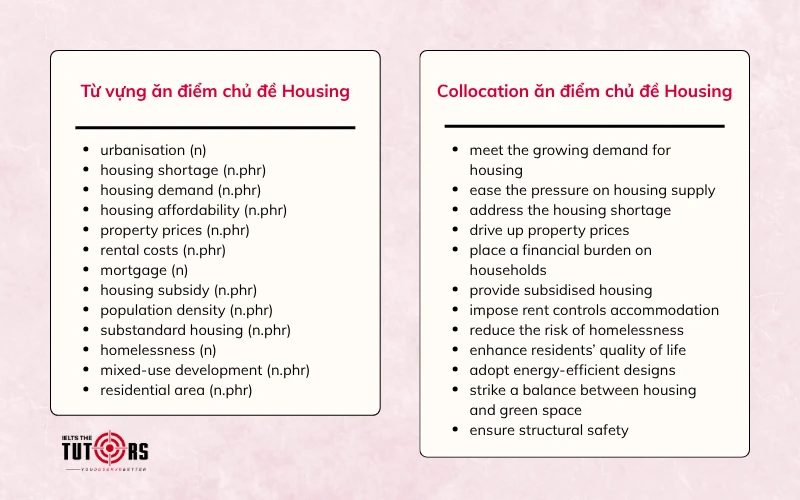
Từ vựng hay trong IELTS Writing task 2 topic Housing:
urbanisation (n): quá trình đô thị hóa
housing shortage (n.phr): tình trạng thiếu nhà ở
housing demand (n.phr): nhu cầu nhà ở
housing affordability (n.phr): khả năng chi trả nhà ở
property prices (n.phr): giá bất động sản
rental costs (n.phr): chi phí thuê nhà
mortgage (n): khoản vay thế chấp mua nhà
housing subsidy (n.phr): trợ cấp nhà ở
population density (n.phr): mật độ dân số
substandard housing (n.phr): nhà ở không đạt tiêu chuẩn
homelessness (n): tình trạng vô gia cư
mixed-use development (n.phr): khu phát triển kết hợp nhà ở, thương mại và dịch vụ
residential area (n.phr): khu dân cư
Collocations nên học topic Housing Writing task 2:
meet the growing demand for housing: đáp ứng nhu cầu nhà ở ngày càng tăng
ease the pressure on housing supply: giảm áp lực lên nguồn cung nhà ở
address the housing shortage: giải quyết tình trạng thiếu nhà ở
drive up property prices: đẩy giá bất động sản lên cao
place a financial burden on households: tạo gánh nặng tài chính cho các hộ gia đình
provide subsidised housing: cung cấp nhà ở được trợ giá
impose rent controls: áp dụng biện pháp kiểm soát giá thuê
live in substandard accommodation: sống trong nơi ở không đạt tiêu chuẩn
reduce the risk of homelessness: giảm nguy cơ vô gia cư
enhance residents’ quality of life: nâng cao chất lượng sống của cư dân
adopt energy-efficient designs: áp dụng thiết kế tiết kiệm năng lượng
strike a balance between housing and green space: cân bằng giữa phát triển nhà ở và không gian xanh
ensure structural safety: bảo đảm an toàn kết cấu công trình
Kết luận
Nhìn chung, các đề bài về chủ đề Housing thường xoay quanh nhu cầu nhà ở, khả năng chi trả, quy hoạch đô thị và vai trò của chính phủ. Vì vậy, khi luyện IELTS Writing Task 2 topic Housing, bạn nên tìm hiểu một số vấn đề thực tế như giá nhà, nhà ở xã hội, áp lực đô thị hóa và thiết kế nhà ở bền vững. Những kiến thức này sẽ giúp bạn chọn luận điểm phù hợp và phát triển bài viết tự nhiên hơn.
Hy vọng những ý tưởng và từ vựng trong bài đã giúp bạn hiểu rõ hơn các dạng đề thường gặp. Đừng quên theo dõi IELTS The Tutors để tham khảo thêm nhiều chủ đề IELTS Writing Task 2 hữu ích và từng bước cải thiện band điểm nhé!
Phạm Công Danh
Cố vấn học thuật tại IELTS The Tutors
Mình hiện là cố vấn học thuật tại IELTS The Tutors với hơn 2 năm kinh nghiệm giảng dạy tiếng Anh, tập trung vào kỹ năng Speaking. Mình tin rằng những kiến thức và phương pháp mình chia sẻ sẽ giúp bạn cải thiện giao tiếp, xây dựng sự tự tin và tiến bộ rõ rệt trong hành trình luyện thi IELTS.
Bạn còn thắc mắc về bài viết này?
Bấm đăng ký tư vấn ngay để được đội ngũ cố vấn giải đáp sâu hơn về kiến thức bạn đang đọc
Bài viết này từ IELTS The Tutors sẽ giúp bạn hệ thống các dạng đề IELTS Writing Task 2 Food thường gặp, kèm ý tưởng, từ vựng và collocation hữu ích để phát triển bài luận tự tin hơn tại nhà.
Bài viết từ IELTS The Tutors sẽ giúp bạn hệ thống các Science and Technology topics thường gặp, kèm theo ý tưởng và từ vựng hữu ích để tự tin phát triển bài luận ngay tại nhà.
Trong bài viết này, IELTS The Tutors sẽ tổng hợp những ý tưởng, từ vựng và bài mẫu IELTS Writing Task 2 topic Economy, giúp bạn hiểu rõ các vấn đề thường gặp và biết cách triển khai luận điểm phù hợp hơn.
Nếu bạn thường bí ý khi gặp đề IELTS Writing Task 2 Culture, hãy cùng IELTS The Tutors chuẩn bị các ý tưởng cho luận điểm, từ vựng và collocation cần thiết để phát triển bài luận mạch lạc hơn.
Trong bài viết dưới đây, IELTS The Tutors sẽ giúp bạn hệ thống những chủ đề Media IELTS Writing Task 2 thường gặp, kèm theo hướng triển khai và nhóm từ vựng dễ ứng dụng.