Khi gặp IELTS Writing Task 2 topic Gender, nhiều thí sinh dễ đưa ra quan điểm cảm tính hoặc phát triển ý chưa đủ sâu. Bài viết của IELTS The Tutors sẽ giúp bạn tiếp cận chủ đề này rõ ràng hơn qua các đề mẫu, ý tưởng triển khai lập luận chi tiết kèm bài tham khảo để bạn dễ dàng áp dụng vào bài Writing của mình.
Các vấn đề thường gặp trong chủ đề Gender
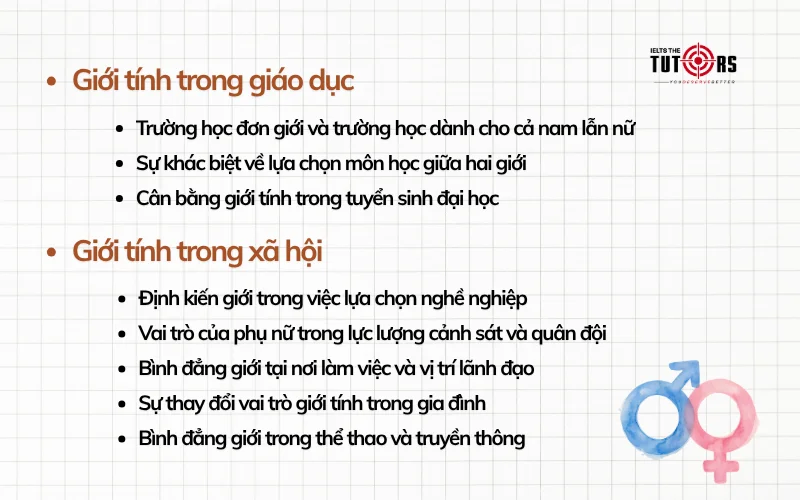
Trong IELTS Writing Task 2, topic Gender thường tập trung vào hai phạm vi chính là giáo dục và đời sống xã hội. Đề bài có thể khai thác sự chênh lệch trong lựa chọn ngành học, cơ hội nghề nghiệp, vị trí lãnh đạo hoặc cách xã hội nhìn nhận vai trò của nam và nữ.
Một số vấn đề có thể xuất hiện trong đề IELTS Writing task 2 topic Gender:
- Học sinh nam và nữ nên học chung để tăng khả năng giao tiếp, hợp tác hay học riêng để phù hợp hơn với đặc điểm và tốc độ phát triển của từng giới.
- Nữ giới thường lựa chọn các ngành nghệ thuật, ngôn ngữ và nhân văn, trong khi nam giới có xu hướng theo học khoa học, kỹ thuật hoặc công nghệ. Đề bài có thể yêu cầu phân tích nguyên nhân và đánh giá liệu xu hướng này có cần thay đổi hay không.
- Các trường đại học có nên tuyển số lượng sinh viên nam và nữ bằng nhau trong mọi ngành học để bảo đảm bình đẳng giới, hay nên lựa chọn hoàn toàn dựa trên năng lực của từng ứng viên.
- Nam và nữ có thực sự sở hữu những phẩm chất khác nhau, từ đó phù hợp với các nhóm nghề nghiệp khác nhau, hay việc phân chia công việc theo giới chỉ bắt nguồn từ định kiến xã hội.
- Phụ nữ có nên đảm nhận vai trò ngang bằng với nam giới trong cảnh sát và quân đội, dù đây là những công việc thường đòi hỏi thể lực, khả năng chịu áp lực và đối mặt với nguy hiểm.
- Có nên quy định một tỷ lệ nhất định các vị trí quản lý cấp cao dành cho phụ nữ để giảm khoảng cách giới, hay doanh nghiệp chỉ nên bổ nhiệm dựa trên kinh nghiệm và năng lực.
- Vai trò trong gia đình đang thay đổi khi ngày càng có nhiều người cha ở nhà chăm con, còn người mẹ đi làm và trở thành nguồn thu nhập chính. Đề bài có thể yêu cầu giải thích nguyên nhân và đánh giá ảnh hưởng của xu hướng này.
- Thể thao nam thường nhận được nhiều thời lượng phát sóng, tài trợ và sự quan tâm hơn thể thao nữ. Thí sinh có thể được yêu cầu phân tích nguyên nhân và xem xét liệu truyền thông có nên dành mức độ đưa tin tương đương cho cả hai giới hay không.
Một số đề bài mẫu trong IELTS Writing task 2 Gender
IELTS Writing Task 2 topic Gender có thể xuất hiện dưới nhiều dạng bài và yêu cầu người viết đánh giá vấn đề từ nhiều góc nhìn. Bạn có thể tham khảo những đề mẫu dưới đây để hiểu rõ hơn cách ra đề và chuẩn bị ý tưởng trước khi viết:
- Some people think that schools should educate boys and girls together, while others believe the two genders should be taught separately. Discuss both views and give your opinion.
- In many schools and universities, women tend to study the humanities, such as arts and languages, while men more often choose science-related subjects. Some believe this tendency should be changed. To what extent do you agree or disagree?
- Universities should accept equal numbers of male and female students in every subject. To what extent do you agree or disagree?
- Some people think that men and women have different qualities. Therefore, certain jobs are more suitable for men, while others are more suitable for women. To what extent do you agree or disagree?
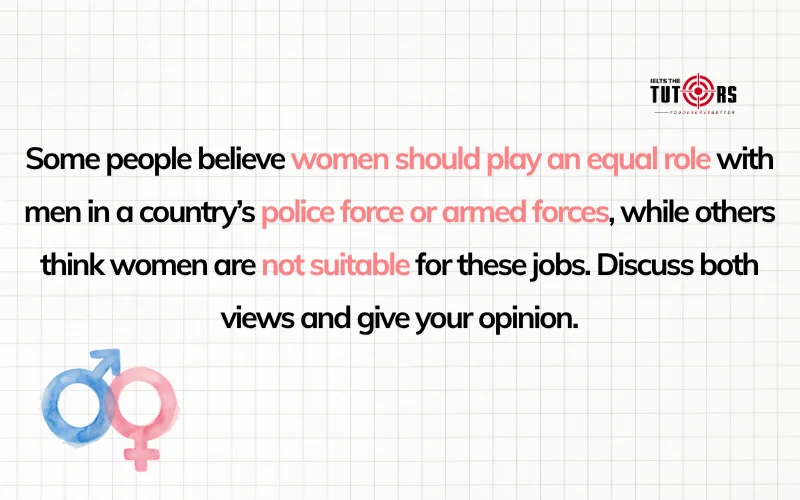
- Some people believe women should play an equal role with men in a country’s police force or armed forces, while others think women are not suitable for these jobs. Discuss both views and give your opinion.
- Most high-level positions in companies are filled by men, even though women account for more than half of the workforce in many developed countries. Companies should be required to allocate a certain percentage of these positions to women. To what extent do you agree or disagree?
- More fathers now stay at home and take care of their children while mothers go out to work. Why is this happening? Is it a positive or negative development?
- Television channels broadcast more men’s sport than women’s sport. Why is this the case? Should they provide equal coverage for both genders?
Ý tưởng triển khai chủ đề Gender Writing task 2

Giới tính trong giáo dục (Gender in Education)
Trường học đơn giới và trường học dành cho cả nam lẫn nữ
Đề bài: Some people think that schools should educate boys and girls together, while others believe the two genders should be taught separately. Discuss both views and give your opinion.
Ý tưởng triển khai bài Writing task 2 topic Gender:
| Co-educational Schools |
Single-sex Schools |
- Mixed schools prepare students for universities, workplaces and society, where they will regularly interact with both genders.
- Learning together from a young age helps boys and girls communicate naturally and work effectively in mixed teams.
- Mixed classrooms can challenge gender stereotypes by showing that both boys and girls can perform well in any subject.
- Daily interaction encourages students to view the opposite gender as equal classmates, which can reduce sexism and discrimination.
- Classroom discussions benefit from a wider range of experiences, viewpoints and ways of thinking.
- Mixed education develops communication, teamwork and emotional skills that are useful in future relationships and employment.
- Both genders have equal access to the same subjects, facilities and extracurricular opportunities.
- Co-educational schools are more practical and cost-effective because facilities, teachers and equipment can be shared.
- Regular interaction can reduce awkwardness, unhealthy curiosity and the objectification of the opposite gender.
- Overall, mixed schools offer a more realistic social environment and stronger preparation for adult life.
|
- Separate schools may help students concentrate better by reducing romantic distractions and pressure to impress the opposite sex.
- Teaching methods can be adjusted to suit the learning styles, interests and developmental needs of each gender.
- Students may feel less pressure to follow traditional gender expectations, such as girls focusing on appearance or boys acting overly masculine.
- Some students may feel more confident speaking, leading activities or trying unfamiliar subjects without fear of being judged by the opposite sex.
- Single-sex schools may encourage girls to choose science subjects and boys to explore arts or languages without social pressure.
- Separating students may allow schools to manage differences in maturity, behaviour and physical development more effectively.
- Some single-sex schools report fewer behavioural problems and a calmer classroom environment.
- Separate education may suit families whose religious, cultural or personal values favour gender separation.
- Parents can choose single-sex education when they believe it better matches their child’s personality, needs or learning preferences.
- Overall, single-sex schools may provide greater focus and confidence for some students, but their effectiveness depends on the individual learner.
|
Sự khác biệt về lựa chọn môn học giữa hai giới
Đề bài: In many schools and universities, women tend to study the humanities, such as arts and languages, while men more often choose science-related subjects. Some believe this tendency should be changed. To what extent do you agree or disagree?
Ý tưởng triển khai bài Writing task 2 topic Gender:
| Agree |
Disagree |
- Gender stereotypes may discourage girls from choosing science and boys from studying arts, even when they have suitable abilities.
- Social expectations, teaching methods and media influence can shape subject choices from an early age.
- Encouraging more women to enter STEM can improve their access to higher-paid careers and help reduce the gender pay gap.
- Greater gender diversity in science and technology can bring different perspectives and lead to more inclusive products and solutions.
- A lack of visible female scientists and male role models in the humanities can make traditional gender divisions appear normal.
- Gender-based guidance from teachers, parents or career advisers can prevent students from recognising their real potential.
- Discrimination and an unwelcoming workplace culture may discourage women from continuing in male-dominated industries.
- Schools should challenge stereotypes, provide gender-neutral career guidance and support students who choose less traditional subjects.
|
- Students should be free to choose subjects based on their interests and strengths rather than gender targets.
- Differences in subject choices are not always caused by discrimination and may partly reflect personal preferences.
- Humanities, languages and creative subjects are equally valuable, so increasing STEM participation should not imply that these fields are less important.
- Forcing students into non-traditional fields may create pressure, dissatisfaction and resentment.
- Equal opportunity is more important than equal numbers, as a fair system should remove barriers without controlling individual choices.
- Population-level trends should not be used to judge individuals, as many women succeed in STEM and many men thrive in the humanities.
- Participation in non-traditional subjects is already increasing naturally as social attitudes become more open.
- Schools should present all options fairly but allow students to make the final decision for themselves.
|
Cân bằng giới tính trong tuyển sinh đại học
Đề bài: Universities should accept equal numbers of male and female students in every subject. To what extent do you agree or disagree?
Ý tưởng triển khai bài Writing task 2 topic Gender:
| Agree |
Disagree |
- A 50/50 quota can create more balanced representation and give both genders equal access to every subject.
- Greater female participation in fields such as engineering can challenge traditional gender stereotypes.
- Gender-balanced classrooms can bring different perspectives and encourage more varied discussion and collaboration.
- Quotas can create visible role models and encourage younger students to enter fields traditionally dominated by the opposite gender.
- Mandatory targets may produce faster change when voluntary efforts have failed to reduce gender imbalance.
- Temporary quotas can help address the long-term effects of past discrimination against women in education and employment.
- Balanced enrolment can prepare students for workplaces where men and women are expected to cooperate equally.
- Equal representation can help prevent certain academic fields from remaining dominated by one gender.
- Quotas may encourage universities to provide better support for underrepresented students.
- A clear admissions policy can show that universities are committed to gender equality.
- Increasing admission numbers may gradually improve gender equality within traditionally unbalanced professions.
|
- University places should be awarded based on academic ability and suitability rather than gender.
- A fixed quota may force universities to reject qualified applicants simply because too many candidates of the same gender apply.
- Some subjects naturally attract more applicants from one gender, making an equal split difficult or impossible to achieve.
- Universities may need to admit less qualified candidates to meet the quota, which could weaken academic standards.
- A rigid quota treats students as gender categories rather than individuals with different abilities, interests and ambitions.
- Students admitted under a quota may face stigma and have their achievements unfairly questioned.
- Gender quotas may restrict freedom of choice by ignoring the subjects that students genuinely want to study.
- Gender is only one aspect of diversity, so a 50/50 rule may overlook factors such as income, disability and social background.
- The main causes of gender imbalance often begin earlier through childhood stereotypes and unequal encouragement at school.
- More effective alternatives include gender-blind admissions, scholarships, outreach programmes and early encouragement for underrepresented groups.
- Equal admission numbers do not guarantee equal treatment, as students may still face discrimination or an unwelcoming academic environment.
|
Giới tính trong xã hội (Gender in Society)
Định kiến giới trong việc lựa chọn nghề nghiệp
Đề bài: Some people think that men and women have different qualities. Therefore, certain jobs are more suitable for men, while others are more suitable for women. To what extent do you agree or disagree?
Ý tưởng triển khai bài Writing task 2 topic Gender:
| Agree |
Disagree |
- Average differences in physical strength may make men more suitable for highly demanding jobs such as firefighting, mining or military combat.
- Pregnancy and childcare responsibilities may interrupt women’s careers or make certain working conditions more difficult.
- Women may be more suited to caring professions because they are often encouraged to develop empathy and communication skills.
- Differences in risk tolerance may influence why more men enter dangerous or highly competitive occupations.
- Some traditional divisions of labour developed because men and women performed different physical and family roles.
- Certain jobs may require specific physical qualities that are more common among one gender.
- Employers may consider biological differences when workplace safety or physical performance is essential.
- Men and women may have different average strengths, which could influence their career preferences.
- Gender-based career patterns may continue because people often choose jobs that match social expectations and family roles.
- A limited degree of job specialisation by gender may be practical in a small number of physically demanding roles.
|
- Applicants should be assessed through objective physical tests because many women can meet the same standards as men.
- Pregnancy is temporary, and maternity leave or flexible working arrangements can help women continue their careers.
- Caring abilities are shaped by personality and experience, so men can also succeed as nurses, teachers or childcare workers.
- Risk tolerance varies between individuals and should not be used to judge an entire gender.
- Traditional roles were often shaped by social restrictions and limited technology rather than differences in ability.
- Modern technology has reduced the need for physical strength in many occupations, making most jobs suitable for both genders.
- Clear job requirements and fair testing are more reliable than assumptions based on gender.
- Differences within each gender are often greater than differences between men and women as groups.
- These expectations can become self-fulfilling and discourage talented people from entering fields traditionally associated with the opposite gender.
- Restricting jobs by gender wastes talent, reinforces discrimination and prevents employers from selecting the most capable candidates.
|
Vai trò của phụ nữ trong lực lượng cảnh sát và quân đội
Đề bài: Some people believe women should play an equal role with men in a country’s police force or armed forces, while others think women are not suitable for these jobs. Discuss both views and give your opinion.
Ý tưởng triển khai bài Writing task 2 topic Gender:
| Women Should Have an Equal Role |
Women May Not Be Suitable for Certain Roles |
- Women should have equal access to police and military careers because employment opportunities should be based on ability rather than gender.
- Many women have already worked successfully as police officers, soldiers, pilots and intelligence specialists in different countries.
- Women can contribute valuable skills such as communication, negotiation and conflict de-escalation, which are particularly useful in police work.
- Female officers are often needed when dealing with female victims, suspects or communities where contact between men and women is restricted.
- Modern police and military work increasingly depends on technology, intelligence and strategic thinking rather than physical strength alone.
- Allowing women to serve expands the recruitment pool and prevents capable candidates from being excluded solely because of their gender.
- Female officers can act as role models, challenge gender stereotypes and encourage more women to pursue demanding careers.
- Women who meet the same physical, professional and psychological standards as men should be allowed to serve in any suitable role.
|
- Some combat positions require exceptional physical strength and endurance, which fewer women may be able to meet on average.
- Carrying heavy equipment, rescuing injured colleagues and operating in extreme conditions may create greater physical challenges for some female personnel.
- Women may face higher injury risks during physically demanding training and combat duties.
- Pregnancy and maternity leave can temporarily limit deployment and create staffing challenges in operational units.
- Mixed-gender teams may require additional policies and facilities to manage privacy, relationships and accommodation.
- Critics argue that lowering physical standards to increase female participation could reduce operational effectiveness.
- Some people believe that integrating women into traditionally male combat units may affect teamwork and unit cohesion.
- Certain frontline duties may therefore remain unsuitable for individuals who cannot meet the required standards, regardless of gender.
|
Bình đẳng giới tại nơi làm việc và vị trí lãnh đạo
Đề bài: Some people believe that gender equality has already been achieved, while others think that much more progress still needs to be made. Discuss both views and give your opinion.
Ý tưởng triển khai bài Writing task 2 topic Gender:
| Gender Equality Has Largely Been Achieved |
Much More Progress Is Still Needed |
- Women now have equal legal rights in many countries, including the right to vote, work, own property and receive an education.
- Anti-discrimination and equal-pay laws provide a stronger legal foundation for protecting women’s rights.
- Girls and women have gained much wider access to schools, universities and professional training.
- Women can now enter nearly every profession, including medicine, law, engineering, science and politics.
- Female participation in the workforce has increased significantly, especially in developed countries.
- Public attitudes have become more supportive of women’s education, careers and leadership.
- Younger generations tend to support more equal relationships and less rigid gender roles.
- Successful female politicians, scientists, business leaders and athletes provide visible role models for younger women.
- Women’s achievements are more widely recognised in education, business, sport and public life.
- Some countries, particularly in Northern Europe, have made substantial progress towards gender equality.
- Media representation of successful and independent women has improved over time.
- Compared with previous generations, women today have far greater freedom to make decisions about education, work and family life.
- Formal barriers that once prevented women from studying, working or participating in politics have largely been removed in many societies.
- Overall, the progress made over recent decades shows that gender equality is increasingly accepted as a social norm.
|
- Legal equality does not always lead to equal treatment in workplaces, families or wider society.
- Women may still earn less than men, particularly after having children or entering senior positions.
- In some poorer or conservative societies, girls still face child marriage, limited education and other serious restrictions.
- Women remain underrepresented in senior management, political leadership, technology and engineering.
- Pregnancy discrimination, hiring bias and unequal promotion opportunities continue to limit women’s careers.
- Traditional gender roles still place most childcare, housework and unpaid care responsibilities on women.
- The unequal burden of unpaid work can reduce women’s income, career progression and financial independence.
- The success of a small number of women does not prove that all women have equal access to opportunities.
- Violence, domestic abuse and sexual harassment remain major threats to women’s safety and freedom.
- Progress varies greatly between countries, and women in many regions still lack basic rights and protection.
- Advertising and entertainment still often objectify women or reinforce narrow beauty standards and gender stereotypes.
- Access to reproductive healthcare and control over personal medical decisions remain restricted in some places.
- Women from minority ethnic groups, low-income backgrounds or other disadvantaged communities may face several forms of discrimination at once.
- Overall, gender equality cannot be considered complete while major gaps remain in pay, leadership, safety, unpaid work and personal freedom.
|
Sự thay đổi vai trò giới tính trong gia đình
Đề bài: More fathers now stay at home and take care of their children while mothers go out to work. Why is this happening? Is it a positive or negative development?
Ý tưởng triển khai bài Writing task 2 topic Gender:
Reasons why this is happening
- Changing attitudes towards gender roles have made society more accepting of fathers as primary caregivers and mothers as breadwinners.
- Women’s rising education levels and incomes mean that the mother may be the higher earner in a household.
- High childcare costs can make it more affordable for one parent to remain at home.
- Some fathers willingly choose childcare because they value family time more than career advancement.
- Job loss or unstable employment may lead the father to stay home while the mother continues working.
- Remote work and flexible schedules have made it easier for parents to divide paid work and childcare responsibilities.
- Paid paternity leave and family-friendly policies encourage fathers to take a more active caregiving role.
- Some mothers choose to pursue demanding careers while their partners take greater responsibility at home.
- Couples increasingly believe that family responsibilities should be divided according to ability and preference rather than gender.
- Wider social acceptance of diverse family structures has made role reversal more common.
Is it a positive or negative development?
| Positive |
Negative |
- This arrangement challenges the traditional belief that men should work while women should care for children.
- Allowing the higher-earning parent to continue working can strengthen the family’s financial position.
- Full-time parental care can provide children with consistent attention and a stable home environment.
- Fathers can form stronger emotional bonds with their children and become more involved in their development.
- Flexible family roles allow couples to make practical decisions based on their circumstances rather than gender expectations.
- Greater flexibility can improve work–life balance and allow both parents to participate more actively in family life.
- Greater father involvement supports gender equality and reduces pressure on mothers to sacrifice their careers.
- Women gain more freedom to develop their careers without being expected to handle most childcare duties.
- Children learn that both men and women are capable of earning an income and providing care.
- This trend can encourage workplaces and governments to introduce better parental leave and flexible working policies.
|
- Stay-at-home fathers may face social judgement because caregiving is still viewed as a female responsibility in some communities.
- The father may lose career opportunities, professional skills and future earning potential after a long employment break.
- Depending on one income may reduce household savings and create financial pressure.
- Staying at home for long periods may cause loneliness, stress or a loss of professional identity.
- An arrangement caused by unemployment rather than personal choice may lead to frustration or resentment.
- Combining work and childcare at home may blur responsibilities and increase stress for both parents.
- Limited or unpaid parental leave may make this arrangement difficult for families with lower incomes.
- Working mothers may still experience guilt or criticism for spending less time at home.
- Differences in expectations about money, parenting and household authority may create tension between partners.
- Social attitudes may change more slowly than family practices, leaving some couples without sufficient community support.
|
Bình đẳng giới trong thể thao và truyền thông
Đề bài: Television channels broadcast more men’s sport than women’s sport. Why is this the case? Should they provide equal coverage for both genders?
Ý tưởng triển khai bài Writing task 2 topic Gender:
Why men’s sports receive more coverage
- Men’s sports usually attract larger audiences, allowing broadcasters to earn more from advertising and sponsorship.
- Men’s leagues have received greater investment and media attention for much longer, giving them stronger professional systems and fan bases.
- Male athletes often receive higher salaries, larger sponsorship deals and greater publicity, making them more attractive to the media.
- Many viewers consider men’s competitions more exciting because of differences in speed, strength and physical power.
- Traditional attitudes have long presented sport as a male activity, shaping audience preferences and media decisions.
- Female competitions are sometimes poorly promoted or scheduled at inconvenient times, which further reduces their audiences.
- Male-dominated leadership within sports media may contribute to assumptions that women’s competitions are less commercially valuable.
- The continued lack of coverage reinforces the belief that men’s sports are more important and worth watching.
| Equal Coverage Should Be Provided |
Equal Coverage Should Not Be Required |
- More balanced coverage would give female athletes fairer opportunities to gain recognition and develop their careers.
- Women’s sports cannot build a large audience without regular exposure, creating a cycle of low coverage and limited public interest.
- Greater visibility can attract more fans, sponsors and investment, helping women’s competitions improve over time.
- Successful women’s events show that audiences are willing to watch when competitions receive effective promotion and suitable scheduling.
- Equal representation can challenge gender stereotypes and show that sporting achievement is not limited to men.
- Female athletes can become role models who encourage more girls to participate in sport and pursue professional careers.
- Public broadcasters have a social responsibility to promote fairness and should not base every programming decision solely on profit.
- A conscious increase in coverage may be necessary to correct the effects of past underinvestment and discrimination.
|
- Broadcasters are commercial organisations and should prioritise programmes that attract the largest audiences.
- Forcing channels to show events with low viewing figures could reduce advertising income and create financial losses.
- Limited broadcasting time should be allocated according to audience demand rather than fixed gender quotas.
- Viewers should be free to choose the sports they enjoy rather than being encouraged to watch content through compulsory quotas.
- Differences in popularity do not necessarily result from discrimination, as audiences may simply prefer particular leagues or competitions.
- Dedicated sports channels and streaming platforms can provide more women’s coverage without reducing popular content on general channels.
- Coverage should increase gradually as public interest grows instead of imposing an immediate equal split.
- Supporters of a market-based approach argue that women’s sports will naturally receive more attention when demand becomes strong enough.
|
Xem thêm:
Phân tích đề bài và bài mẫu topic Gender Writing task 2
Đề bài: Some people believe women should play an equal role with men in a country’s police force or armed forces, while others think women are not suitable for these jobs. Discuss both views and give your opinion.
Phân tích đề bài:
- Dạng bài: Discuss both views and give your opinion
- Từ khoá chính: women should play an equal role, police force or armed forces, not suitable
- Hướng triển khai: Bài viết trước hết trình bày những lo ngại về yêu cầu thể chất và hiệu quả hoạt động khi phụ nữ tham gia lực lượng cảnh sát hoặc quân đội. Sau đó, bài viết bảo vệ quan điểm rằng cơ hội nên dựa trên năng lực cá nhân, miễn là mọi ứng viên đều đáp ứng cùng tiêu chuẩn về thể chất, chuyên môn và tâm lý.
Dàn bài gợi ý:
Introduction
- Paraphrase đề bài: Có ý kiến cho rằng phụ nữ nên giữ vai trò bình đẳng với nam giới trong lực lượng cảnh sát và quân đội, trong khi những người khác cho rằng họ không phù hợp với các công việc này.
- Thesis statement: Bài viết sẽ thảo luận cả hai quan điểm trước khi khẳng định rằng cơ hội nghề nghiệp nên được quyết định dựa trên năng lực thay vì giới tính.
Body Paragraph 1: Phụ nữ nên có vai trò bình đẳng
- Việc tuyển dụng nên dựa trên khả năng thực tế, không phải giới tính của ứng viên.
- Nhiều phụ nữ đã làm tốt trong các vị trí như cảnh sát, quân nhân, phi công và chuyên gia tình báo.
- Các kỹ năng giao tiếp, đàm phán và xử lý xung đột của nữ giới có thể đặc biệt hữu ích trong công tác cảnh sát.
- Sĩ quan nữ cũng cần thiết khi làm việc với nạn nhân hoặc nghi phạm nữ và tại những cộng đồng có quy định nghiêm ngặt về tiếp xúc giữa hai giới.
- Nhiều công việc hiện đại trong quân đội và cảnh sát ngày càng phụ thuộc vào công nghệ, tình báo và tư duy chiến lược, thay vì chỉ dựa vào sức mạnh thể chất.
- Theo quan điểm cá nhân, phụ nữ đáp ứng đầy đủ tiêu chuẩn chuyên môn, thể chất và tâm lý nên có quyền phục vụ ở mọi vị trí phù hợp.
Body Paragraph 2: Những lo ngại về sự phù hợp của phụ nữ
- Một số nhiệm vụ chiến đấu đòi hỏi sức mạnh và sức bền rất cao, chẳng hạn mang thiết bị nặng hoặc cứu đồng đội trong điều kiện khắc nghiệt.
- Thai sản có thể tạm thời ảnh hưởng đến khả năng triển khai nhiệm vụ và tạo thêm khó khăn trong việc bố trí nhân sự.
- Đội ngũ có cả nam và nữ cũng cần thêm chính sách và cơ sở vật chất để bảo đảm quyền riêng tư.
- Một số người lo rằng việc hạ thấp tiêu chuẩn nhằm tăng số lượng nữ giới có thể làm giảm hiệu quả hoạt động.
- Tuy nhiên, giải pháp không phải là loại phụ nữ khỏi các vị trí này mà là duy trì cùng một tiêu chuẩn công bằng cho mọi ứng viên.
Conclusion
- Tóm tắt: Những lo ngại về yêu cầu thể chất và việc tổ chức nhân sự là hợp lý, nhưng không nên trở thành lý do để hạn chế cơ hội của toàn bộ phụ nữ.
- Khẳng định: Phụ nữ nên được trao quyền bình đẳng trong lực lượng cảnh sát và quân đội, miễn là họ đáp ứng đầy đủ các tiêu chuẩn của công việc.
Bài mẫu Writing task 2 topic Gender:
Some people argue that women should serve on equal terms with men in the police and armed forces, while others consider them unsuitable for such demanding work. Although certain roles require exceptional physical ability, I believe access should depend on individual competence rather than gender.
Those who oppose equal participation mainly focus on operational demands. Frontline soldiers and some police officers may need to carry heavy equipment, rescue injured colleagues and work for long periods in dangerous conditions. Since men are physically stronger on average, critics fear that fewer women will meet the standards required for these duties. They also argue that mixed-gender units may require additional accommodation and staffing arrangements, particularly during pregnancy or maternity leave. Most importantly, lowering physical requirements simply to increase female representation could weaken team performance and place personnel at risk.
However, these concerns do not justify excluding all women. Modern policing and military work involves far more than physical combat; many positions depend on intelligence, technology, strategic judgement, communication and negotiation. Women who possess these skills can perform as effectively as men, and female officers may be particularly valuable when assisting female victims, searching female suspects or working in communities where contact between men and women is restricted. Allowing women to apply also widens the recruitment pool and prevents capable candidates from being rejected because of stereotypes. In my view, every role should have clear physical, professional and psychological standards, and all applicants should be assessed against the same requirements.
In conclusion, concerns about strength and operational efficiency are understandable, especially in frontline roles. Nevertheless, women who satisfy the relevant standards should have the same opportunity as men to serve in the police or armed forces.
(282 words, band +7.5)
Từ vựng & collocation chủ đề Gender
Từ vựng nên học cho IELTS Writing Task 2 topic Gender
| Từ vựng |
Từ loại |
Ý nghĩa |
| gender equality |
noun phrase |
bình đẳng giới |
| gender inequality |
noun phrase |
bất bình đẳng giới |
| gender discrimination |
noun phrase |
sự phân biệt đối xử về giới |
| gender stereotype |
noun phrase |
định kiến giới |
| gender role |
noun phrase |
vai trò của nam và nữ trong xã hội |
| gender gap |
noun phrase |
khoảng cách giữa hai giới |
| equal opportunity |
noun phrase |
cơ hội bình đẳng |
| equal representation |
noun phrase |
sự đại diện cân bằng giữa hai giới |
| merit-based selection |
noun phrase |
tuyển chọn dựa trên năng lực |
| academic ability |
noun phrase |
năng lực học tập |
| subject preference |
noun phrase |
sở thích lựa chọn môn học |
| single-sex education |
noun phrase |
giáo dục đơn giới |
| coeducational school |
noun phrase |
trường học dành cho cả nam và nữ |
| social development |
noun phrase |
sự phát triển về mặt xã hội |
| male-dominated profession |
noun phrase |
nghề nghiệp có phần lớn lao động là nam |
| female representation |
noun phrase |
mức độ hiện diện của phụ nữ |
| workplace discrimination |
noun phrase |
phân biệt đối xử tại nơi làm việc |
| career advancement |
noun phrase |
sự phát triển và thăng tiến nghề nghiệp |
| professional competence |
noun phrase |
năng lực chuyên môn |
| physical capability |
noun phrase |
năng lực thể chất |
| shared parental responsibility |
noun phrase |
trách nhiệm nuôi dạy con được chia sẻ |
| gender pay gap |
noun phrase |
chênh lệch thu nhập giữa nam và nữ |
Collocation hữu ích cho IELTS Writing Task 2 topic Gender
| Collocation |
Ý nghĩa |
| promote gender equality |
thúc đẩy bình đẳng giới |
| address gender inequality |
giải quyết tình trạng bất bình đẳng giới |
| eliminate gender discrimination |
xóa bỏ sự phân biệt đối xử về giới |
| challenge gender stereotypes |
xóa bỏ định kiến giới |
| reinforce traditional gender roles |
củng cố vai trò giới truyền thống |
| provide equal opportunities |
tạo cơ hội bình đẳng |
| judge individuals on their merits |
đánh giá cá nhân dựa trên năng lực |
| adopt merit-based selection |
áp dụng hình thức tuyển chọn dựa trên năng lực |
| select the most qualified applicants |
lựa chọn những ứng viên có năng lực tốt nhất |
| attend single-sex schools |
học tại trường đơn giới |
| study in a coeducational environment |
học trong môi trường có cả nam và nữ |
| develop social and communication skills |
phát triển kỹ năng xã hội và giao tiếp |
| choose subjects based on personal interest |
chọn môn học dựa trên sở thích cá nhân |
| be influenced by gender stereotypes |
chịu ảnh hưởng của định kiến giới |
| encourage women to enter STEM fields |
khuyến khích phụ nữ theo đuổi các ngành STEM |
| pursue male-dominated careers |
theo đuổi những nghề do nam giới chiếm đa số |
| assess candidates according to ability |
đánh giá ứng viên dựa trên năng lực |
| meet the same professional standards |
đáp ứng cùng một tiêu chuẩn chuyên môn |
| perform physically demanding duties |
thực hiện các nhiệm vụ đòi hỏi thể lực cao |
| remove gender-based barriers |
loại bỏ các rào cản dựa trên giới tính |
| face workplace discrimination |
đối mặt với phân biệt đối xử tại nơi làm việc |
| increase female representation |
tăng tỷ lệ hiện diện của phụ nữ |
| reduce the gender pay gap |
thu hẹp chênh lệch thu nhập giữa hai giới |
| share childcare responsibilities equally |
chia sẻ trách nhiệm chăm sóc con công bằng |
| divide household duties more fairly |
phân chia việc nhà công bằng hơn |
| support women’s career development |
hỗ trợ sự phát triển nghề nghiệp của phụ nữ |
| provide equal media coverage |
bảo đảm mức độ đưa tin ngang nhau |
| increase the visibility of female athletes |
nâng cao mức độ hiện diện của vận động viên nữ |
Tóm lại, IELTS Writing Task 2 topic Gender không yêu cầu bạn phải đưa ra những quan điểm quá phức tạp. Điều quan trọng là xác định đúng câu hỏi, nhìn nhận vấn đề công bằng và giải thích rõ vì sao cơ hội nên dựa trên năng lực, hoàn cảnh hoặc lựa chọn cá nhân thay vì những định kiến có sẵn.
Hy vọng các ý tưởng, bài mẫu và từ vựng theo chủ đề trong bài sẽ giúp bạn viết nên lập luận chắc chắn. Đừng quên theo dõi IELTS The Tutors để cập nhật thêm nhiều tài liệu IELTS Writing hữu ích nhé!