IELTS Writing Task 2 topic Law thường yêu cầu thí sinh bàn luận về hệ thống pháp luật, nguyên nhân tội phạm và các hình thức xử phạt. Bài viết từ IELTS The Tutors sẽ cung cấp đề mẫu, hướng triển khai ý tưởng, bài viết tham khảo cùng nhóm từ vựng hay để bạn chuẩn bị tốt hơn cho chủ đề này.
Trong IELTS Writing Task 2, topic Law thường không xuất hiện dưới dạng kiến thức pháp lý chuyên sâu mà chủ yếu được khai thác qua nhóm Crime and Punishment. Chủ đề này thường xoay quanh hệ thống pháp luật, nguyên nhân của tội phạm và các hình thức xử phạt.
Một số vấn đề phổ biến gồm:
Thế giới nên áp dụng một hệ thống pháp luật chung hay để mỗi quốc gia xây dựng luật riêng dựa trên văn hóa, lịch sử và điều kiện xã hội.
Nghèo đói có phải là nguyên nhân chính dẫn đến tội phạm hay hành vi phạm pháp còn chịu ảnh hưởng từ giáo dục, gia đình, thất nghiệp và ý thức cá nhân.
Tăng số lượng cảnh sát trên đường phố có phải là cách duy nhất để giảm tội phạm hay cần kết hợp với giáo dục, tạo việc làm và hỗ trợ cộng đồng.
Thanh thiếu niên phạm tội nghiêm trọng có nên chịu hình phạt giống người trưởng thành hay cần được xem xét dựa trên độ tuổi và khả năng nhận thức.
Án tù dài hạn có phải là biện pháp hiệu quả nhất để giảm tội phạm hay nên áp dụng thêm các giải pháp như đào tạo nghề, tư vấn tâm lý và lao động công ích.
Nguyên nhân khiến người từng ngồi tù tiếp tục phạm tội sau khi được trả tự do và những biện pháp giúp họ tái hòa nhập xã hội.
Án tử hình có thực sự giúp kiểm soát tội phạm nghiêm trọng hay tù chung thân là lựa chọn phù hợp hơn.
Một số đề bài mẫu trong IELTS Writing task 2 Law
Các đề IELTS Writing Task 2 topic Law có thể xuất hiện dưới nhiều dạng bài khác nhau, đòi hỏi thí sinh đọc kỹ yêu cầu và xác định đúng hướng lập luận. Dưới đây là một số đề mẫu giúp bạn làm quen với cách ra đề và luyện kỹ năng triển khai bài viết:
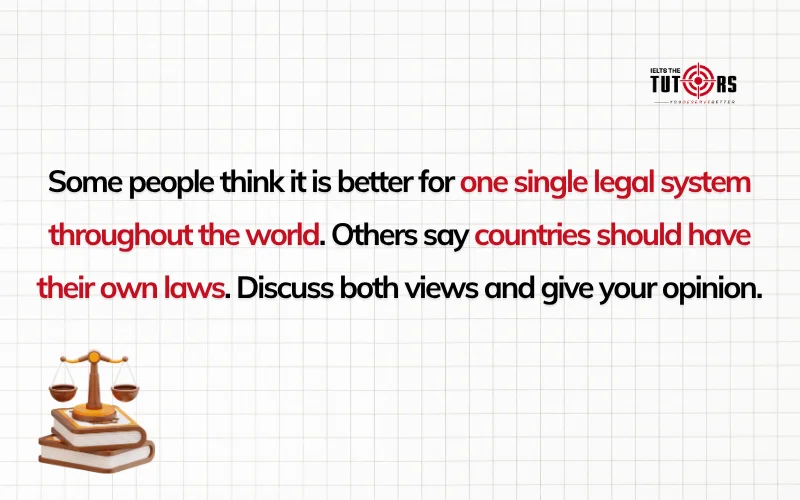
Some people think it is better for one single legal system throughout the world. Others say countries should have their own laws. Discuss both views and give your opinion.
Some people think that poverty is the reason behind most crimes. Do you agree or disagree?
Some countries are struggling with an increase in the rate of crime. Many people think that having more police on the streets is the only way to reduce crime. To what extent do you agree?
In some societies, the number of crimes committed by teenagers is growing. Some people think that regardless of age, teenagers who commit major crimes should receive adult punishment. To what extent do you agree?
Some people think that the best way to reduce crime is to give longer prison sentences. Others, however, believe there are better alternative ways of reducing crime. Discuss both views and give your opinion.
Many criminals commit further crimes as soon as they are released from prison. What do you think are the causes of this? What possible solutions can you suggest?
The death penalty is the best way to control and reduce serious crime. To what extent do you agree?
Ý tưởng triển khai chủ đề Law Writing task 2
Luật chung toàn cầu hay luật riêng từng quốc gia
Đề bài: Some people think it is better for one single legal system throughout the world. Others say countries should have their own laws. Discuss both views and give your opinion.
Ideas for Writing task 2 topic Law:
One Single Legal System
Countries Should Have Their Own Laws
A universal legal system could protect basic human rights and ensure that serious crimes such as genocide, torture and war crimes are punished everywhere.
Shared laws would prevent criminals from escaping justice simply by crossing national borders.
Common legal standards could make international trade easier by simplifying contracts, intellectual property rules and business regulations.
A unified system could improve cooperation on extradition, cybercrime, terrorism, immigration and refugee protection.
Travellers, workers and international families would face less confusion because the same rules would apply in every country.
Global environmental laws could help countries address climate change, ocean pollution and wildlife protection more effectively.
Universal laws could ensure that people receive equal treatment and similar punishments for the same offences.
Common regulations could prevent multinational companies from exploiting weak labour, tax, environmental or consumer protection laws.
Clear global rules could reduce duplication and make international organisations more efficient.
National laws can reflect each country’s cultural traditions, religious beliefs and social values.
Countries have the right to govern themselves and allow their citizens to decide laws through democratic processes.
Laws should suit local economic conditions because developing and wealthy countries often have different needs and priorities.
Different legal systems allow countries to test new policies and learn from one another’s successes and failures.
Creating a universal system would be difficult because countries follow different legal traditions and may disagree over who should make or enforce the laws.
Local conditions such as geography, population density and historical background often require different legal solutions.
National legal systems allow lawmakers to remain directly accountable to local voters.
A single global authority could become too powerful, while several legal systems provide alternatives and limit the risk of centralised control.
Imposing one legal model may be viewed as cultural domination, particularly if powerful countries control the system.
Nghèo đói là nguyên nhân chính dẫn đến người phạm tội
Đề bài: Some people think that poverty is the reason behind most crimes. Do you agree or disagree?
Ideas for Writing task 2 topic Law:
Agree
Disagree
Poverty can push people to steal food, money or essential goods when they cannot meet basic needs.
Unemployment and low wages may leave people with few legal ways to support themselves.
Young people in disadvantaged areas may join gangs or sell drugs to earn money and gain a sense of belonging.
Limited access to education and job training can reduce legitimate career opportunities and increase the risk of crime.
Economic inequality may create frustration and resentment, which can lead to theft, robbery and other property crimes.
Hunger, homelessness, debt and unaffordable healthcare may drive desperate people to break the law.
Economic downturns can increase unemployment and financial pressure, which may contribute to higher crime rates.
Poor neighbourhoods may have fewer schools, youth programmes and support services, leaving young people more exposed to crime.
Poverty is therefore a major cause of survival-related and property crime.
Wealthy people also commit serious offences such as fraud, corruption, tax evasion and insider trading.
Greed and the desire for greater wealth or power can motivate crime even when offenders are already financially secure.
Domestic violence, assault and murder are often caused by anger, jealousy or revenge rather than poverty.
Mental illness, addiction and childhood trauma can contribute to criminal behaviour across all income groups.
Organised crime, cybercrime and human trafficking are often carried out by skilled or well-funded criminal networks.
Family upbringing, moral values, peer influence and community support can affect criminal behaviour more directly than income.
Sexual offences, harassment, drunk driving and other crimes occur among people from every social and economic background.
Most people living in poverty do not commit crimes, showing that low income alone cannot explain criminal behaviour.
Poverty may contribute to some offences, but it cannot be considered the main cause of most crimes.
Tăng cường cảnh sát để giảm tội phạm
Đề bài: Some countries are struggling with an increase in the rate of crime. Many people think that having more police on the streets is the only way to reduce crime. To what extent do you agree?
Ideas for Writing task 2 topic Law:
Agree
Disagree
A visible police presence can deter potential offenders because they are more likely to fear being caught.
More officers on the streets can respond to emergencies quickly and prevent crimes from becoming more serious.
Faster police responses allow victims to receive immediate help and increase the chance of arresting offenders.
Regular patrols can improve public confidence and encourage residents to report suspicious behaviour.
Additional officers can gather intelligence, identify crime patterns and disrupt organised criminal networks.
Increasing police numbers is a visible measure that can produce short-term improvements in high-crime areas.
More police officers can remove repeat offenders from the streets and protect the public from immediate threats.
A stronger police force may be necessary in areas affected by violence, organised crime or weak law enforcement.
Police patrols can be targeted at crime hotspots where the risk of offending is particularly high.
More police can form part of an effective crime-reduction strategy when officers are properly trained and accountable.
Police visibility mainly deals with immediate risks and can make communities feel safer in the short term.
Effective community policing can improve cooperation between officers and local residents.
Poverty, unemployment and inequality should be addressed because financial hardship can push people towards crime.
Education, after-school activities and youth mentoring can prevent children from joining gangs or developing criminal behaviour.
Rehabilitation, addiction treatment and mental health support can address the underlying causes of repeated offending.
Community programmes can strengthen social bonds and encourage local people to take part in crime prevention.
CCTV, street lighting and security systems can deter crime and protect public spaces at a lower long-term cost.
Safer urban design can reduce hiding places, improve visibility and limit opportunities for criminal activity.
Effective courts, fair sentencing and reliable prosecution are also necessary to ensure that offenders face consequences.
Serious crimes such as trafficking and corruption require cooperation between police, courts, government agencies and other countries.
Stronger weapon controls may reduce violent crime by limiting criminals’ access to firearms.
Hiring large numbers of officers is expensive, while prevention programmes may offer better long-term value.
More police often treat the symptoms of crime rather than the social and economic conditions that cause it.
Excessive or aggressive policing may damage public trust, discourage cooperation and increase tension within communities.
Hình phạt dành cho tội phạm vị thành niên
Đề bài: In some societies, the number of crimes committed by teenagers is growing. Some people think that regardless of age, teenagers who commit major crimes should receive adult punishment. To what extent do you agree?
Ideas for Writing task 2 topic Law:
Agree
Disagree
Teenagers who commit serious crimes should receive punishments that reflect the harm caused to victims, regardless of the offender’s age.
Strict punishment may deter other young people from committing violent crimes and show that serious offences have serious consequences.
Removing dangerous offenders from society can protect the public and reduce the risk of further harm.
Many older teenagers understand the difference between right and wrong and should therefore be held accountable for deliberate actions.
Premeditated murder, mass violence and other extreme crimes may be too serious for age to serve as a major excuse.
Applying serious penalties can prevent repeat offenders from exploiting a system that is seen as too lenient.
Equal punishment may appear fairer to victims because the damage caused by a crime does not become less serious when the offender is young.
Older teenagers are already trusted with some adult responsibilities, so they should also accept the consequences of serious criminal behaviour.
In exceptional cases involving clear intent and extreme violence, adult sentencing may be justified.
The strongest position is that punishment should depend mainly on the seriousness of the crime and the threat posed by the offender.
Teenagers should be treated differently because their brains, judgement and impulse control are still developing.
Young offenders usually have greater potential for rehabilitation because their behaviour and personality are not yet fully formed.
Juvenile facilities can provide education, therapy and behavioural support, while adult prisons may expose teenagers to violence and hardened criminals.
Family problems, poverty, abuse, gang pressure and untreated mental illness may strongly influence teenage offending.
A blanket rule ignores important differences in age, maturity, mental capacity and level of involvement.
Placing teenagers in adult prisons may increase trauma and make them more likely to reoffend after release.
International child-rights principles generally support separate justice systems and age-appropriate sentencing for minors.
Harsh punishment can affect disadvantaged young people more severely and deepen existing social inequality.
Life sentences or irreversible punishments give young offenders little opportunity to change, rebuild their lives or return safely to society.
The stronger position is to assess each case individually and prioritise rehabilitation while still imposing appropriate consequences.
Án tù dài hạn hay các biện pháp thay thế
Đề bài: Some people think that the best way to reduce crime is to give longer prison sentences. Others, however, believe there are better alternative ways of reducing crime. Discuss both views and give your opinion.
Ideas for Writing task 2 topic Law:
Longer Prison Sentences
Alternative Approaches
Longer sentences may deter some people from committing crimes because the consequences are more severe.
Keeping dangerous offenders in prison for longer prevents them from harming the public during that period.
Harsh punishment may provide victims and their families with a stronger sense of justice.
Longer sentences send a clear message that serious crimes will lead to serious consequences.
Repeat violent offenders may need longer imprisonment because they pose an ongoing threat to society.
Fixed sentencing rules can make punishments more consistent and reduce excessive leniency.
However, long prison terms are expensive and place a heavy burden on public budgets.
Lengthy imprisonment may separate families, increase poverty and weaken communities.
Prisoners may lose work skills and social connections, making reintegration more difficult after release.
Long sentences do not address the causes of crime and may fail to reduce reoffending.
Harsh punishment may not deter crimes caused by addiction, mental illness, desperation or strong emotions.
Longer sentences can worsen prison overcrowding and lead to unsafe or inhumane conditions.
Governments should reduce poverty, improve education and create jobs to address the social causes of crime.
Rehabilitation programmes can treat addiction, improve mental health and change harmful behaviour.
Education and vocational training can help offenders find stable employment after release.
Community service and restorative justice allow offenders to repair some of the harm they have caused.
Probation, house arrest and electronic monitoring can punish non-violent offenders without placing them in prison.
Drug courts and treatment programmes are more suitable for offenders whose crimes are linked to addiction.
Early intervention, youth programmes and family support can prevent vulnerable young people from entering crime.
Alternatives to prison are often cheaper and can reduce overcrowding in correctional facilities.
Maintaining employment and family ties can help offenders return to society more successfully.
A combination of punishment, rehabilitation and social support is more likely to reduce repeat crime.
Different offences should receive different responses rather than relying on one punishment for every criminal.
Prison should mainly be reserved for violent and dangerous offenders, while less serious criminals receive suitable alternatives.
Nguyên nhân và giải pháp cho tình trạng tái phạm
Đề bài: Many criminals commit further crimes as soon as they are released from prison. What do you think are the causes of this? What possible solutions can you suggest?
Ideas for Writing task 2 topic Law:
Causes
Solutions
Ex-offenders often struggle to find stable work because of limited skills, outdated qualifications and discrimination from employers.
Prisons may expose offenders to violent behaviour, criminal networks and more serious forms of crime instead of helping them change.
Broken family ties, social rejection and a lack of positive support can push former prisoners back towards criminal associates.
Untreated mental illness, trauma and addiction can continue after release and lead offenders back into crime.
A lack of housing, food and other basic needs may force former prisoners to commit survival-related crimes.
Long prison sentences can make offenders dependent on prison routines and unable to manage everyday life independently.
Gang connections and peer pressure may draw former offenders back into criminal activity after release.
Strict probation conditions may send offenders back to prison for minor violations rather than new crimes.
Permanent social stigma can make former offenders believe they have no chance of building a better life.
Court fines, debt and other financial obligations may become impossible to repay through legal employment.
Prisons should provide vocational training, education and partnerships with employers willing to hire former offenders.
The prison system should focus on rehabilitation through education, counselling, behavioural programmes and life-skills training.
Reintegration programmes should provide mentoring, family counselling, community support and regular assistance from social workers.
Mental health care, addiction treatment and counselling should begin in prison and continue after release.
Transitional accommodation, rent assistance and basic financial support should be available during the first months after release.
Gradual-release programmes should teach practical skills such as budgeting, banking, transport use and decision-making.
Gang-exit programmes should provide counselling, safe relocation and access to positive social groups.
Probation should be realistic and supportive, using warnings, assistance and gradual penalties instead of immediate imprisonment.
Governments should reduce discrimination, offer second chances and allow criminal records to be cleared after a sustained period of good behaviour.
Flexible payment plans, financial counselling and temporary debt relief can reduce the pressure to earn money illegally.
Án tử hình đối với tội phạm nghiêm trọng
Đề bài: The death penalty is the best way to control and reduce serious crime. To what extent do you agree?
Ideas for Writing task 2 topic Law:
Agree
Disagree
The fear of execution may discourage some people from committing serious crimes.
Executing dangerous criminals permanently prevents them from reoffending or escaping from prison.
Capital punishment may be seen as a proportionate response to murder and other exceptionally serious offences.
Some victims’ families may feel that the punishment provides justice and emotional closure.
Supporters believe the death penalty sends a strong message that society will not tolerate extreme violence.
Keeping offenders in prison for life may appear costly, so execution is sometimes viewed as a way to reduce public spending.
Some people argue that certain crimes are so cruel that rehabilitation should no longer be considered.
Capital punishment may satisfy public demand for strict penalties and stronger action against violent crime.
Supporters may justify the punishment through traditional, cultural or religious beliefs about retribution.
The death penalty is sometimes presented as a final solution for the most dangerous and violent offenders.
Severe punishment may strengthen public confidence in the justice system when dealing with extreme crimes.
Supporters argue that society has a moral duty to impose the harshest punishment for the most serious crimes.
There is no clear evidence that the death penalty reduces crime more effectively than other punishments.
Life imprisonment without parole can protect the public without taking a human life.
Wrongful convictions can lead to innocent people being executed, and such mistakes cannot be corrected.
Executions do not always bring closure and may extend the suffering of victims’ families through lengthy legal proceedings.
State-sanctioned killing may normalise violence and weaken society’s respect for human life.
Death penalty cases are often more expensive because they involve longer trials, appeals and special prison arrangements.
The death penalty removes any possibility of rehabilitation, personal change or meaningful contribution from prison.
Criminal sentences should be based on justice and public safety rather than anger, revenge or political pressure.
Many moral and religious traditions oppose killing and place greater value on forgiveness and redemption.
Governments should focus on prevention, rehabilitation and the social causes of crime, such as poverty, poor education and addiction.
The death penalty may be applied unfairly because poorer defendants and minority groups often have weaker legal representation.
Execution violates the right to life and is widely regarded as a cruel and irreversible punishment.
Phân tích đề bài và bài mẫu topic Law Writing task 2
Đề bài: Some people think it is better for one single legal system throughout the world. Others say countries should have their own laws. Discuss both views and give your opinion.
Phân tích đề bài:
Dạng bài: Discuss both views and give your opinion
Từ khoá chính: one single legal system, throughout the world, countries should have their own laws
Hướng triển khai: Trước hết, bài viết cần trình bày lợi ích của một hệ thống pháp luật chung, như hỗ trợ xử lý tội phạm xuyên biên giới và tăng cường hợp tác quốc tế. Sau đó, bài viết bảo vệ quan điểm mỗi quốc gia nên duy trì luật riêng để phù hợp với văn hóa, điều kiện xã hội và chủ quyền, đồng thời vẫn hợp tác thông qua các hiệp ước quốc tế trong những vấn đề chung.
Dàn bài gợi ý:
Introduction
Paraphrase đề bài: Có ý kiến cho rằng thế giới nên áp dụng một hệ thống pháp luật chung, trong khi những người khác muốn mỗi quốc gia duy trì luật riêng.
Thesis statement: Bài viết sẽ thảo luận cả hai quan điểm trước khi khẳng định rằng các quốc gia nên giữ hệ thống pháp luật riêng nhưng vẫn hợp tác trong các vấn đề quốc tế.
Body Paragraph 1 – Lợi ích của một hệ thống pháp luật toàn cầu
Luật chung có thể bảo vệ các quyền cơ bản và bảo đảm những tội nghiêm trọng như tội ác chiến tranh hoặc tra tấn được xử lý nhất quán.
Sự thống nhất về pháp luật giúp ngăn tội phạm trốn tránh trách nhiệm bằng cách di chuyển sang quốc gia khác.
Các quy định chung cũng tạo thuận lợi cho thương mại quốc tế và tăng cường hợp tác trong việc chống tội phạm mạng, khủng bố và ô nhiễm môi trường.
Nhờ đó, các quốc gia có thể phối hợp hiệu quả hơn trước những vấn đề vượt ra ngoài biên giới.
Body Paragraph 2 – Lợi ích của luật quốc gia và ý kiến cá nhân
Luật pháp của mỗi nước phản ánh văn hóa, tôn giáo, điều kiện kinh tế và các giá trị xã hội riêng.
Việc duy trì luật riêng giúp bảo vệ chủ quyền quốc gia và cho phép người dân tham gia vào quá trình xây dựng pháp luật thông qua hệ thống dân chủ.
Một hệ thống toàn cầu khó có thể đáp ứng nhu cầu của mọi quốc gia và còn có nguy cơ tập trung quá nhiều quyền lực vào một cơ quan duy nhất.
Theo quan điểm cá nhân, các nước nên giữ hệ thống pháp luật riêng, nhưng cần ký kết hiệp ước và hợp tác quốc tế trong những lĩnh vực như nhân quyền, môi trường và tội phạm xuyên biên giới.
Conclusion
Tóm tắt: Một hệ thống luật chung có thể hỗ trợ hợp tác và bảo đảm tính nhất quán, trong khi luật quốc gia phù hợp hơn với hoàn cảnh của từng nước.
Khẳng định: Duy trì các hệ thống pháp luật riêng kết hợp với hợp tác quốc tế là hướng tiếp cận hợp lý hơn.
Bài mẫu Writing task 2 topic Law:
Some people argue that the world would benefit from a single legal system, whereas others believe each country should retain its own laws. Although common rules could improve cooperation in certain areas, I believe national legal systems are more practical because they reflect local values and preserve democratic control.
Supporters of a global system claim that it would create greater consistency and fairness. The same legal standards could be applied to serious offences such as human trafficking, terrorism and war crimes, making it harder for offenders to escape justice by crossing borders. Shared rules could also simplify international trade by reducing differences in contracts, business regulations and intellectual property law. In addition, global agreements on cybercrime and environmental protection could help countries respond more effectively to problems that no nation can solve alone.
However, maintaining separate legal systems offers stronger advantages. Laws are shaped by a country's culture, religion, economic conditions and social priorities, so rules suitable for one society may be inappropriate for another. National systems also allow citizens to influence legislation through their own democratic institutions and hold lawmakers accountable. Creating a single global authority would not only be extremely difficult but could also place excessive power in an international body that may not represent all countries fairly. In my view, nations should therefore keep their own laws while cooperating through treaties and international organisations on cross-border crime, human rights and environmental issues. This approach combines national sovereignty with the benefits of global coordination.
In conclusion, a universal legal system could improve consistency and international cooperation, but national laws are better suited to cultural diversity and local needs. Targeted international agreements are therefore preferable to replacing all legal systems with one global model.
(285 words, band +7.5)
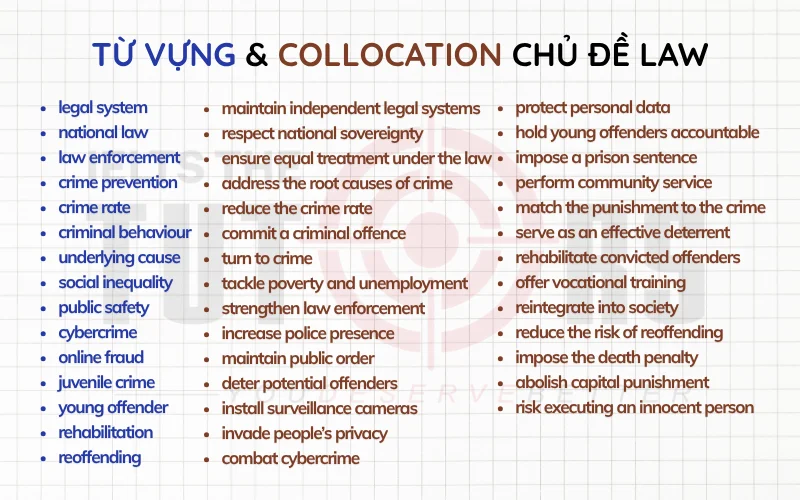
Từ vựng & collocation chủ đề Law
Từ vựng nên học cho IELTS Writing Task 2 topic Law
Từ vựng
Từ loại
Ý nghĩa
legal system
noun phrase
hệ thống pháp luật
national law
noun phrase
luật pháp quốc gia
law enforcement
noun phrase
hoạt động thực thi pháp luật
crime prevention
noun phrase
công tác phòng chống tội phạm
crime rate
noun phrase
tỷ lệ tội phạm
criminal behaviour
noun phrase
hành vi phạm tội
underlying cause
noun phrase
nguyên nhân gốc rễ
social inequality
noun phrase
bất bình đẳng xã hội
public safety
noun phrase
an toàn công cộng
police presence
noun phrase
sự hiện diện của cảnh sát
surveillance technology
noun phrase
công nghệ giám sát
cybercrime
noun
tội phạm mạng
online fraud
noun phrase
hành vi lừa đảo trực tuyến
juvenile crime
noun phrase
tội phạm vị thành niên
young offender
noun phrase
người trẻ phạm tội
prison sentence
noun phrase
án tù
community service
noun phrase
lao động phục vụ cộng đồng
deterrence
noun
sự răn đe
rehabilitation
noun
quá trình cải tạo người phạm tội
reoffending
noun
hành vi tái phạm
capital punishment
noun phrase
án tử hình
wrongful conviction
noun phrase
việc kết án oan
Collocation hữu ích cho IELTS Writing Task 2 topic Law
Collocation
Ý nghĩa
maintain independent legal systems
duy trì các hệ thống pháp luật độc lập
respect national sovereignty
tôn trọng chủ quyền quốc gia
ensure equal treatment under the law
bảo đảm mọi người được đối xử bình đẳng trước pháp luật
address the root causes of crime
giải quyết nguyên nhân gốc rễ của tội phạm
reduce the crime rate
làm giảm tỷ lệ tội phạm
commit a criminal offence
thực hiện hành vi phạm tội
turn to crime
sa vào con đường phạm tội
tackle poverty and unemployment
giải quyết nghèo đói và thất nghiệp
strengthen law enforcement
tăng cường hoạt động thực thi pháp luật
increase police presence
tăng sự hiện diện của cảnh sát
maintain public order
duy trì trật tự công cộng
deter potential offenders
răn đe những người có ý định phạm tội
install surveillance cameras
lắp đặt camera giám sát
invade people’s privacy
xâm phạm quyền riêng tư của người dân
combat cybercrime
đấu tranh chống tội phạm mạng
protect personal data
bảo vệ dữ liệu cá nhân
hold young offenders accountable
buộc người trẻ phạm tội chịu trách nhiệm
take a young offender’s age into account
cân nhắc độ tuổi của người phạm tội
impose a prison sentence
tuyên án tù
perform community service
thực hiện lao động phục vụ cộng đồng
match the punishment to the crime
áp dụng hình phạt tương xứng với tội phạm
serve as an effective deterrent
đóng vai trò là biện pháp răn đe hiệu quả
rehabilitate convicted offenders
cải tạo những người đã bị kết án
offer vocational training
cung cấp chương trình đào tạo nghề
reintegrate into society
tái hòa nhập xã hội
reduce the risk of reoffending
giảm nguy cơ tái phạm
take individual circumstances into account
cân nhắc hoàn cảnh riêng của từng vụ việc
impose the death penalty
áp dụng án tử hình
abolish capital punishment
bãi bỏ án tử hình
risk executing an innocent person
có nguy cơ xử tử người vô tội
Nhìn chung, IELTS Writing Task 2 topic Law không đòi hỏi bạn phải có kiến thức pháp luật chuyên sâu. Điều quan trọng là hiểu đúng vấn đề, xây dựng lập luận rõ ràng và sử dụng từ vựng phù hợp với ngữ cảnh. Khi đã nắm chắc các ý tưởng phổ biến, ghi nhớ những collocation hữu ích và luyện viết theo từng dạng bài, bạn sẽ dễ dàng cải thiện chất lượng bài viết và tiến gần hơn đến band điểm mong muốn.
Hy vọng những gợi ý và từ vựng trong bài sẽ giúp bạn tự tin hơn khi gặp chủ đề Law. Đừng quên theo dõi IELTS The Tutors để cập nhật thêm nhiều tài liệu luyện thi IELTS Writing hữu ích nhé!
Phạm Công Danh
Cố vấn học thuật tại IELTS The Tutors
Mình hiện là cố vấn học thuật tại IELTS The Tutors với hơn 2 năm kinh nghiệm giảng dạy tiếng Anh, tập trung vào kỹ năng Speaking. Mình tin rằng những kiến thức và phương pháp mình chia sẻ sẽ giúp bạn cải thiện giao tiếp, xây dựng sự tự tin và tiến bộ rõ rệt trong hành trình luyện thi IELTS.
Bạn còn thắc mắc về bài viết này?
Bấm đăng ký tư vấn ngay để được đội ngũ cố vấn giải đáp sâu hơn về kiến thức bạn đang đọc
Bài viết từ IELTS The Tutors sẽ giúp bạn hệ thống các hướng ra đề phổ biến, tham khảo cách triển khai ý và bổ sung từ vựng hữu ích cho IELTS Writing Task 2 topic Traditional and Modern Life.
Bài viết này từ IELTS The Tutors sẽ giúp bạn nắm được các hướng ra đề thường gặp, cách triển khai ý theo từng vấn đề và những từ vựng hữu ích cho IELTS Writing Task 2 topic Consumerism.
Bài viết này của IELTS The Tutors sẽ giúp bạn nhận diện nhanh yêu cầu chính của từng đề, các ý tưởng hay và bộ từ vựng cần thiết cho IELTS Writing Task 2 topic Public Transport để bạn luyện viết hiệu quả hơn.
Bài viết từ IELTS The Tutors sẽ giúp bạn tìm hiểu các hướng ra đề phổ biến, tham khảo cách phát triển ý và bổ sung từ vựng hữu ích cho IELTS Writing Task 2 topic Child Development.
Nếu đang trong giai đoạn nước rút, bạn có thể tham khảo bài viết từ IELTS The Tutors để nắm các hướng ra đề phổ biến, học cách phát triển ý và bổ sung từ vựng hữu ích cho IELTS Writing Task 2 topic Artificial Intelligence.
Bài viết của IELTS The Tutors sẽ giúp bạn tiếp cận chủ đề này rõ ràng hơn qua các đề mẫu, ý tưởng triển khai lập luận chi tiết kèm bài tham khảo để bạn dễ dàng áp dụng vào bài Writing của mình.