Khi tỷ lệ người cao tuổi ngày càng tăng, nhiều vấn đề về việc làm, lương hưu, chăm sóc sức khỏe và trách nhiệm giữa các thế hệ cũng được đặt ra. Vì vậy, Aging Population IELTS Writing Task 2 là chủ đề đòi hỏi bạn nhìn vấn đề từ nhiều góc độ thay vì chỉ tập trung vào những áp lực mà dân số già gây ra.
Nếu đang trong giai đoạn nước rút trước kỳ thi, bài viết từ IELTS The Tutors sẽ giúp bạn nhanh chóng hệ thống các hướng ra đề thường gặp trong IELTS Writing Task 2 topic Aging Population, tham khảo cách triển khai ý và chọn lọc những từ vựng nên học để áp dụng vào bài viết dễ dàng hơn.
Các vấn đề thường gặp trong chủ đề Aging population
Trong IELTS Writing Task 2, topic Aging Population thường xoay quanh những thay đổi xảy ra khi tỷ lệ người cao tuổi trong xã hội ngày càng tăng. Đề bài có thể khai thác ảnh hưởng đến kinh tế, việc làm, hệ thống phúc lợi, trách nhiệm chăm sóc hoặc mối quan hệ giữa các thế hệ. Một số vấn đề thường gặp gồm:
Dân số già mang lại những lợi ích gì và tạo thêm những áp lực nào cho chính phủ, nền kinh tế và xã hội.
Tuổi thọ ngày càng tăng gây áp lực ra sao lên hệ thống y tế, lương hưu và lực lượng lao động, đồng thời cần những giải pháp nào để giảm bớt các vấn đề này.
Việc tăng tuổi nghỉ hưu và khuyến khích người cao tuổi tiếp tục làm việc mang lại lợi ích hay gây ra những bất lợi cho người lao động và xã hội.
Gia đình, chính phủ hay các dịch vụ chuyên nghiệp nên chịu trách nhiệm chăm sóc và hỗ trợ người cao tuổi khi họ không còn khả năng tự lo cho bản thân.
Chính phủ nên ưu tiên ngân sách cho chăm sóc người cao tuổi hay đầu tư nhiều hơn vào giáo dục và phát triển thế hệ trẻ.
Vì sao khoảng cách giữa người trẻ và người cao tuổi ngày càng lớn, người cao tuổi đóng góp gì cho gia đình và cộng đồng, và làm thế nào để tăng sự kết nối giữa các thế hệ.
Ý tưởng triển khai topic Aging population IELTS Writing task 2
Già hoá dân số và những lợi ích cho xã hội
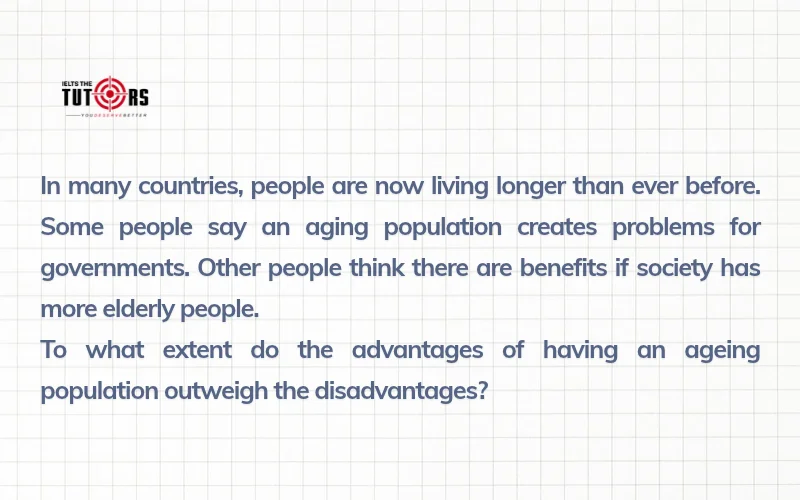
Đề bài: In many countries, people are now living longer than ever before. Some people say an aging population creates problems for governments. Other people think there are benefits if society has more elderly people. To what extent do the advantages of having an ageing population outweigh the disadvantages?
Yêu cầu đề bài:
Phân tích lợi ích (advantages) của dân số già
Phân tích thách thức/bất lợi (disadvantages) của dân số già
Đánh giá liệu lợi ích có lớn hơn bất lợi không (to what extent outweigh)
Ý tưởng triển khai bài Writing task 2:
Advantages
Disadvantages
Older people can pass on valuable knowledge, life experience and practical skills to younger generations.
Grandparents can provide childcare support, helping working parents reduce costs and balance work with family responsibilities.
Older consumers often have savings and disposable income, creating demand for healthcare, tourism and leisure services.
Retired people can contribute to society through volunteering, charity work and community activities.
Older generations help preserve traditions, cultural values and historical knowledge.
Longer life expectancy reflects improvements in healthcare, public health and overall living standards.
Experienced employees who remain in work can provide mentorship and preserve valuable professional knowledge.
A larger elderly population may strengthen family bonds and encourage greater respect and care between generations.
Older populations may contribute to safer communities because elderly people are generally less involved in crime.
Longer lives give people more time to remain socially active and contribute to their families and communities.
An aging population increases healthcare spending because older people require more medical treatment and long-term care.
Longer retirement periods and fewer workers place greater pressure on pension and social security systems.
A shrinking working-age population can cause labour shortages, reduce tax revenue and slow economic growth.
Younger workers may face a heavier financial burden as they support a growing number of retirees.
Governments may need to spend more on nursing homes, accessible transport and age-friendly infrastructure.
Many older people experience loneliness, social isolation and declining mental health, particularly when they live alone.
Living longer does not always mean living healthier, as age-related illnesses and disabilities can reduce quality of life.
Differences in wealth, public spending and policy priorities can create tension between younger and older generations.
Older societies may adapt more slowly to technological and economic change if fewer young workers enter the labour market.
Housing can become less available to younger families when property wealth and larger homes remain concentrated among older generations.
Dân số già tăng và những áp lực lên xã hội
Đề bài: In many countries today the retirement age from work has been raised. Do the advantages of raising the retirement age from work outweigh the disadvantages?
Yêu cầu đề bài:
Phân tích lợi ích (advantages) của việc tăng tuổi nghỉ hưu
Phân tích bất lợi (disadvantages) của việc tăng tuổi nghỉ hưu
Đánh giá liệu lợi ích có lớn hơn bất lợi không (outweigh)
Ý tưởng triển khai bài Writing task 2:
Advantages
Disadvantages
A higher retirement age can reduce pressure on pension systems because people contribute for longer and receive benefits for fewer years.
Keeping experienced employees in the workforce can help maintain productivity, skilled labour and tax revenue.
Raising the retirement age reflects longer life expectancy and the fact that many older adults remain healthy and capable of working.
Working for additional years allows individuals to save more money and improve their financial security after retirement.
Allowing older people to remain employed makes better use of their experience, knowledge and professional skills.
A larger working population can reduce the financial burden that an ageing population places on younger taxpayers.
Continuing to work can provide social interaction, purpose and career satisfaction for older people who want to remain economically active.
Flexible or phased retirement can allow older employees to work fewer hours instead of leaving the workforce completely.
Adjusting retirement ages can help governments respond to demographic changes and an ageing population.
Raising the retirement age can encourage employers and society to recognise the value of older workers.
Extending working life can be unfair to people in physically demanding jobs who may no longer be healthy enough to continue working.
Older employees may experience declining health, fatigue or reduced ability to perform demanding tasks.
Working for longer leaves people with less time to enjoy retirement, travel, hobbies and family life.
People may contribute to pension systems for longer but receive retirement benefits for a much shorter period.
Delayed retirement may reduce some job openings and career progression opportunities for younger workers.
Older workers who lose their jobs may struggle to find new employment while still being too young to claim a pension.
A higher retirement age may increase stress and burnout among people who feel physically or mentally ready to stop working.
Staying in work for longer may prevent older adults from caring for elderly relatives, grandchildren or other family members.
A single retirement age is difficult to apply fairly because different occupations place very different physical and mental demands on workers.
Age discrimination may continue, leaving some older people expected to work longer but unable to secure suitable employment.
Tăng độ tuổi nghỉ hưu và kéo dài thời gian làm việc cho người cao tuổi
Đề bài: In the developed world, average life expectancy is increasing. What problems will this cause for individuals and society? Suggest some measures that could be taken to reduce the impact of aging populations.
Yêu cầu đề bài:
Phân tích vấn đề (problems) của việc tuổi thọ tăng lên cho cả cá nhân và xã hội
Đề xuất giải pháp (measures/solutions) để giảm thiểu tác động của dân số già
Ý tưởng triển khai bài Writing task 2:
Problems
Solutions
Older people are more likely to suffer from chronic illness, disability and declining independence as they live longer.
Longer retirement periods can leave older people with insufficient savings and greater dependence on pensions or family support.
Retirement, bereavement and living alone can increase loneliness, depression and a loss of purpose among older people.
Growing numbers of elderly patients can place heavy pressure on hospitals, healthcare workers and long-term care services.
A larger retired population increases pension and social-security spending while fewer workers contribute taxes.
A shrinking working-age population can cause labour shortages and slow economic growth.
A rising dependency ratio can place greater financial pressure on younger workers who must support a growing elderly population.
Older people may struggle with mobility and daily activities, increasing demand for family and professional care.
Cities and public facilities may not be designed for people with reduced mobility.
Wealth and property may become concentrated among older generations, contributing to intergenerational inequality and tension.
The knowledge and experience of retired people may be lost when they leave the workforce completely.
Long-term elderly care can become increasingly expensive for both families and governments.
Governments should invest in preventive healthcare, regular screenings and healthy-ageing programmes to help people remain healthier for longer.
Pension systems should be reformed while individuals are encouraged to build private retirement savings from an earlier age.
Community programmes, volunteering and intergenerational activities can help seniors remain socially connected and active.
Governments should expand home care, nursing facilities, community care centres and other affordable elderly-care services.
Raising the retirement age gradually and offering phased retirement can reduce pension pressure and keep experienced workers economically active.
Countries can attract younger migrant workers and use automation to fill labour shortages and maintain productivity.
Family-friendly policies such as childcare support and parental leave can encourage higher birth rates and improve the long-term population balance.
Assistive technology, smart homes and remote health monitoring can help seniors live independently for longer.
Age-friendly transport, accessible buildings and safer public spaces should be developed to meet the needs of older residents.
Governments should design tax, housing and welfare policies that distribute support more fairly across generations.
Flexible working, part-time roles and mentoring schemes can allow older people to continue contributing their skills and experience.
Long-term care insurance and sustainable funding schemes can spread care costs and reduce pressure on public finances.
Con cháu nên có trách nhiệm chăm sóc người cao tuổi
Đề bài: If old people are no longer physically, mentally or financially able to look after themselves, younger family members should be legally responsible for supporting them. To what extent do you agree or disagree?
Yêu cầu đề bài: Đánh giá mức độ đồng ý với quan điểm: người trẻ trong gia đình nên có trách nhiệm pháp lý chăm sóc người già khi họ không tự chăm sóc được.
Ý tưởng triển khai bài Writing task 2:
Agree
Disagree
Adult children have a moral responsibility to support parents who cared for them when they were young.
Family care reflects values of filial responsibility and helps preserve strong relationships between generations.
Elderly people may receive more personal attention and emotional support when cared for by family members.
Many older people prefer to remain with their families and live in familiar surroundings rather than enter residential care.
Requiring families to contribute could reduce pressure on government-funded pensions, healthcare and residential care.
A legal obligation could discourage adult children from neglecting or abandoning elderly parents.
Sharing responsibility for elderly relatives can strengthen family bonds and encourage younger generations to value care and respect.
Families should take some responsibility for their own members instead of depending entirely on public services.
Legal responsibility could establish a clear minimum standard of financial support for vulnerable elderly people.
Overall, family responsibility can complement government support and help ensure that elderly people are not neglected.
A moral responsibility to help parents does not necessarily mean that such support should be required by law.
Younger adults may already face high housing costs, childcare expenses and other financial pressures, making compulsory support unfair.
Not every family has the money, time, space or medical knowledge needed to provide suitable elderly care.
Professional caregivers may provide safer and more specialised support for people with dementia, disabilities or serious health conditions.
Older people have paid taxes throughout their lives, so governments also have a responsibility to provide adequate pensions, healthcare and social care.
Family relationships vary greatly, and it would be unreasonable to force someone to care for a parent who was abusive, absent or estranged.
Forced caregiving may cause stress, resentment and burnout, which can reduce the quality of care and increase the risk of neglect.
Caregiving responsibilities often fall disproportionately on women and may damage their careers, income and financial independence.
A single law cannot fairly account for differences in family income, health, employment and the number of elderly relatives requiring support.
Governments should encourage and support family caregiving through financial assistance and flexible services rather than forcing it through law.
Chính phủ nên ưu tiên ngân sách cho người già hay người trẻ
Đề bài: Some people believe that the care of elderly people should be a priority of government spending. Others believe that government spending should focus more on young people, especially on their education. Discuss both views and give your opinion.
Yêu cầu đề bài:
Thảo luận quan điểm 1: Chi tiêu chính phủ ưu tiên chăm sóc người già
Thảo luận quan điểm 2: Chi tiêu chính phủ ưu tiên người trẻ, đặc biệt giáo dục
Đưa ra ý kiến cá nhân
Ý tưởng triển khai bài Writing task 2:
Elderly Care Should Be Prioritised
Youth and Education Should Be Prioritised
Older people deserve public support because they have worked, paid taxes and contributed to society throughout their lives.
Ageing populations mean that more elderly people need pensions, healthcare and long-term care.
Older people often have serious health conditions and require medical care that they cannot afford on their own.
Many elderly people can no longer work, so adequate pensions and financial assistance are necessary to prevent poverty.
Government-funded elderly care reduces the financial and caregiving burden placed on working-age family members.
Providing proper care allows older people to maintain dignity and a reasonable quality of life in their final years.
Supporting older people reflects a fair social contract in which citizens receive assistance after contributing to society during their working lives.
The needs of sick and vulnerable elderly people are immediate and cannot always be postponed in favour of long-term investment.
Neglecting a large elderly population can increase family pressure, poverty and wider social inequality.
A balanced society should protect vulnerable citizens at every stage of life, including old age.
Spending on young people is an investment in the future because today’s students will become tomorrow’s workers and taxpayers.
Quality education can improve social mobility, reduce poverty and give disadvantaged children better opportunities.
A well-educated workforce can raise productivity, attract investment and support long-term economic growth.
Investing in education can provide young people with the skills needed for technology, science and other growing industries.
Better education can reduce future unemployment, crime and dependence on welfare by improving people’s employment prospects.
Educational benefits can continue across generations because educated parents are better able to support their children’s development.
Public education promotes equal opportunity by ensuring that children’s future prospects do not depend entirely on their family income.
In countries with large young populations, spending on education may benefit a greater proportion of society.
Economic returns from education can help generate the tax revenue needed to fund healthcare, pensions and elderly care in the future.
When public resources are limited, education may deserve greater priority because it can create long-term economic and social benefits.
Người trẻ không còn giao tiếp với người lớn tuổi
Đề bài: Nowadays in many countries young people don’t communicate with older people as much as they used to. Why is this happening? How could this situation be improved?
Yêu cầu đề bài:
Giải thích nguyên nhân (Why) thanh niên giao tiếp ít với người già hơn trước
Đề xuất giải pháp (How) để cải thiện tình trạng này
Ý tưởng triển khai bài Writing task 2:
Why Young and Older People Communicate Less
How to Improve the Situation
Young people rely heavily on smartphones and social media, while many older people are less familiar with digital communication.
Different interests, values and cultural references can leave younger and older generations with little common ground.
Busy work and study schedules leave younger people with less time to visit or talk to older family members.
Young adults increasingly move away for education or work, creating greater physical distance between generations.
Young and older people often spend time in separate social spaces, so they have fewer opportunities to interact naturally.
Negative stereotypes can cause young people to see the elderly as outdated, while older people may view younger generations as irresponsible.
Different communication styles can create frustration, as younger people often prefer quick messages while older people may value longer conversations.
Younger people may underestimate the knowledge and experience that older generations can offer.
Families and community centres can teach older people how to use smartphones, messaging apps and video calls.
Shared activities such as cooking, gardening, games or community events can help both generations find common interests.
Families should set aside regular time for meals, visits and other activities that encourage meaningful interaction.
Regular visits, video calls and multigenerational living arrangements can help families maintain closer relationships.
Schools, nursing homes and community centres can organise programmes that bring different age groups together.
Education and positive media representation can challenge age-based stereotypes and encourage mutual respect.
Both generations should learn to adapt their communication styles and become more patient listeners.
Mentoring and skills-exchange programmes can allow older people to share professional experience, traditional skills and life lessons with younger people.
Từ vựng & collocation ăn điểm chủ đề Aging population
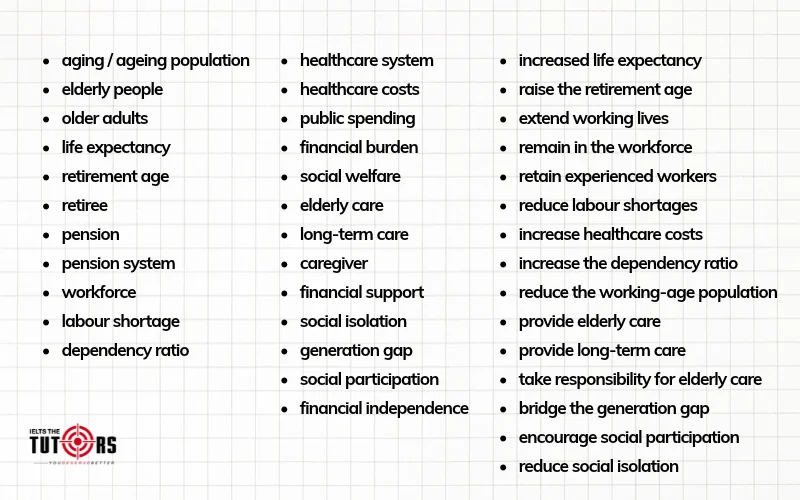
Từ vựng nên học cho IELTS Writing Task 2 topic Aging Population
Từ vựng
Từ loại
Ý nghĩa
aging / ageing population
noun phrase
dân số già hóa
elderly people
noun phrase
người cao tuổi
older adults
noun phrase
người lớn tuổi
life expectancy
noun phrase
tuổi thọ trung bình
retirement age
noun phrase
tuổi nghỉ hưu
retiree
noun
người đã nghỉ hưu
pension
noun
lương hưu
pension system
noun phrase
hệ thống lương hưu
workforce
noun
lực lượng lao động
labour shortage
noun phrase
tình trạng thiếu lao động
dependency ratio
noun phrase
tỷ lệ người phụ thuộc
healthcare system
noun phrase
hệ thống y tế
healthcare costs
noun phrase
chi phí chăm sóc sức khỏe
public spending
noun phrase
chi tiêu công
financial burden
noun phrase
gánh nặng tài chính
social welfare
noun phrase
phúc lợi xã hội
elderly care
noun phrase
việc chăm sóc người cao tuổi
long-term care
noun phrase
chăm sóc dài hạn
caregiver
noun
người chăm sóc
financial support
noun phrase
hỗ trợ tài chính
social isolation
noun phrase
sự cô lập xã hội
generation gap
noun phrase
khoảng cách thế hệ
social participation
noun phrase
sự tham gia vào các hoạt động xã hội
financial independence
noun phrase
sự độc lập về tài chính
Collocation hữu ích cho topic Aging Population IELTS Writing Task 2
Collocation
Ý nghĩa
increased life expectancy
tuổi thọ ngày càng tăng
a rising proportion of elderly people
tỷ lệ người cao tuổi ngày càng tăng
raise the retirement age
tăng tuổi nghỉ hưu
extend working lives
kéo dài thời gian làm việc
remain in the workforce
tiếp tục tham gia lực lượng lao động
retain experienced workers
giữ lại những lao động giàu kinh nghiệm
reduce labour shortages
giảm tình trạng thiếu lao động
place pressure on the healthcare system
gây áp lực lên hệ thống y tế
increase healthcare costs
làm tăng chi phí y tế
put pressure on pension systems
gây áp lực lên hệ thống lương hưu
place a financial burden on the government
tạo gánh nặng tài chính cho chính phủ
increase the dependency ratio
làm tăng tỷ lệ người phụ thuộc
reduce the working-age population
làm giảm dân số trong độ tuổi lao động
provide financial support for the elderly
hỗ trợ tài chính cho người cao tuổi
provide elderly care
cung cấp dịch vụ chăm sóc người cao tuổi
provide long-term care
cung cấp dịch vụ chăm sóc dài hạn
take responsibility for elderly care
chịu trách nhiệm chăm sóc người cao tuổi
rely on family members for support
phụ thuộc vào người thân để được hỗ trợ
allocate public funds to elderly care
phân bổ ngân sách công cho chăm sóc người cao tuổi
contribute to society
đóng góp cho xã hội
pass on knowledge and experience
truyền lại kiến thức và kinh nghiệm
bridge the generation gap
thu hẹp khoảng cách thế hệ
encourage social participation
khuyến khích tham gia các hoạt động xã hội
reduce social isolation
giảm tình trạng cô lập xã hội
maintain an active lifestyle
duy trì lối sống năng động
Bài mẫu topic Aging Population IELTS Writing Task 2
Đề bài: In many countries, people are now living longer than ever before. Some people say an aging population creates problems for governments. Other people think there are benefits if society has more elderly people.
To what extent do the advantages of having an ageing population outweigh the disadvantages?
Bài mẫu:
Longer life expectancy has led to ageing populations in many countries. Although a larger elderly population can bring social and economic benefits, I believe the disadvantages are greater because of the pressure placed on healthcare, pensions and the working population.
On the positive side, older people can continue to make valuable contributions to society. Many retirees have extensive knowledge and life experience that can be passed on to younger generations, whether through family support, volunteering or community activities. Grandparents may also help with childcare, allowing parents to work while reducing childcare costs. Some older adults who remain employed can help businesses retain experienced workers and reduce labour shortages. In addition, older consumers create demand for healthcare, leisure and tourism services, which can support employment and economic activity. A longer lifespan can also be seen as a sign of improvements in healthcare and living standards.
However, the challenges are more significant. As the proportion of elderly people rises, governments must spend more on medical treatment, long-term care and pensions. At the same time, a smaller working-age population may lead to labour shortages and lower tax revenue, meaning fewer workers have to support a growing number of retirees. This can place a heavier financial burden on younger generations and limit government spending on areas such as education and infrastructure. Ageing societies may also face social problems, particularly loneliness and isolation among older adults who live alone or have limited contact with their families.
In conclusion, an ageing population offers benefits through experience, family support and continued economic participation. Nevertheless, the growing demands on healthcare, pension systems and the workforce mean that the disadvantages outweigh the advantages overall.
(275 words, band 8.0)
Kết luận
Có thể thấy, topic Aging Population IELTS Writing Task 2 không chỉ xoay quanh câu chuyện người cao tuổi sống lâu hơn mà còn liên quan đến cách xã hội thích nghi với sự thay đổi về dân số. Khi làm bài, bạn nên cân nhắc cả những đóng góp của người lớn tuổi lẫn áp lực lên y tế, lương hưu, việc làm và ngân sách để lập luận cân bằng hơn.
IELTS The Tutors hy vọng các ý tưởng và từ vựng hữu ích trong bài sẽ giúp bạn luyện tập viết chủ đề này hiệu quả hơn. Chúc bạn sớm đạt band IELTS Writing như mong muốn!
Mai Minh Châu
Giáo viên tại IELTS The Tutors
Mình hiện đang giảng dạy tại IELTS The Tutors và từng bắt đầu với vai trò IELTS Coach. Trong quá trình dạy, mình nhận ra nhiều bạn chưa hiểu bản chất kiến thức, nên mình xây dựng các bài viết học thuật theo hướng dễ hiểu, sát thực tế, dựa trên trải nghiệm giảng dạy và sửa bài mỗi ngày.
Bạn còn thắc mắc về bài viết này?
Bấm đăng ký tư vấn ngay để được đội ngũ cố vấn giải đáp sâu hơn về kiến thức bạn đang đọc
Bài viết này từ IELTS The Tutors sẽ giúp bạn nắm nhanh các hướng ra đề phổ biến, cách phát triển ý và nhóm từ vựng nên học để xử lý topic Architecture chắc ý hơn.
Bài viết này của IELTS The Tutors sẽ giúp bạn nắm nhanh các hướng ra đề, cách phát triển ý và nhóm từ vựng hữu ích để xử lý Video Games IELTS Writing Task 2 tự tin hơn.
Bài viết từ IELTS The Tutors sẽ giúp bạn hệ thống các ý tưởng quan trọng trong topic Museum IELTS Writing Task 2 theo từng vấn đề, kèm từ vựng và bài mẫu để bạn dễ học cách lập luận và áp dụng vào bài viết của mình.
Bài viết này của IELTS The Tutors sẽ giúp bạn nắm rõ các hướng ra đề thường gặp trong Music IELTS Writing Task 2, gợi ý cách phát triển ý và chọn lọc những từ vựng hữu ích để áp dụng linh hoạt vào bài viết.
Trong bài viết này, IELTS The Tutors sẽ cùng bạn hệ thống những hướng ra đề đáng chú ý, cách phát triển ý và nhóm từ vựng hữu ích để việc ôn tập topic Personality trở nên dễ dàng hơn.
Trong bài này, IELTS The Tutors sẽ cùng bạn hệ thống những hướng triển khai dễ áp dụng, từ vựng cần thiết, đề mẫu và bài viết tham khảo để bạn có thêm ideas khi luyện các dạng đề topic Book & Reading IELTS Writing Task 2